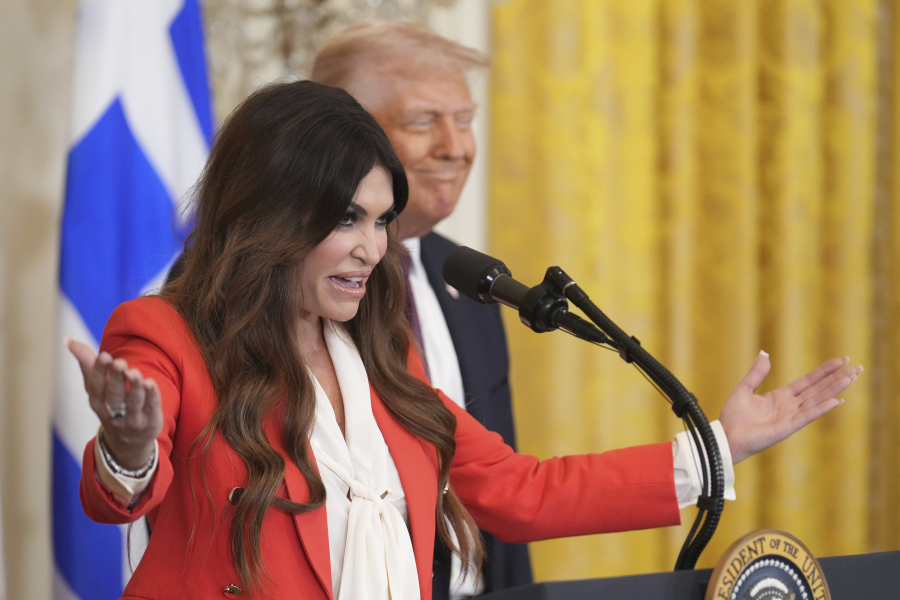

Greek political and business circles spent much of the weekend dissecting a Wall Street Journal report published Friday on Kimberly Guilfoyle, the U.S. ambassador to Greece, and her role in promoting energy deals across Southeast Europe. The article also scrutinized Christos Marafatsos, a Greek-American lobbyist who has emerged as a frequent presence alongside her.
At the center of the story is a broader geopolitical project: efforts to move U.S. liquefied natural gas through Greece and northward into the Balkans and Eastern Europe via the so-called Vertical Corridor. Among the companies positioned to benefit is Venture Global, the U.S. LNG producer working with Atlantic-SEE LNG, a venture involving Greek infrastructure group Aktor and state-controlled gas supplier DEPA Commercial.
The Journal’s more provocative contention is that Guilfoyle’s approach to diplomacy risks blurring the boundaries between official U.S. policy, personal relationships and private commercial interests. It reported, among other things, an alleged heated exchange between Guilfoyle and Greek Energy Minister Stavros Papastavrou in which she invoked political developments in Romania and suggested that Washington possessed enough influence to contribute to the downfall of governments—and that Greece was not necessarily immune.
ΔΙΑΒΑΣΤΕ ΕΠΙΣΗΣ

The reported remarks have reverberated in Romania. Local media have examined politicians who attended a March 31 gathering with Guilfoyle and Marafatsos at Bucharest’s Isoletta restaurant. Dominic Fritz, leader of the pro-European USR party, has sought explanations from Sorin Grindeanu, head of the Social Democratic Party, and George Simion, leader of the nationalist AUR, asking whether political upheaval surrounding Prime Minister Ilie Bolojan’s government involved outside pressure.
Yet focusing exclusively on Guilfoyle and Marafatsos risks missing another important strand of the Journal’s reporting: Venture Global.
The LNG company appears repeatedly in the article and has long attracted the Journal’s attention. The newspaper has chronicled Venture Global and co-founders Michael Sabel and Robert Pender, including the company’s connections with Donald Trump’s political orbit. It previously reported that Sabel attended an April 2024 gathering of energy executives with Trump at Mar-a-Lago. Venture Global subsequently contributed $1 million to Trump’s second inaugural committee.
The Journal has also highlighted the company’s employment of former Trump-administration officials and its position as a beneficiary of Washington’s push to accelerate U.S. LNG exports.
That history matters when interpreting the latest article. The story is not merely about an unconventional ambassador or an unusually well-connected lobbyist. It forms part of a wider examination of Venture Global, its commercial partners and the U.S. political and diplomatic machinery supporting energy projects from which the company could benefit.
The Journal’s treatment of Marafatsos raises a separate issue: access. Although he holds no official diplomatic position, Marafatsos has enjoyed unusually close proximity to Guilfoyle’s diplomatic activities while simultaneously working as a lobbyist. The central question is whether his commercial relationships were always sufficiently clear to officials and business executives meeting him in discussions surrounding the Vertical Corridor.
Guilfoyle and Marafatsos knew each other before she became ambassador and were both active in Trump’s political campaign. The Journal focused particularly on Marafatsos’s professional relationship with Aktor, but U.S. lobbying disclosures show that his business interests extend further into the Greek corporate landscape.
Filings under the U.S. Lobbying Disclosure Act show that Marafatsos’s Catalyst Strategies LLC reported five clients during the first two quarters of 2026, nine active reports and $400,000 in lobbying income. Clients included PPC North America, a subsidiary of Greece’s Public Power Corp.; Panos Xenokostas’s Onex Technologies; Aktor Energy; British-based ASMA Associates Ltd.; and Singapore’s O&G International Ventures Inc. Onex was the largest client by disclosed fees, paying $120,000 during the period.
Marafatsos told the Journal he was “proud” to promote commercial initiatives that advance U.S. interests while creating economic opportunities in Greece and Southeast Europe. The more consequential question may be how comfortable his clients remain with the attention. An early indication will come when subsequent U.S. lobbying disclosures reveal whether the relationships endured after the Journal put Marafatsos—and the intersection of diplomacy, lobbying and energy business in Southeast Europe—under a much brighter spotlight.