
A Greek court has dismissed a lawsuit brought by Grigoris Dimitriadis, the nephew and former secretary-general of Prime Minister Kyriakos Mitsotakis, against one of the country’s largest media groups and two journalists, in a ruling that addresses the boundaries of press freedom when reporting on matters at the center of public and institutional scrutiny. The decision marks the third lawsuit brought by Dimitriadis over reporting related to Greece’s surveillance scandal to be rejected by a Greek court, adding to a series of rulings involving media coverage of one of the country’s most politically sensitive controversies in recent years.
Dimitriadis has occupied a central place in the public debate surrounding the affair. Beyond being Mitsotakis’s nephew and a former top aide in the prime minister’s office, he has been linked in published reporting to individuals who emerged as key figures in the surveillance scandal. His name has consequently featured prominently in reporting and public scrutiny surrounding the use of Predator spyware and the broader wiretapping affair.
The Athens Court of First Instance, sitting as a multi-judge panel, rejected at first instance Dimitriadis’s lawsuit against Alter Ego Media and journalists Argyro Tsatsouli and Lefteris Charalampopoulos. The case concerned an article published by the Greek news website in.gr on Oct. 23, 2023, under the headline “Wiretapping: Investigation Upgraded - What Government and Opposition Say.”
ΔΙΑΒΑΣΤΕ ΕΠΙΣΗΣ
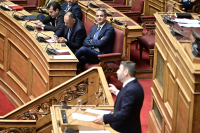

The ruling is significant less for the dismissal itself than for the court’s reasoning. It examines how journalists should be judged when reporting on an unfolding controversy in which allegations, official investigations and intense political debate overlap—and where not all relevant facts have yet been definitively established. At the time the article appeared, Greece was in the midst of a prolonged controversy over state-authorized wiretapping and the use of Predator, a powerful commercial spyware program. The affair had already generated extensive coverage in Greek and international media and had been examined by the Greek Parliament’s Committee on Institutions and Transparency.
The court took into account Dimitriadis’s former position as secretary-general to the prime minister, one of the most senior posts in the Greek premier’s office, as well as responsibilities connected to the National Intelligence Service that had been transferred to him. Against that backdrop, the court found that the purpose of the disputed article wasn’t to personally target or disparage Dimitriadis, but to inform readers about a matter of substantial public interest.
Central to the ruling was the question of when journalistic conduct should be assessed. The court said reporting should be evaluated on the basis of the information and evidence reasonably available to journalists at the time of publication, rather than through the lens of facts that emerged later. That distinction carries broader implications for investigative reporting. Requiring journalists to meet a standard based on information that became available only after publication, the court reasoned, could have a chilling effect on investigative journalism, particularly in cases involving significant public interest.
The ruling also gives considerable weight to the role of the press in a democratic society. Journalism, according to the court’s reasoning, isn’t confined to reporting facts that have already been conclusively proved. It can also encompass, provided the requisite journalistic care is exercised, the reporting of information that forms part of a serious public debate and is subject to institutional investigation.
The decision comes against the backdrop of a surveillance controversy that has drawn attention well beyond Greece and raised questions about intelligence oversight, political accountability and the use of commercial spyware in a European Union member state. The Athens court ultimately concluded that Alter Ego Media and the two journalists had acted within the protections afforded to press freedom and within the media’s democratic function of informing the public. It therefore dismissed Dimitriadis’s lawsuit at first instance.
As the third such lawsuit by Dimitriadis to be rejected by a court, the decision adds to a developing body of Greek case law concerning the legal protections available to journalists reporting on the surveillance affair. Its reasoning offers a notable statement on the latitude afforded to the press when covering politically sensitive matters while the underlying facts remain the subject of public debate and institutional investigation.