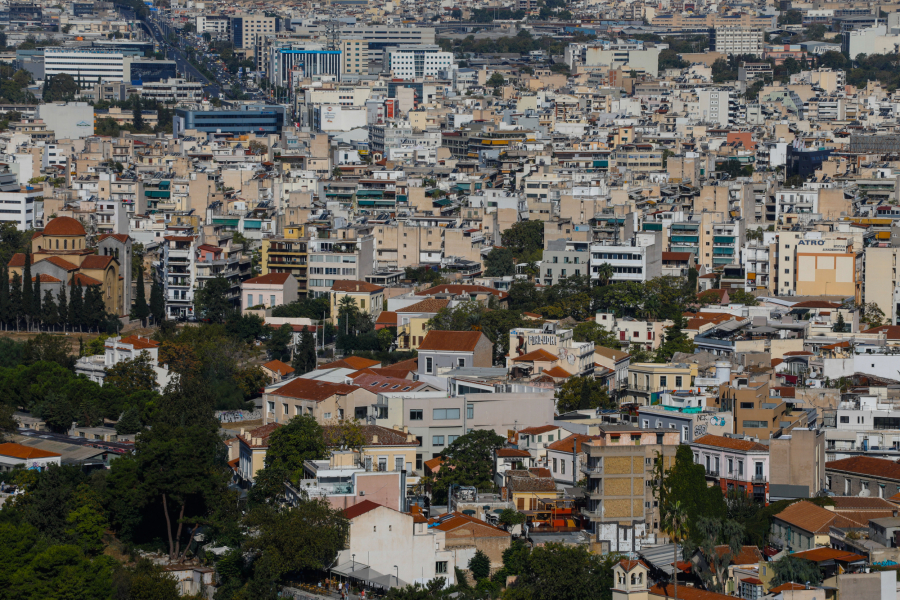

Greece has one of Europe’s more unusual housing problems: It has plenty of homes and relatively high homeownership, yet housing has become increasingly unaffordable for the people who live there.
A new International Monetary Fund analysis points to a combination of rapidly rising prices, high household housing costs, constrained supply in the places where people most want to live and a mismatch between Greece’s large housing stock and the homes actually available to buyers and renters.
The result is a housing squeeze that has become one of the country’s most pressing economic and social issues, despite a property market that, on paper, doesn’t appear to suffer from a shortage of buildings.
ΔΙΑΒΑΣΤΕ ΕΠΙΣΗΣ

In its study, “Inside Greece’s Housing Affordability Paradoxes,” completed April 30, 2026, the IMF describes a market shaped by the lingering effects of Greece’s decade-long debt crisis, a powerful postpandemic rebound in property prices and the growing influence of tourism and short-term rentals.
Greek home prices fell more than 40% between 2008 and 2016 as the country went through its sovereign-debt crisis and a prolonged recession. Since then, they have risen roughly 85%, while disposable income per capita has increased by 47%. The divergence has become particularly pronounced since the pandemic: Home prices have climbed 61% since the fourth quarter of 2020.
Even after that increase, the IMF estimates that Greek residential property is overvalued by only around 10%. The bigger problem is affordability. For a household earning the median income, buying a home increasingly requires financial resources that many Greeks don’t have. IMF calculations for 2024 show that the median-income household earned 7% less than the income needed to qualify for a mortgage covering 70% of a property’s value. With an 80% loan-to-value mortgage, the income gap widened to 17%.
Coming up with the down payment can be an even bigger obstacle. A household saving 10% of its annual income would need roughly 24 years to accumulate the down payment required for the first scenario and about 14 years for the second.
That is pushing more of the affordability problem into the rental market. Rent inflation accelerated after the pandemic and reached 10% in 2025, while asking rents on newly marketed properties have risen even more sharply, particularly in Athens and Thessaloniki, Greece’s two largest cities. Housing costs are now absorbing a striking share of household income. Using microdata from the European Union’s EU-SILC survey, the IMF estimates that median housing costs exceeded one-third of disposable household income in 2025.
About two infive Greek households spend more than 40% of their income on housing, putting them above the threshold commonly used to identify households facing housing-cost overburden. Another 20% spend between 30% and 40%, leaving them particularly exposed to a decline in income or higher borrowing costs.
Greece’s traditionally high rate of homeownership offers less protection than might be expected. More than six in 10 households own their homes outright, without a mortgage. But those households still face substantial expenses for energy, maintenance and property taxes. Part of the problem is the age and poor energy efficiency of Greece’s housing stock. Just 7.4% of homes are rated energy class B or better. Greek homes consume about 65% more energy per square meter than homes in Portugal, according to the IMF study.
The paradox
That helps explain one side of Greece’s housing paradox. The other is even more striking: The country doesn’t lack homes. Greece has one of the highest numbers of dwellings per capita in Europe, and around 35% of its housing stock isn’t used as a primary residence. An estimated 12% to 13% of all homes are vacant.
Yet a large stock of unused property doesn’t necessarily translate into homes that people can buy or rent. More than half of Greece’s unoccupied properties were built before 1980. Bringing many of them back onto the market requires costly renovations and can be complicated by limited access to financing, fragmented ownership and unresolved legal or planning issues.
The homes that are available are also frequently priced beyond the reach of local households. In 2025, 55% of homes listed for sale had asking prices above €200,000, while roughly one-third were listed above €280,000. The median asking rent was around €575 a month nationwide and €785 in Attica, the region that includes Athens and its surrounding suburbs. Tourism adds another layer of pressure.
The number of properties listed for short-term rental jumped 240% between 2017 and 2024, rising from fewer than 100,000 to more than 230,000. Short-term rentals now account for roughly 3.5% of Greece’s total housing stock, with much higher concentrations on tourist islands, in central Athens and in the port city of Piraeus.
The IMF’s analysis associates a greater prevalence of short-term rentals with higher property prices and, to a lesser extent, higher rents in areas where demand is strongest. That dynamic is particularly important in Greece, where the tourism industry is a major pillar of the economy and residential property increasingly serves both local housing demand and an international visitor market.
The IMF’s central conclusion is that Greece’s housing crisis is less a conventional shortage of buildings than a problem of where homes are located, how they are used and whether ordinary households can afford them. That distinction matters for policy.
Rather than focusing primarily on stimulating demand, the IMF argues for bringing more vacant homes back into use. Measures could include incentives and subsidies for renovation, alongside disincentives for keeping properties vacant for extended periods. Addressing fragmented ownership, encouraging long-term rentals and expanding social and affordable housing could also increase the stock that is actually available to residents.
The fund is more cautious about broad subsidies designed to help households buy or rent. When housing supply can’t respond quickly, additional purchasing power risks being capitalized into higher prices. In that case, part of the government support intended for households can ultimately accrue to landlords and sellers.