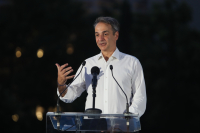
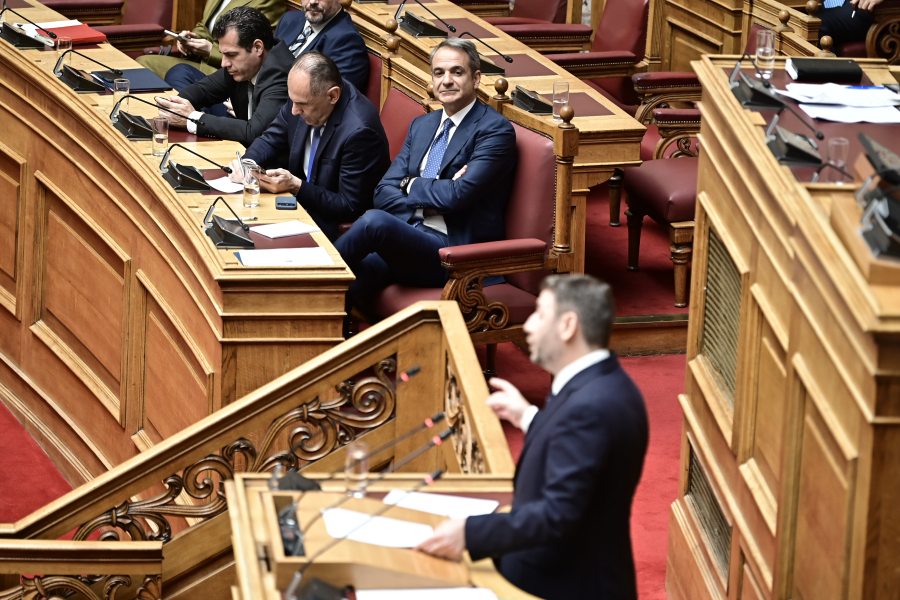
Greek Prime Minister Kyriakos Mitsotakis sought to portray himself as the defender of institutional stability during a parliamentary debate on constitutional reform Friday. Instead, the session became a reminder of the scandal that has done more than any other to dent his image as a modernizing European leader: the illegal surveillance of politicians and journalists under his watch.
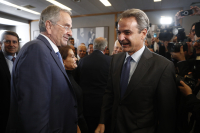
What was meant to be a discussion over amendments to Greece’s Constitution quickly spiraled into a bitter confrontation between Mitsotakis and PASOK leader Nikos Androulakis, whose phone was wiretapped by Greece’s National Intelligence Service (EYP) in 2022 while he was running to lead the center-left party.
The exchange underscored how the surveillance affair—one that triggered international scrutiny from the European Parliament and rights groups but never seriously threatened Mitsotakis’ parliamentary majority—remains politically toxic for the prime minister.
Mitsotakis opened the debate by accusing PASOK of acting irresponsibly for refusing to support constitutional amendments it had itself argued should be revised.
“PASOK has failed to rise to the occasion,” he told lawmakers, accusing the party of putting political tactics ahead of the Constitution.
But Androulakis turned the attack back on the government, arguing that Mitsotakis had no credibility to lecture anyone on democratic institutions.
“Are you going to give us lessons on institutional responsibility?” he asked. “Who? The boss who didn’t take the bullet?”
The line electrified the chamber.
It was a pointed reference to the resignation of Grigoris Dimitriadis, Mitsotakis’ nephew and former chief of staff, who stepped down alongside the head of the intelligence service after it emerged that Androulakis had been placed under legal surveillance by EYP. Dimitriadis, one of the most influential figures in the prime minister’s office, denied wrongdoing.
Androulakis’ implication was unmistakable: Dimitriadis had paid the political price to spare the prime minister himself. “Tell your nephew there is only one boss,” he said. “The Greek people—not you.”
The surveillance scandal erupted in 2022 after Androulakis, then a member of the European Parliament, discovered an attempt to infect his phone with Predator spyware. Subsequent reporting revealed that Greece’s intelligence service had also been legally monitoring him. The revelations prompted resignations but stopped short of directly implicating Mitsotakis, who insisted he had neither ordered nor known about the surveillance.
That explanation has never fully satisfied critics.
The intelligence service had been placed directly under the authority of the prime minister’s office immediately after Mitsotakis took power in 2019—a move he said would improve oversight. Opponents argue it instead concentrated political responsibility at the top while allowing accountability to fall on subordinates once the scandal became public.
Friday’s debate broadened beyond surveillance into a wider attack on Mitsotakis’ record.
Androulakis accused the government of presiding over a culture of impunity, citing not only the wiretapping affair but also allegations involving public procurement and recycling contracts.
“What began as shadows have become darkness,” he said, describing a government marked by “corruption and impunity.”
The prime minister dismissed the accusations as political theater, arguing that PASOK had become consumed by opposition to his conservative New Democracy party rather than offering constructive alternatives.
“You are incapable of saying that some proposals are simply the right thing to do,” Mitsotakis said, accusing PASOK of putting partisan interests ahead of constitutional reform.
The exchange soon took on the tone of an election debate rather than a constitutional one.
Mitsotakis defended his political legitimacy by pointing to New Democracy’s commanding victories in the 2019 and 2023 elections.
“The people are the boss,” he said. “They gave us 41 percent three times.”
He also mocked PASOK for becoming the official opposition only after the collapse of Syriza, saying Androulakis had reached the role “by accident” rather than through a direct electoral mandate.
Androulakis countered that democratic legitimacy is measured not only by election victories but by respect for institutions.
His criticism echoed concerns repeatedly raised by European lawmakers and civil liberties organizations over media freedom, judicial independence and surveillance practices in Greece during Mitsotakis’ tenure.
The debate was further disrupted by repeated interruptions from Zoë Konstantopoulou, leader of the left-wing Course of Freedom party, leading to another acrimonious exchange with the prime minister. Mitsotakis’ remarks toward Konstantopoulou prompted accusations of sexism before he left the chamber rather than remain for her speech.
Greek Constitutional Debate Revives Scrutiny of Mitsotakis Over Surveillance Scandal
 Φωτογραφία: ΜΙΧΑΛΗΣ ΚΑΡΑΓΙΑΝΝΗΣ/EUROKINISSI
Mitsotakis opened the debate by accusing PASOK of acting irresponsibly for refusing to support constitutional amendments it had itself argued should be revised.