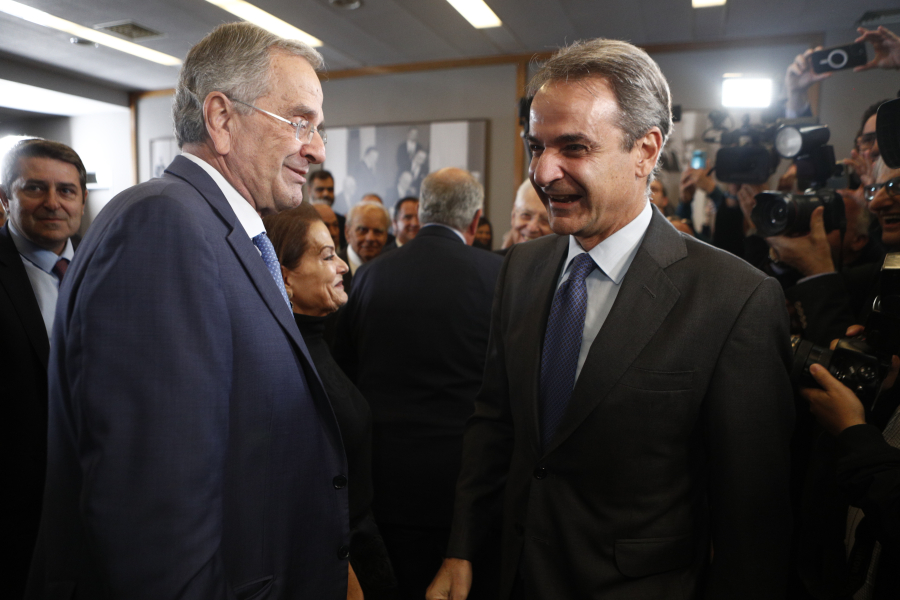
Greek Prime Minister Kyriakos Mitsotakis is confronting a sharp erosion of the political dominance that delivered him an outright parliamentary majority three years ago, with his center-right New Democracy party now polling well below 30% and a potential challenge from former Prime Minister Antonis Samaras threatening to further fracture the conservative vote.
The latest survey by polling firm Interview puts New Democracy at 26.8%, a steep decline from the roughly 41% it won in Greece’s June 2023 national election. While Mitsotakis’s party retains an 11-point lead over its nearest rival, its current level of support leaves the prospect of another single-party majority increasingly remote and underscores how much political ground the prime minister has lost since his re-election.
The deterioration is particularly significant because Mitsotakis is losing support despite facing no strong or unified opposition. Greece’s center-left remains divided and SYRIZA, once the country’s main opposition party, has virtually collapsed. Yet New Democracy has failed to capitalize on that weakness, suggesting that voters abandoning the governing party are dispersing across an increasingly fragmented political landscape rather than consolidating behind a single challenger.
For Mitsotakis, an even greater danger may now be emerging from within the broader conservative electorate.
Samaras, a former prime minister and former New Democracy leader who has become an increasingly vocal critic of the government, appears to have the potential to turn dissatisfaction on the right into an organized political challenge. The poll finds that 12% of respondents would be “very” or “fairly” likely to vote for a party led by Samaras. Including the 9% who say they would be “slightly” likely to do so, 21% don't rule out supporting such a party.
The figures don't mean that a Samaras-led party would necessarily win a double-digit share of the vote, or that all of its support would come directly at New Democracy’s expense. But for a governing party already polling at 26.8%, even a relatively modest defection of conservative voters could prove politically damaging.
The risk for Mitsotakis is therefore no longer simply that New Democracy has fallen far below its 2023 election result. It is that Samaras could deepen those losses by opening a new front on the prime minister’s right, further splintering the conservative electorate and making the parliamentary arithmetic for another outright majority significantly more difficult.
In that sense, the poll exposes a growing vulnerability at the heart of Mitsotakis’s political position: He remains comfortably ahead of every rival, but his dominance is increasingly relative. New Democracy is first largely in a field of weakened and fragmented opponents, while the electoral coalition that gave Mitsotakis his commanding 2023 victory appears to be eroding.
A Samaras-led party could accelerate that process. Even without threatening New Democracy’s position as the largest party, it could draw away enough conservative voters to deprive Mitsotakis of the support needed for single-party rule, potentially forcing him into unfamiliar coalition politics—or leaving Greece facing a prolonged period of political fragmentation.