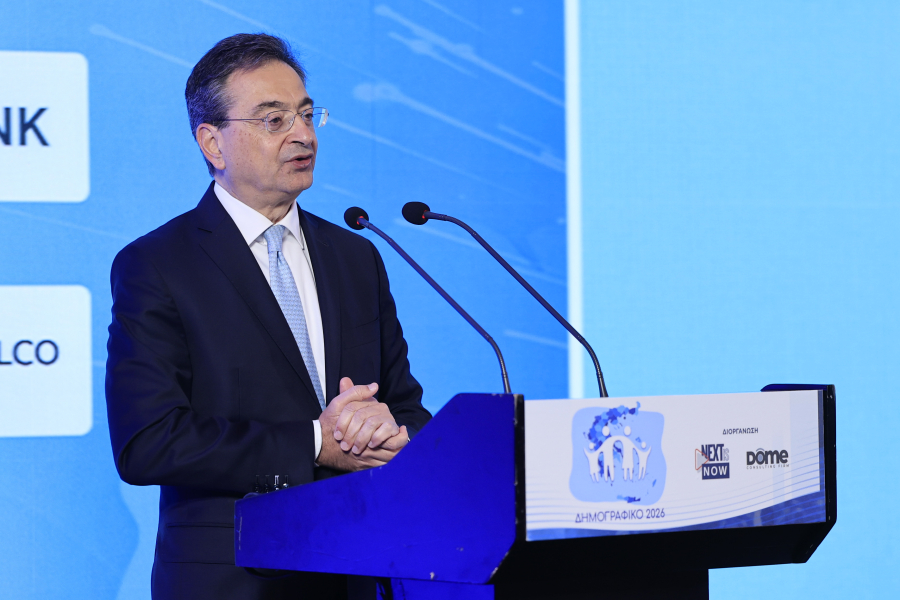

Eurobank Chief Executive Fokion Karavias is making the case that Greece’s private sector has a responsibility to invest in public education, as the lender joins the country’s other major banks in a €160 million initiative to upgrade three of Greece’s leading universities.
Karavias, in a letter to Eurobank employees, described high-quality public education as essential to long-term economic growth and social prosperity, positioning the investment as part of the bank’s broader effort to support younger generations and strengthen the connection between education and the economy.
“We see high-quality public education as a fundamental prerequisite for long-term sustainable economic growth and social prosperity, and we are responding to the responsibility of the private sector to support it,” Karavias said.
Eurobank and Greece’s three other systemic banks—the lenders that dominate the country’s banking industry—will provide a combined €160 million to upgrade infrastructure at the National and Kapodistrian University of Athens, the National Technical University of Athens and Aristotle University of Thessaloniki.
The three institutions occupy a prominent place in Greek higher education and scientific research, but parts of their infrastructure have struggled to keep pace with the needs of modern universities. Karavias said the initiative is intended to address that gap through large-scale renovations of buildings, student facilities and teaching spaces.
At the National and Kapodistrian University of Athens, the funding will support studies and renovation work on facilities used by roughly 100,000 students and employees. Karavias described the contribution as the university’s largest donation in decades.
At Aristotle University of Thessaloniki, the initiative includes renovations of student residences as well as upgrades to lecture halls and communal spaces. At the National Technical University of Athens, the funding will support the restoration of the historic Gini Building, part of a broader effort to revitalize an area of central Athens that includes the university’s historic campus and the National Archaeological Museum.
The National Technical University project carries particular significance for Karavias, who graduated from the institution. In his message to employees, he described the initiative in personal terms, noting that many Eurobank staff members also began their careers after studying at Greece’s public universities.
“Many of us began our journey at public universities—and we have not forgotten that,” he said, presenting the contribution as a way of giving back to institutions that played a formative role in the lives and careers of their graduates.
The university investment also expands Eurobank’s involvement in a broader push by Greece’s banking sector to support public education. The four systemic banks are already participating in the “Marietta Giannakou” program, which finances the renovation and modernization of public school buildings across Greece.
Together, the school and university initiatives represent more than €500 million in funding, according to Karavias, extending from primary and secondary education to the university level.
For Eurobank, the investments form part of a social-impact strategy that places particular emphasis on education, equal opportunity and younger generations. Karavias said the bank’s approach is built around the idea that education should be more closely connected with the productive economy and that access to high-quality learning opportunities can contribute to the country’s longer-term competitiveness.
Eurobank’s education-related programs range from recognizing high-achieving secondary-school students across Greece to supporting language education for members of the Pomak minority in the northern region of Thrace. The bank has also backed educational initiatives focused on artificial intelligence and programs for gifted children.
Karavias said the common thread running through those efforts is a commitment to equal opportunity, merit and academic excellence, as well as broader access to high-quality education.
The emphasis comes as Greece continues to confront structural challenges that extend beyond its recovery from the sovereign-debt crisis, including demographic pressures and the need to retain highly skilled young workers. Against that backdrop, Karavias is framing investment in education not simply as philanthropy, but as part of the foundation for the country’s future economic performance.
For Eurobank, that argument also reflects a broader view of the role a major financial institution can play beyond its core banking operations. After a decade in which Greece’s banks were largely focused on restructuring their balance sheets and reducing the legacy of the financial crisis, Karavias is pointing to education as an area where the private sector can contribute to the country’s longer-term development.
The investment, he suggested, is ultimately about more than renovating university buildings. By supporting the institutions that educate the next generation, Eurobank and its peers are investing in the human capital on which Greece’s future growth will depend.
For Karavias, the connection is also personal. His reference to the National Technical University as his “alma mater”—the institution that nurtured and educated him—underscored the message at the heart of his letter: that those who benefited from Greece’s public universities have a responsibility to help strengthen them for those who come next.