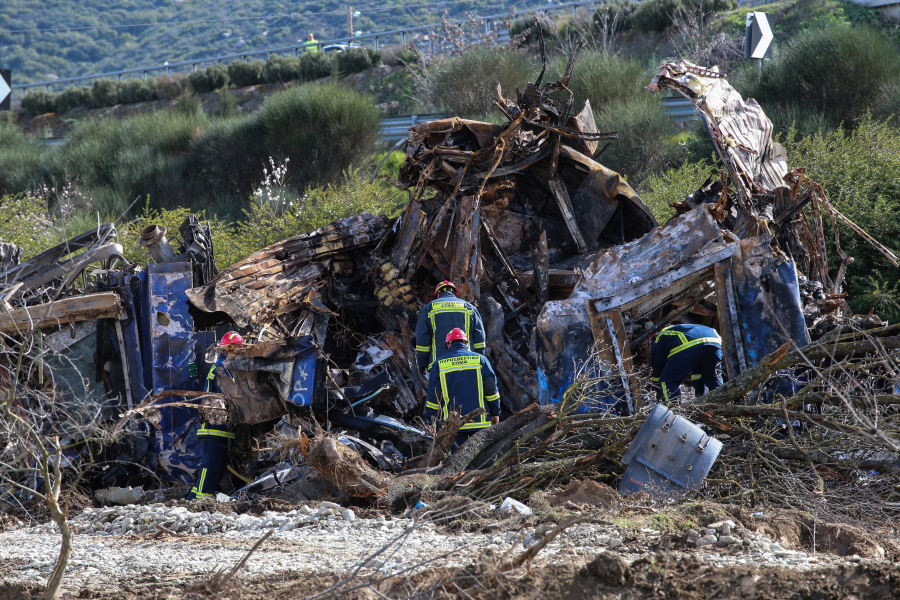
Dimitris Mitroulias, a deputy prosecutor at Greece’s Supreme Court, has proposed that Christos Triantopoulos, a former deputy minister attached to the prime minister’s office, be referred to a special court over allegations connected with alterations made to the crash site after two trains collided near Tempe, in central Greece, on Feb. 28, 2023. The collision killed 57 people, many of them young passengers and university students.
The recommendation centers not on the causes of the collision itself but on what happened in its immediate aftermath. The removal of soil, debris and other material from the site—widely described in Greece by the politically charged term bazoma, or “backfilling”—has fueled accusations from victims’ relatives and critics that potentially valuable evidence was lost before the circumstances of the disaster could be fully investigated.
According to the report, the prosecutor is seeking the referral of five of eight defendants on a misdemeanor charge of breach of duty. Alongside Triantopoulos, the proposed defendants include Kostas Agorastos, the former regional governor of Thessaly, the region where the crash occurred, and three officials associated primarily with the fire service. A judicial council will have the final say on whether the case proceeds to a special court, with a decision expected in the fall.
For readers outside Greece, the prospect of a special court carries particular significance. Under the Greek constitutional system, alleged offenses committed by government ministers in connection with their official duties can follow a special parliamentary and judicial process rather than the path of an ordinary criminal prosecution. The prosecutor’s recommendation therefore represents a step toward a rare proceeding involving the conduct of a former member of the government.
The Tempe disaster has remained a potent political issue more than three years after the crash, drawing attention not only to longstanding deficiencies in Greece’s railway system but also to the government’s response and the integrity of the investigations that followed. Relatives of the victims have repeatedly pressed for accountability, while questions surrounding the treatment of the crash site have become a separate controversy from the criminal proceedings over the collision itself.
Triantopoulos has denied wrongdoing. According to the report, he told investigators that his presence in the area was limited to coordinating state assistance and communicating with the public, and that he had no operational or investigative authority over the crash site. He also denied having a decision-making role in the movement of soil, train cars or resurfacing work, saying the relevant actions were decided and carried out by other officials. He has said that major excavation and removal work took place on March 1 and March 2, before he first visited the crash site on the afternoon of March 3.
Agorastos has also denied responsibility, describing the Thessaly regional government’s role as supportive and arguing that decisions concerning the management of the site and preservation of evidence belonged to investigative authorities. He has said the regional administration supplied machinery when requested but didn’t direct the handling of evidence.
The prosecutor has separately recommended that proceedings involving three lower-ranking fire-service employees be split from the ministerial case and transferred to prosecutors in Larissa, the city closest to the crash, for further examination of an alleged breach of duty related to their investigative responsibilities.
If the judicial council accepts the recommendation, the proceedings against Triantopoulos would become the first special-court case arising from the Tempe disaster, according to the report. A separate investigation remains pending involving former Transport and Infrastructure Minister Kostas Achilleas Karamanlis and former ministry officials over alleged breaches of duty connected with the period leading up to the crash.