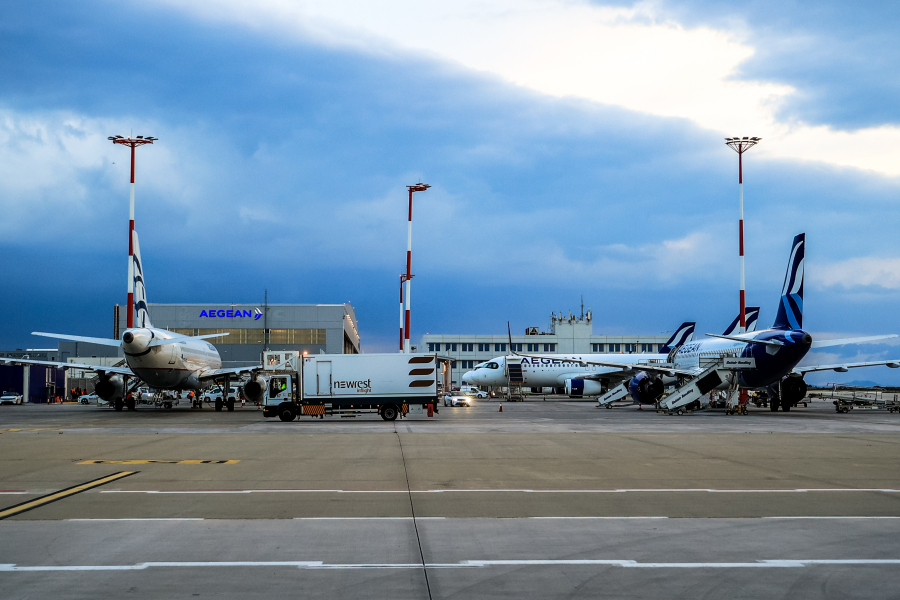
Greece recorded one of the steepest increases in air-transport prices in the European Union in June, as strong travel demand, seasonal pressures and the conflict in the Middle East continued to reshape the region’s aviation market.
Prices for air-passenger services in Greece rose 15.1% in June 2026 from a year earlier, according to data from Eurostat, the European Union’s statistics agency. That was the second-largest increase among the bloc’s member states, behind Austria, where prices climbed 22.3%.
The rise highlights the pressure facing travelers heading to Greece, one of Europe’s most heavily visited summer destinations. Demand typically surges during the peak tourism season, when millions of foreign visitors travel to the country’s islands and coastal regions. This year, airlines are also contending with route changes, higher operating costs and disruptions linked to the Middle East conflict.
ΔΙΑΒΑΣΤΕ ΕΠΙΣΗΣ


Airfare prices across the EU have been volatile since the beginning of 2025, reflecting shifting travel demand, seasonal patterns and geopolitical developments. Conflict-related changes to flight networks have forced some carriers to reroute aircraft, lengthening journeys and increasing fuel and staffing costs.
Across the EU, annual air-transport inflation reached a recent peak in April 2025, when prices rose 13.7% from the same month a year earlier. The pace of growth eased during the summer before prices declined on an annual basis in early 2026.
The market then rebounded in February and March. Prices fell again by 4.7% in April 2026, before rising 8.1% in May and 3.1% in June.
International flights accounted for much of the volatility. Prices for international air travel rose 14.1% in April 2025 and 8.7% in May 2026. They were up 4.5% in June. Domestic fares increased at a more moderate rate of 2%.
The gap among EU countries was wide. Belgium recorded the bloc’s sharpest increases during the second quarter of 2026, with prices rising 41.5% in April, 33.8% in May and 28.7% in June compared with the same months a year earlier.
At the other end of the spectrum, Slovakia posted the largest declines. Prices there fell 53% in April, 48.2% in May and 45.1% in June. Hungary and Poland also reported significant decreases in June, of 13.6% and 13.1%, respectively.