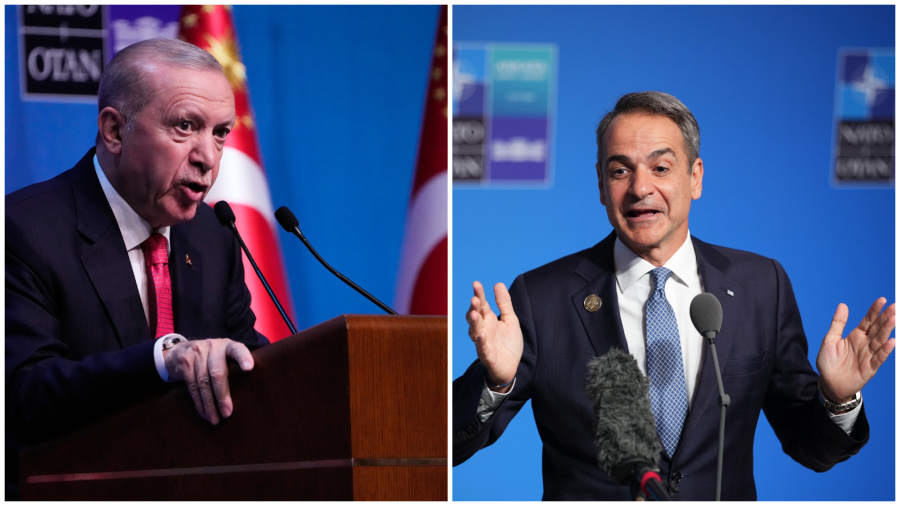

Turkish President Recep Tayyip Erdogan sharply criticized Greece’s opposition to Ankara’s potential acquisition of U.S.-made F-35 fighter jets, accusing Prime Minister Kyriakos Mitsotakis of making a “mistake” by raising concerns over the issue.
Speaking after the NATO summit in Ankara, Erdogan dismissed objections from both Greece and Israel, insisting that neither country had any say over Turkey’s defense procurement.
“Israeli and Greek opposition to Turkey’s purchase of F-35s has no place in my world,” Erdogan said. “Mr. Mitsotakis should not make such a mistake.”
Erdogan made clear that Turkey has no intention of scaling back its military modernization plans, arguing that Ankara has every legitimate right to acquire advanced fighter aircraft and other defense systems. He added that negotiations with the United States are ongoing and expressed confidence that Washington would ultimately approve the sale.
ΔΙΑΒΑΣΤΕ ΕΠΙΣΗΣ

“President Trump has a positive attitude toward the sale of F-35 fighter jets to Turkey. I hope the United States will keep its promise,” Erdogan said.
Despite his criticism of Athens, Erdogan also signaled that long-standing disputes in the Aegean should be resolved through direct dialogue between the two countries.
“As the leaders of Turkey and Greece, it is our duty to resolve the problems in the Aegean,” he said.
Mitsotakis, however, underscored that NATO’s unity cannot be separated from respect for international law and good-neighborly relations. Speaking upon his arrival at the summit, the Greek prime minister avoided responding directly to Erdogan’s remarks but stressed that the alliance must take into account the legitimate security concerns of all member states.
“At a time when my country continues to face a casus belli from Turkey should we exercise our sovereign and lawful right to extend our territorial waters, it is clear that the sensitivities and security concerns of every NATO member must be respected,” Mitsotakis said.
The Greek prime minister was referring to the standing 1995 resolution of the Turkish Parliament authorizing military action should Greece extend its territorial waters beyond six nautical miles—a threat Athens argues is incompatible with the principles of the NATO alliance.
Mitsotakis said that outstanding disputes between the two countries should be addressed through diplomacy, cooperation and respect for international law, reiterating that NATO is fundamentally a defensive alliance built on trust among its members.
The Greek leader also highlighted Athens’ defense commitments, noting that Greece has already exceeded NATO’s 3.5% defense spending benchmark and is implementing a €25 billion modernization program for its armed forces. He stressed that Greece has consistently met its alliance obligations despite years of economic hardship and today ranks among NATO’s highest defense spenders.
Addressing broader security challenges, Mitsotakis said Europe is assuming greater responsibility for its own defense, arguing that stronger European capabilities reinforce rather than weaken NATO. He also called for diplomacy to prevail in the Middle East, warning that renewed instability could drive up energy prices and place further pressure on European economies.