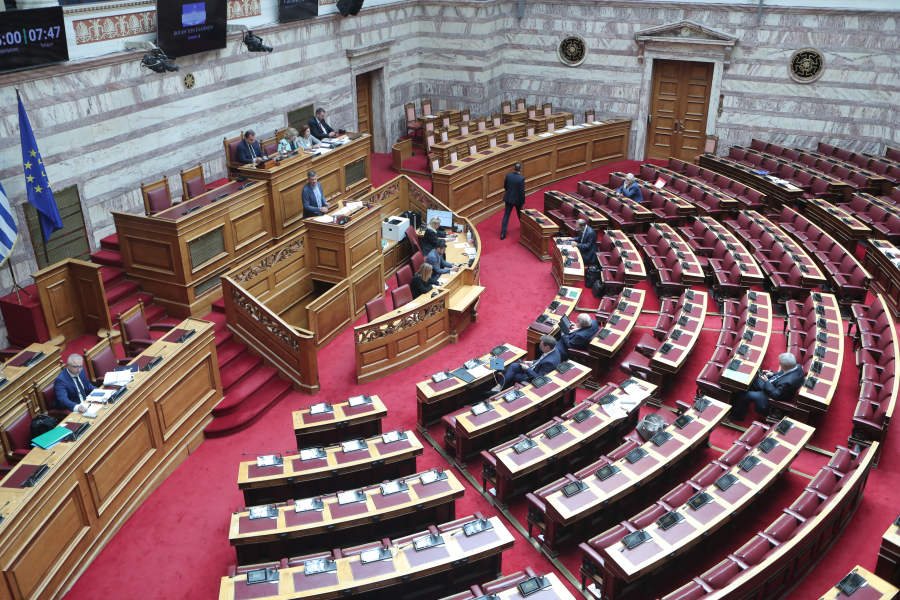
Greece’s ruling New Democracy party is facing accusations of institutional overreach after its lawmakers blocked the summons of two central figures in the country’s long-running wiretapping scandal before Parliament’s Institutions and Transparency Committee.
The dispute erupted after opposition parties requested testimony from Grigoris Dimitriadis, a former senior aide and nephew of Prime Minister Kyriakos Mitsotakis, and Tal Dilian, an Israeli businessman linked to Intellexa, the company associated with Predator spyware.
The opposition argued that the summons was mandatory under Parliament’s rules because the request had secured the backing of the required two-fifths of committee members. New Democracy rejected that interpretation, saying the two men could not be summoned because they were not public officials or public figures in the relevant legal sense.
ΔΙΑΒΑΣΤΕ ΕΠΙΣΗΣ


The argument immediately drew scrutiny. Panagiotis Doudonis, an MP with the opposition PASOK party, produced a 2022 document bearing the signature of committee chairman Thanasis Bouras, a New Democracy lawmaker, in which Bouras had supported calling Dilian before the same committee under the same parliamentary provision.
For opposition MPs, the document exposed a direct contradiction. In 2022, they said, the ruling party considered Dilian eligible to testify; in 2026, after Dilian reportedly expressed willingness to appear, New Democracy argued the opposite.
Makis Voridis, speaking for the government majority, defended the decision. He said the opposition’s request violated parliamentary rules because the witnesses no longer held a public role and would not add anything substantial to the inquiry. He also accused opposition parties of abusing their procedural rights.
The explanation failed to convince opposition lawmakers, who accused the majority of staging a cover-up. PASOK, SYRIZA and the Communist Party walked out before the vote, denouncing the procedure as unconstitutional and a breach of Parliament’s rules.
The committee’s New Democracy members then voted against summoning Dimitriadis and Dilian.
The episode adds a new layer of political tension to a scandal that has shadowed Greece for years. Predator spyware, a powerful surveillance tool capable of compromising mobile phones, has been at the center of allegations involving journalists, politicians and public figures. The government has denied wrongdoing, while opposition parties have accused it of obstructing efforts to establish who knew what, and when.
The latest confrontation also drew a response from PASOK after Dimitriadis, in a social-media post, linked the party’s insistence on his testimony to its polling performance.
Lawyer Zacharias Kesses, who represents spyware victims, added a further dimension to the dispute by directly challenging Makis Voridis’s role in the committee proceedings.
Kesses argued that Voridis was not merely a government lawmaker defending the majority’s line, but someone with a personal stake in the spyware affair. According to Kesses, Voridis himself had been targeted with Predator while serving as interior minister, at a time when he was handling sensitive and, in some cases, confidential state matters.
That, Kesses said, should have made Voridis especially interested in establishing who was behind the spyware operation. Instead, he accused Voridis of doing the opposite: failing to file a criminal complaint, failing to join any prosecution as a civil claimant, failing to bring a civil lawsuit and failing to appear before the authorities to testify about the attempt to infect his phone.
Kesses described that stance as a serious institutional failure. In his view, a minister who had allegedly been targeted by illegal spyware had both a legal and moral obligation to help uncover the perpetrators. By supporting the majority’s move to block Tal Dilian’s appearance before the committee, Kesses said, Voridis effectively helped protect the very person who should have been questioned.
He went further, accusing Voridis of helping “shield” the perpetrator, contributing to the cover-up and degrading a parliamentary process designed to establish accountability. Kesses called the committee’s handling of the matter a “black page” in parliamentary history, arguing that the majority’s position did not simply weaken transparency but actively obstructed the investigation of one of Greece’s most serious institutional scandals.