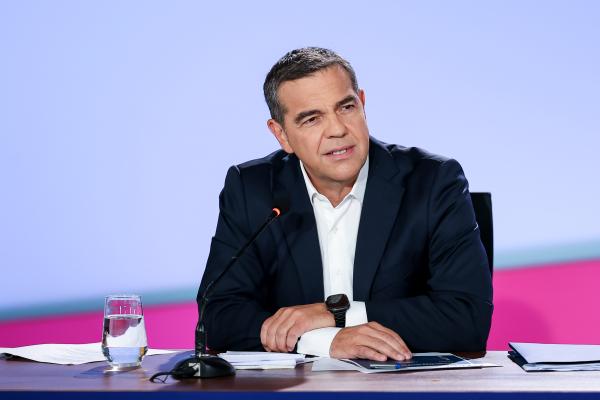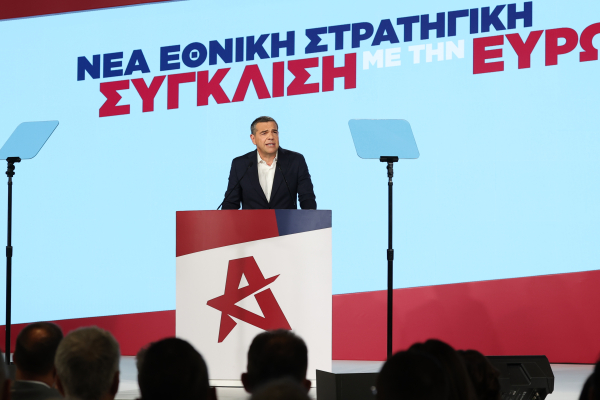
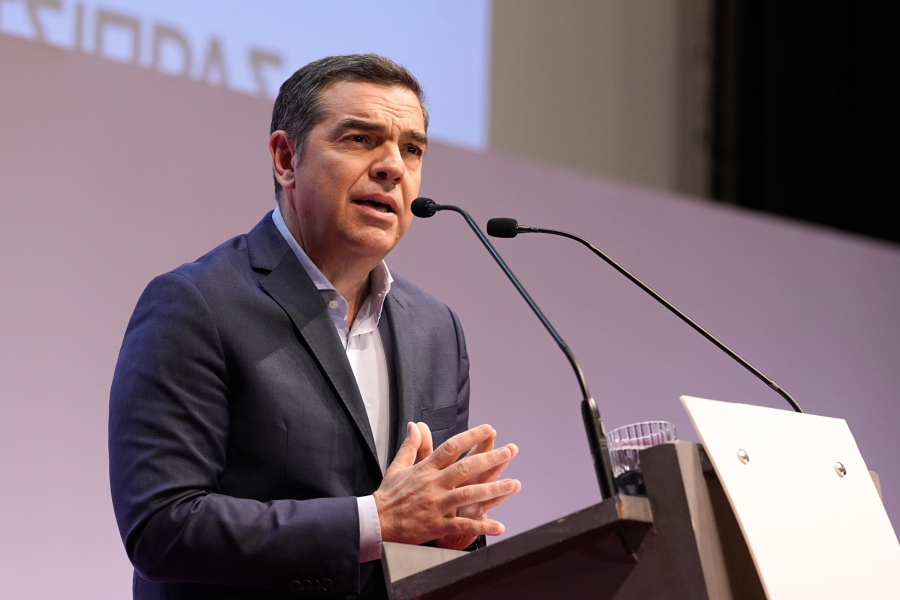

Former Greek prime minister Alexis Tsipras used a public appearance in Thessaloniki on Saturday to send a clear message to progressive voters: he is politically present, determined, and preparing a full return to the centre of Greek politics in a leading role. Closing his speech with the phrase “the journey has begun again,” Tsipras sought to dispel speculation that he might retreat from his plans following the recent emergence of a new political initiative outside the traditional party system.
Speaking at the presentation of his book Ithaca, Tsipras framed his message around what he described as a growing social demand for an alternative political direction. He argued that Greek society is searching for a credible progressive response to what he called a system marked by authoritarianism, oligarchy, injustice and corruption. According to Tsipras, this demand can only be met by the creation of a broad and cohesive progressive force capable of governing, rather than fragmented parties or protest movements without governing prospects.
He stressed that he and his team are working intensively on a new plan for progressive governance, insisting that the progressive electorate is not looking for symbolic opposition but for a viable alternative government. He warned that in the absence of such a perspective, political disillusionment will continue to fuel anti-politics and the rise of the far right, a remark widely interpreted as a veiled reference to newer populist or protest-oriented formations.
Tsipras argued that a recomposition of Greece’s democratic progressive camp is both necessary and unavoidable, stating that it must take place beyond narrow political interests and personal ambitions. However, he emphasized that this process should be methodical and principled, guided by values of integrity, justice and democratic accountability, rather than rushed or improvised.
Turning to policy, the former prime minister delivered a sweeping critique of the current government led by New Democracy, painting a bleak picture of Greece’s trajectory across foreign policy, agriculture, transparency and institutional governance. On foreign affairs, he accused the government of inconsistency and passivity, arguing that Greece has weakened its international standing by failing to defend international law clearly and by adopting what he described as an excessively confrontational posture in global conflicts.
He contrasted this with his own record, claiming that Greece is strongest when it combines dialogue with firm defense of its sovereign rights.
On relations with Turkey and major allies, Tsipras argued that Greece has made strategic concessions without securing tangible benefits in return, citing developments in the Eastern Mediterranean and what he portrayed as a lack of effective deterrence. He also criticized the government’s handling of European and transatlantic diplomacy, suggesting that Greece has lost leverage rather than enhanced it.
In the field of agricultural policy, Tsipras sharply opposed Greece’s support for the EU–MERCOSUR trade agreement, arguing that it exposes Greek farmers and livestock producers to unfair competition from large-scale producers operating under lower environmental, health and labor standards. He accused the government of abandoning the agricultural sector while engaging in symbolic dialogue that fails to address farmers’ structural problems.
A central theme of his speech was institutional decay and transparency. Tsipras pointed to Greece’s poor ranking among European countries on transparency and open governance, arguing that the concentration of power and lack of accountability have created a state that is not only inefficient but potentially dangerous. He linked this assessment to recent tragedies and safety failures, including transport and aviation incidents, which he described as the result of political choices rather than unavoidable accidents.
He went further, accusing the government of democratic backsliding, citing the wiretapping scandal as evidence of a governing model that tolerates surveillance of political opponents, journalists and state officials. According to Tsipras, when the state becomes a tool of control, it also becomes a mechanism for misuse of public resources, undermining trust in democratic institutions.
Concluding his address, Tsipras called for a decisive political break rather than incremental management, invoking the need for what he described as a “new post-transition era” in Greek politics. He outlined his vision of a strong and fair state, based on meritocracy, social protection and transparent governance, and pledged that his political initiative will soon present concrete proposals, including a new digital transparency platform aimed at strengthening public oversight of state spending. Greece, he said, needs political change—and a fundamentally different course.