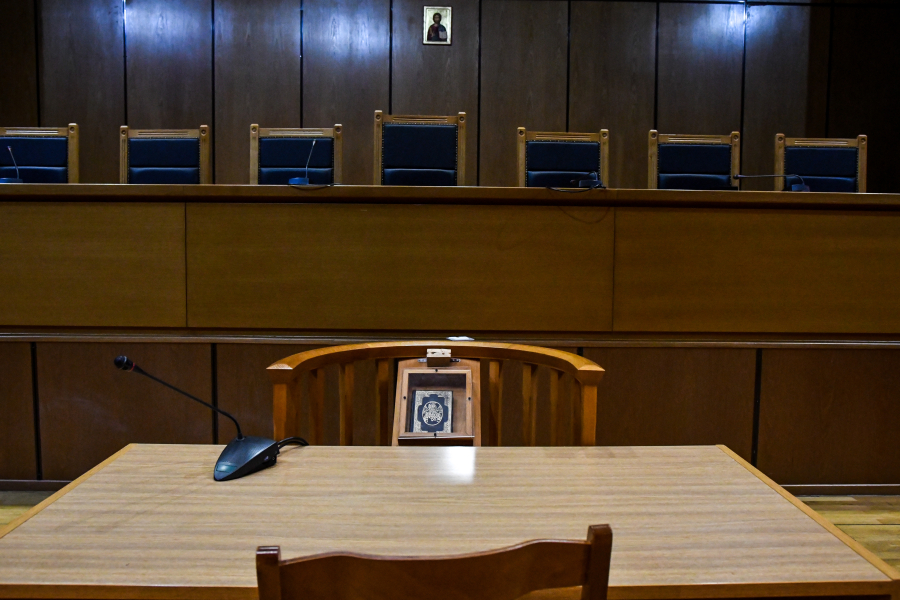
A court in Athens has delivered on Thursday the first criminal convictions in Greece’s sprawling spyware scandal, a case that has raised serious concerns about privacy, press freedom and the rule of law, and has drawn close scrutiny from European institutions.
The Athens Single-Member Misdemeanor Court found businessmen Tal Dilian, Felix Bitzios, Giannis Lavranos and Sara Alexandra Hamou guilty of illegally accessing personal data and intercepting communications through the Predator spyware system. The defendants are linked to two companies accused of distributing and operating Predator, an advanced surveillance tool that can covertly infiltrate smartphones, allowing operators to monitor calls, messages and other private data without the user’s knowledge.
The court imposed a cumulative prison sentence of 126 years and eight months on each defendant. Under Greek law, however, only eight years are enforceable, and even those were suspended pending appeal. While the defendants will not serve time unless the verdict is upheld by a higher court, the ruling is nonetheless significant, as it formally establishes criminal responsibility for the use of Predator in Greece.
ΔΙΑΒΑΣΤΕ ΕΠΙΣΗΣ


In announcing the verdict, the presiding judge said the evidence showed that the four acted in concert, together with other associates, and with shared intent. According to the court, they systematically gained unauthorized access to personal data and private communications. The defendants were convicted of multiple offences, including interference with systems storing personal data, breach of the secrecy of telephone communications and oral conversations, and unlawful access to information systems. The court found that these acts were carried out jointly and repeatedly, in both completed and attempted forms.
A key legal development in the ruling was the court’s acceptance of the prosecutor’s request to partially reclassify the charges. Some acts were treated not as a single continuing offence but as separate concurrent crimes affecting dozens of individual victims. The prosecutor stated that at least 87 identifiable victims were involved, underscoring the scale of the surveillance operation. In addition, the court ruled that several acts initially classified as attempted intrusions should instead be considered completed crimes, after evidence showed that targeted individuals had clicked on infected links sent to their devices.
No mitigating circumstances were recognized for any of the defendants, a decision that contributed to the unusually heavy sentences. More importantly, the court and the prosecution moved to reopen the case beyond the four convicted individuals. The prosecutor ordered that parts of the case file be forwarded for further investigation into potential criminal liability of additional persons who were not defendants in the trial but were described as having detailed knowledge of, or involvement in, the spyware operation. These referrals include possible offences of complicity, false testimony before parliamentary and judicial bodies, and violations of provisions of Greek criminal law relating to espionage.
Among those named are Merom Harpaz, Rotem Farkas, Einat Semana, Sotiris Dalas, Ioannis Boliaris, Ioannis Toumbis, Dimitris Xyteras, Emilios Kosmidis and Kostas Petrisis. Prosecutors cited evidence suggesting possible complicity, false testimony before judicial and parliamentary bodies, and, given the scale, organization and international dimension of the surveillance operation, potential violations of espionage-related provisions of Greek criminal law. The referrals underscore that the convictions do not close the case but instead mark the beginning of a broader investigation into the wider structure behind the illegal surveillance network, including possible foreign involvement.
The prosecution also raised questions about whether Predator-linked companies continued operating in Greece even after public revelations of the scandal, potentially in breach of laws banning the trafficking of certain surveillance software.
Politically, the ruling has intensified an already explosive debate. Predator spyware was used against politicians, journalists and other public figures, prompting accusations that illegal private surveillance overlapped with lawful monitoring conducted by Greece’s National Intelligence Service (EYP). Although the court case focused on private individuals, the judgment has revived allegations that the spyware operation could not have functioned without political tolerance or institutional cover.
Nikos Androulakis, leader of the centre-left PASOK party and one of the surveillance targets, described the verdict as a major blow to the government and what he called a “shadow state” operating at the heart of power. He said the case would ultimately be judged at the European Court of Human Rights and announced plans to demand renewed parliamentary investigations, arguing that earlier inquiries had been deliberately constrained. Androulakis emphasized that his own surveillance began when he was running for party leadership and ended once he was elected, suggesting a clear political motive.
From the main opposition SYRIZA party, leader Sokratis Famellos said the convictions confirmed that an organized surveillance scheme had been in place and accused Prime Minister Kyriakos Mitsotakis of bearing personal responsibility. Former prime minister Alexis Tsipras echoed that view, arguing that while four individuals were convicted, those who designed and directed the operation remained outside the indictment. He directly named Mitsotakis and his close aide Grigoris Dimitriadis, calling them the “moral” and “executive” authors of the violation of the rule of law.
Legal experts also stressed the broader implications of the ruling. Former deputy prime minister and constitutional law scholar Evangelos Venizelos warned that cases involving systemic damage to democratic institutions cannot be closed by political decisions alone. He underlined that judicial scrutiny extends beyond national courts, pointing to the role of European courts in cases involving fundamental rights such as the secrecy of communications.
Journalist Thanasis Koukakis, one of the first victims targeted by the illegal spyware, commented on the guilty verdict in the wiretapping case by saying that “a modest single-judge misdemeanor court essentially did what it was supposed to do.” He said the ruling showed that the justice system acted in line with the Constitution by protecting the rights of the victims and sending a clear message that violations of privacy and personal data “will not go unpunished.” Koukakis noted, however, that “unfortunately, the Supreme Court did not do the same two years ago,” arguing that this failure resulted in the loss of valuable time in investigating the case. Even so, he described the day as a positive one, saying it demonstrated that Greek citizens will not be “defenceless in the face of arbitrary actions by those who possess the technical expertise and the means to monitor them, without any real justification.” After thanking his lawyers, Zacharias Kesses and Petros Lianos, for their support throughout the proceedings, Koukakis stressed that the case is far from over. “We are still at the beginning,” he said. “There is a long road ahead and further judicial processes to come, so that the foul-smelling affair of illegal surveillance can be fully uncovered.”
Despite the suspension of the prison sentences, the judgment marks a watershed moment. It is the first time a Greek court has formally acknowledged criminal wrongdoing linked to the Predator spyware and has laid the groundwork for further judicial scrutiny. By reopening investigations and explicitly recognizing the scale and organization of the surveillance, the ruling shifts the spyware scandal onto a new legal and political terrain, one that could ultimately reach European courts and further test Greece’s commitment to democratic accountability and the rule of law.