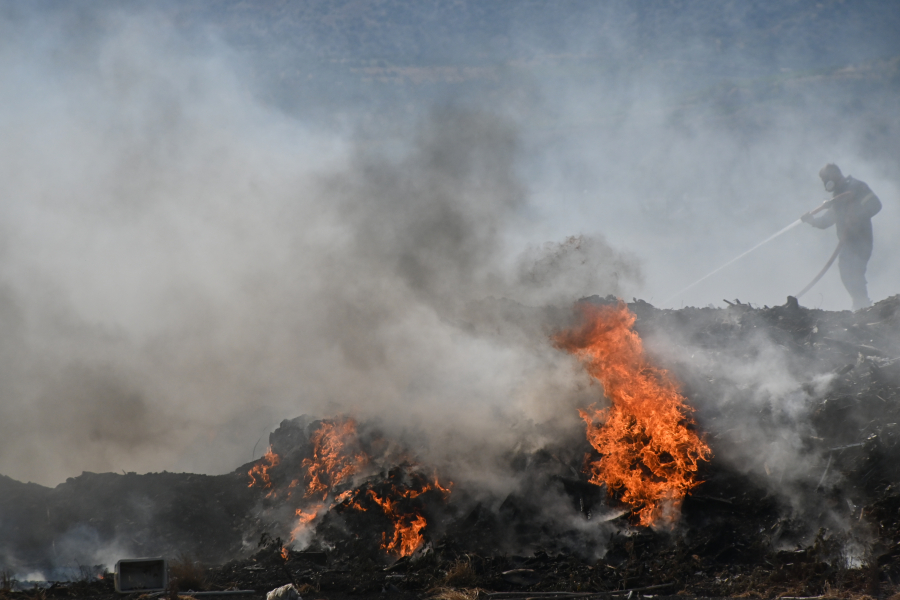
Two elderly people were killed Sunday after becoming trapped by smoke and flames as a fast-moving wildfire swept through residential areas of Salamina, an island just west of Athens, forcing hundreds of people to evacuate by sea and sending several others to hospitals with burns and smoke-inhalation injuries.
The bodies of the two victims were found by firefighters near a burned home on Andromachis Street in Peristeria, one of the areas hardest hit by the blaze. Residents told local media they could hear the elderly pair calling for help as dense smoke engulfed the neighborhood.
Greek fire-service officials said the victims were overcome before firefighting crews could reach them. Authorities are investigating the circumstances of their deaths, including whether they had attempted to leave their home or tried to fight the fire themselves.
ΔΙΑΒΑΣΤΕ ΕΠΙΣΗΣ

The deaths underscored the speed with which the fire developed on Salamina, a densely populated island in the Saronic Gulf that lies only a short distance from the Greek capital and is connected to the mainland primarily by ferry.
According to the Hellenic Fire Service, the first fire was reported at 2:43 p.m. in Peristeria, in an area where homes are interspersed with woodland. A second fire broke out at 3:03 p.m. in the Kaki Vigla-Selinia area.
Within about seven minutes of the first report, the Peristeria fire had grown to dangerous proportions and was advancing toward nearby homes, fire-service officials said. Surveillance-drone images taken at 2:46 p.m. and 2:50 p.m. documented the rapid expansion of the blaze.
Strong winds complicated efforts to contain the fire. Salamina was under a Category 4, or very high, wildfire-risk designation on Sunday, while wind gusts reached force 7 on the Beaufort scale, according to fire-service officials. The winds pushed flames and thick smoke toward residential districts and sharply reduced visibility.
Several homes in Peristeria were damaged or destroyed as the fire moved through the area. Firefighters continued operating under difficult conditions Sunday evening as authorities sought to prevent the flames from reaching additional populated areas.
The emergency prompted a large-scale maritime evacuation from parts of the island. Greece's Coast Guard said 593 people were removed by sea from the Saterli and Kolones areas. The final group of 22 evacuees was being transported aboard a passenger-and-vehicle ferry to the port of Paloukia, Salamina's principal ferry terminal.
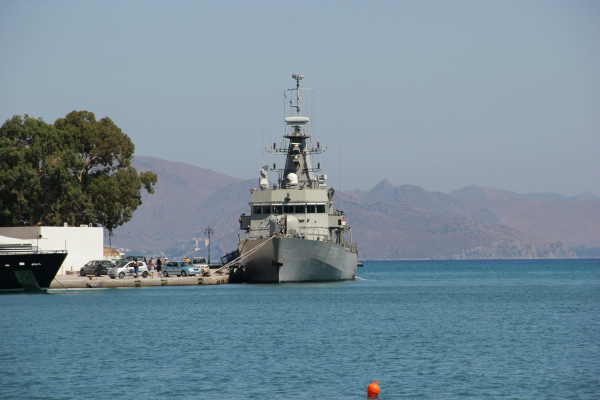
Two Coast Guard vessels and a Fire Service boat remained in the area to provide assistance and monitor conditions after the evacuation operation was completed.
The fire also left a number of people requiring medical treatment. Greek Health Minister Adonis Georgiadis said 10 cases involving people between the ages of 15 and 89 had been recorded, primarily for burns and smoke inhalation.
Five patients were transported, or were in the process of being transported, for hospital care. Among them was a woman suffering second-degree burns over roughly 25% of her body. Another patient was being transferred to Thriasio Hospital, a major public hospital west of Athens. Three people were discharged with medical instructions, while two remained under observation.
Greece's national health emergency coordination center was monitoring the situation and coordinating medical resources.
The Salamina fire comes during the height of Greece's summer wildfire season, when prolonged dry conditions, high temperatures and strong winds can turn relatively small fires into rapidly advancing fronts. The combination is particularly dangerous in areas where woodland and residential development meet, as they do in several parts of Salamina.
For residents of Peristeria, the speed of Sunday's fire left little time to react. Thick smoke enveloped homes as flames advanced through the neighborhood, while emergency crews struggled to reach threatened properties.
The accounts of neighbors who heard the two elderly residents crying for help offered a stark indication of how quickly conditions deteriorated.
By Sunday evening, firefighting operations remained under way and emergency services were on heightened alert as officials monitored the still-changing fire fronts. Protecting residents and preventing the blaze from spreading further into populated areas remained the authorities' immediate priority.