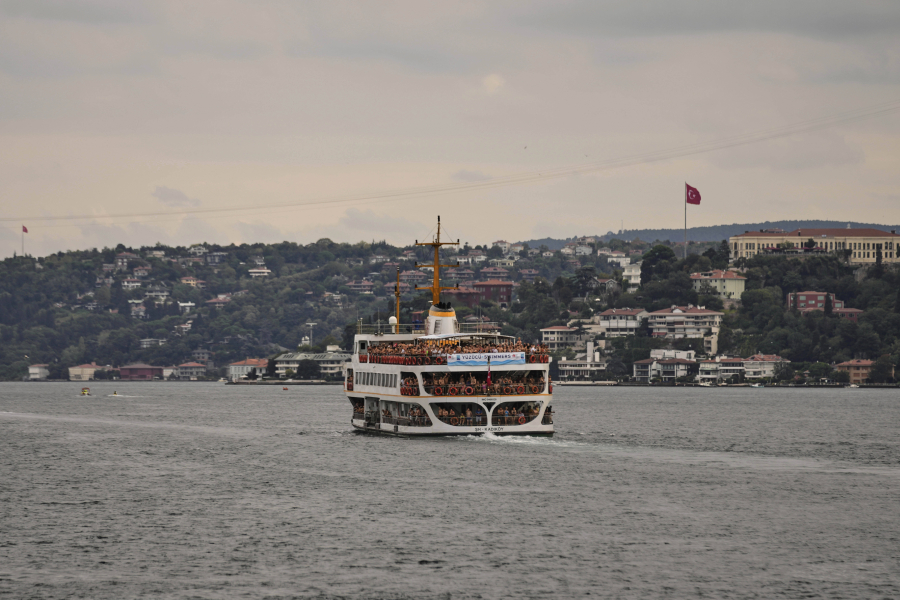

Turkey has established two national marine parks in the Aegean and Eastern Mediterranean, drawing new lines across contested waters and opening another front in its longstanding maritime dispute with Greece.
The parks were established through presidential decrees signed by President Recep Tayyip Erdoğan and published in Turkey’s official gazette on Aug. 15. Ankara presents the initiative as an effort to protect marine ecosystems and biodiversity. But the location of the protected zones closely reflects Turkey’s broader maritime claims, which Greece rejects.
The first park stretches along Turkey’s southwestern coast between Fethiye and Kaş and encompasses waters around Kastellorizo, a small Greek island located just a few kilometers from Turkey. The designation effectively separates Kastellorizo from Rhodes through a large protected zone claimed by Ankara.
ΔΙΑΒΑΣΤΕ ΕΠΙΣΗΣ


The second park lies in the northern Aegean, extending from waters off the Turkish coasts near Tekirdağ and Çanakkale into an area between the Greek islands of Lemnos and Samothrace.
The move follows Greece’s establishment of marine parks in the southern Aegean and Ionian Sea in July 2025 and its publication of a maritime spatial plan reflecting Athens’ interpretation of its maritime jurisdiction. Turkey protested those initiatives and has portrayed its own parks as a response.
Behind the environmental designations lies a decades-old disagreement over how maritime boundaries should be determined.
Greece argues that its islands are entitled to continental shelves and exclusive economic zones under international maritime law. Turkey, which isn’t a party to the United Nations
Convention on the Law of the Sea, argues that islands shouldn’t necessarily receive full effect when maritime boundaries are drawn, particularly when they lie close to Turkey’s mainland.
Kastellorizo is among the most contentious examples. Athens maintains that the island generates maritime rights beyond its territorial waters, while Ankara’s approach would sharply limit their extent.
The new maps also broadly correspond with Turkey’s “Blue Homeland,” or Mavi Vatan, doctrine, which envisions extensive Turkish maritime jurisdiction across the surrounding seas. Greece regards parts of the newly designated areas as falling within its potential continental shelf, although the two countries haven’t formally delimited their continental shelves or exclusive economic zones in these waters.
Marine parks don’t establish sovereignty or settle international maritime boundaries. But official coordinates and national regulations can reinforce a government’s territorial and jurisdictional claims.
For Greece and Turkey, two NATO allies whose relations have periodically been strained by disputes over territorial waters, energy exploration and maritime boundaries, the parks therefore carry significance well beyond conservation. What Ankara describes as environmental protection is likely to be viewed in Athens as another attempt to turn Turkey’s contested maritime claims into facts on the map.