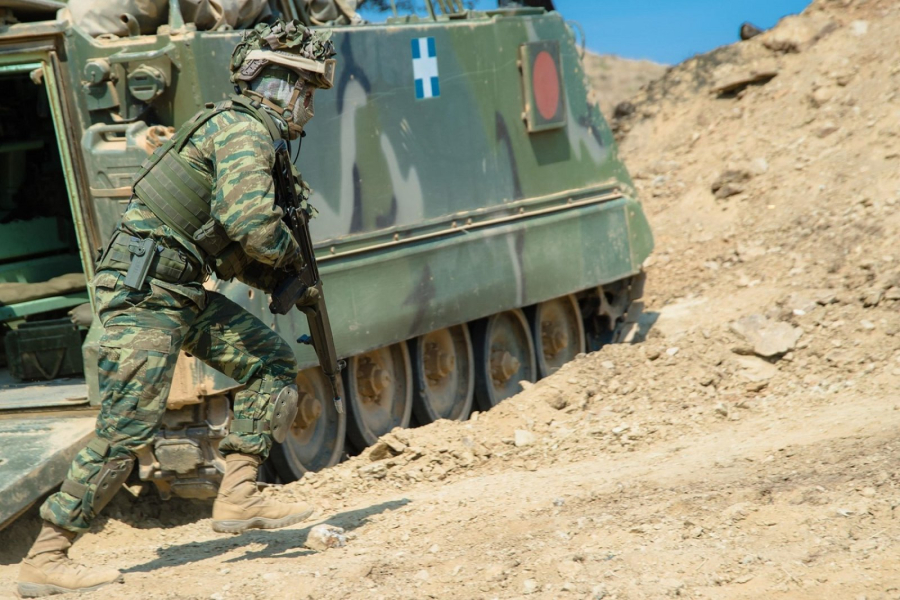

Greece is opening military-run combat-trauma training to civilians under a new government framework that sets out who can participate, how candidates will be selected and what they will have to pay, broadening access to skills traditionally associated with battlefield medicine.
A new joint ministerial decision allows Greek citizens and nationals of other European Union member states between the ages of 18 and 60 to take part in combat-trauma courses offered by the Greek Armed Forces. The rules establish educational and health requirements, selection criteria, documentation requirements and a fee structure for civilian participants.
The training will be provided by the Interbranch Combat Trauma Training Center, which operates under Greece’s Military Nursing Academy. Civilian participation won’t be available simply through individual enrollment. It will require a formal agreement between the Hellenic National Defence General Staff, known by its Greek acronym GEETHA, and the organization or institution through which participants apply.
ΔΙΑΒΑΣΤΕ ΕΠΙΣΗΣ



The framework covers three levels of training: All Service Members, or ASM; Combat Life Savers, or CLS; and Combat Medic/Corpsman, or CMC. Entry requirements become progressively more demanding as the level of medical training increases.
Applicants must be physically fit enough to meet the demands of the courses, while people with final convictions for certain categories of criminal offenses will be excluded. The educational threshold for the introductory ASM program is relatively low: applicants need only to have completed compulsory education.
Candidates for the second-level CLS course must have completed secondary education or previously undergone ASM training.
The requirements are tighter for the advanced CMC program. It is open to students, trainees and graduates of educational institutions at any level where health sciences are taught. People who perform medical or health-related duties for the organization through which they are applying may also qualify.
All instruction will be conducted in person, underscoring the practical nature of a curriculum built around responding to severe injuries in high-pressure environments. Each training group will be limited to 24 participants and will consist exclusively of civilians, who may come from one or several participating organizations.
Courses can be held at the Military Nursing Academy’s facilities or at suitable outside locations using the center’s mobile training unit, giving the Armed Forces scope to bring the program to participating institutions rather than requiring every class to travel to a military facility.
The agreement between GEETHA and each participating organization will be central to how the system operates. It will specify the number of trainees, the timing, duration and location of the course, the fee per participant and the method of payment. Agreements may also establish additional priority criteria and deadlines for submitting documents.
The training won’t be free. Fees will reflect the Armed Forces’ operating costs as well as the cost of certification by the U.S.-based National Association of Emergency Medical Technicians, or NAEMT, together with the applicable statutory surcharge. The ministerial decision doesn’t set a single nationwide price for participants.
Payment may be made either by the individual trainee or by the organization sponsoring the participant and must be deposited into an account of the Hellenic National Defence General Staff no later than the first day of training.
Where demand exceeds available places, staff at the Combat Trauma Training Center will rank applicants. The selection process will take into account how closely a candidate’s profession relates to the subject matter and whether the applicant holds relevant medical certifications, including Basic Life Support and, depending on the course, more advanced qualifications such as ACLS or PHLS.
Military-service history and age will also factor into the selection process. Among applicants who have served, reservists will receive priority over conscripts. Candidates who meet the requirements but lose out because a course is full may be placed in a subsequent training group.
Applicants will have to submit a copy of their identity document, evidence of the education or studies required for the relevant program and medical certificates from an internist and a cardiologist. The training center will obtain criminal-record information through official channels rather than requiring candidates to procure it themselves.