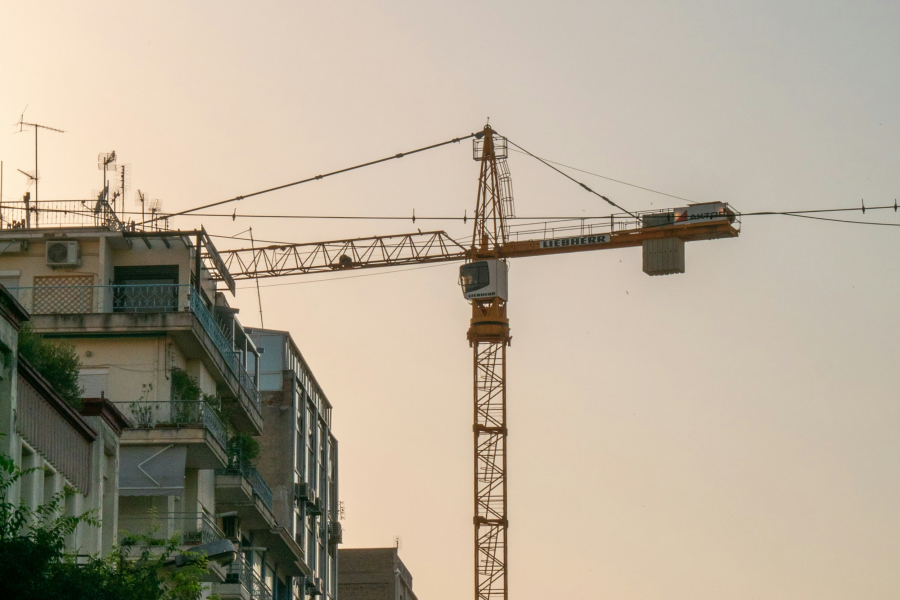

Greece’s construction upswing is spreading across much of the country, with new data suggesting developers aren’t simply building more - they are increasingly building bigger.
Private construction activity strengthened in most Greek regions in the 12 months from July 2025 through June 2026, according to the Hellenic Statistical Authority. Nationwide, the total floor area covered by building permits rose 14.6% to 7.18 million square meters, while the volume of planned construction jumped 20% to nearly 34 million cubic meters.
The gap between those figures and the number of permits points to an important feature of the market: project size matters as much as project count.
ΔΙΑΒΑΣΤΕ ΕΠΙΣΗΣ
Construction area surged 80% in Western Macedonia
Western Macedonia, a northern region bordering Albania and North Macedonia, recorded the sharpest percentage gains. Construction area surged 80% and volume more than doubled, rising 111.9%, even though the number of permits increased just 5.1%. The North Aegean islands also posted striking growth, with area up 63.4% and volume rising 59.6%.
Central Macedonia, home to Thessaloniki, Greece’s second-largest city, recorded a 19.9% increase in area and a 41.9% jump in volume. In Crete, another active property and tourism market, area and volume rose 25.3% and 25.4%, respectively. Western Greece posted gains of 23% and 30.2%.
The largest market in absolute terms remains Attica, the region encompassing Athens and its suburbs. Permitted construction area there climbed 15.6% to more than 2.14 million square meters, while volume increased 19.1% to 10.1 million cubic meters - close to 30% of the national total.
Growth was more moderate in Thessaly, Central Greece, the Ionian Islands, the South Aegean, and Eastern Macedonia and Thrace.
Two regions bucked the broader trend. In the Peloponnese, construction area fell 8.1% and volume declined 13%. Epirus presented a more unusual picture: area increased 15.6%, but volume dropped 9.1%.
The regional divergence underscores why permit counts alone can give an incomplete picture of Greece’s building cycle. A modest rise in approvals can conceal a sharp expansion in construction when the projects breaking ground are substantially larger.