
A proposal by Alexis Tsipras, Greece’s former prime minister, to impose a special tax on residential property purchases by non-EU buyers places the country within a broader global shift toward curbing foreign demand in housing markets—an approach most fully developed in Canada.
Canada’s framework is widely seen as a benchmark for taxing foreign participation in real estate. It layers multiple instruments: steep upfront acquisition taxes, recurring levies on vacant or underused homes, and strict taxation of rental income and capital gains. Central to the system is the Underused Housing Tax, a 1% annual charge on the value of properties left empty or insufficiently utilized by non-residents. Provinces including Ontario and British Columbia go further, imposing additional purchase taxes on foreign buyers that can reach 20% to 25%, materially increasing the cost of entry.
The policy rests on a dual objective. First, it aims to cool speculative inflows of foreign capital that treat housing as a financial asset, a dynamic widely blamed for driving up prices. Second, it seeks to push property owners toward active use—either by occupying homes or placing them on the long-term rental market—thereby boosting supply. Restrictions on purchases by non-residents complement the tax regime, reinforcing its interventionist thrust.
Mr. Tsipras’s proposal envisions a more targeted version tailored to Greece’s market. It would apply additional taxation specifically to non-EU individuals acquiring residential property, potentially through a transfer tax in the range of 15% to 20% on top of existing fees. Policymakers could also consider an annual levy on vacant homes, echoing the Canadian model, to discourage leaving properties idle.
Hypothetical scenarios illustrate the potential impact. An Israeli buyer purchasing a €400,000 apartment in Athens could face an additional €80,000 in taxes under a 20% surcharge, alongside existing transaction costs. If the property remains largely unused, a further €4,000 annual levy could apply. The financial burden would create a clear incentive to either rent out the property or reconsider purely speculative investment.
Similarly, a U.S. investor acquiring a €700,000 home on a Greek island—primarily as a store of value—could incur an extra €140,000 in upfront taxes. Failure to generate rental use could trigger ongoing annual charges, while any eventual sale at a profit could be subject to withholding on capital gains, ensuring tax compliance.
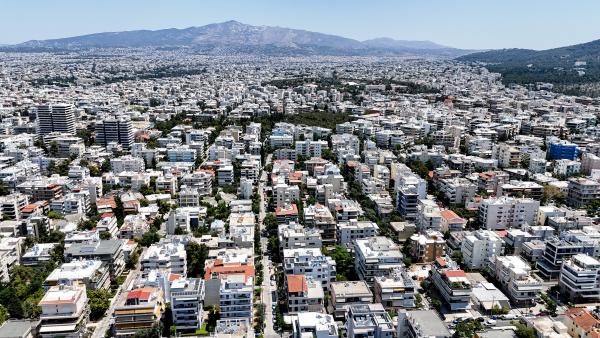
Proponents argue that such measures could help stabilize Greece’s property market, particularly in high-demand areas such as central Athens and major tourist destinations, where foreign capital has played an outsized role in recent price increases. By raising the cost of purely investment-driven purchases, the policy could ease pressure on local buyers.
The proposal also carries a social policy dimension. Revenues generated from taxing foreign buyers and vacant properties could be directed toward a national social housing strategy, aimed at expanding access to affordable housing for lower-income households and younger residents.
Such a program could combine new construction, the redevelopment of state-owned real estate, and partnerships with private developers to offer housing at controlled rents.
Additional funding could support rent subsidies or assistance for first-time buyers, broadening the policy’s impact beyond market stabilization to address affordability more directly.