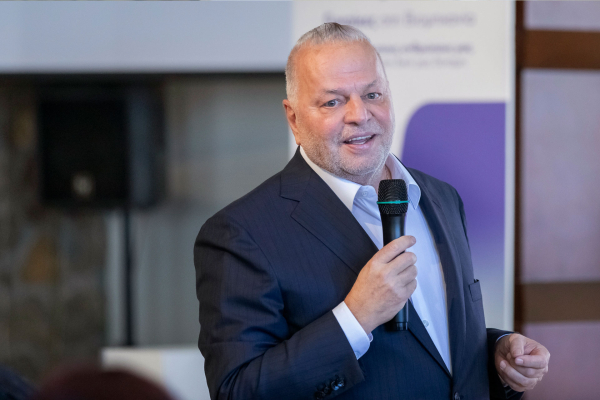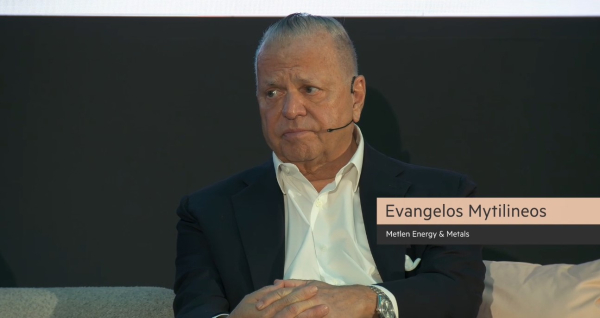
Metlen appears well insulated from the global energy and geopolitical turbulence triggered by the crisis in the Middle East, according to comments made by Evangelos Mytilineos during an analyst briefing on Thursday.
Operating in a highly volatile environment, the company has taken proactive steps to protect its performance. It has already secured full hedging for its aluminum and alumina production for 2026 and 2027 and is extending this strategy into 2028, taking advantage of currently favorable price levels. This approach significantly reduces exposure to market swings while improving visibility over future revenues.
At the same time, Metlen is benefiting from rising aluminum premiums for 2026 — the additional cost above London Metal Exchange benchmark prices for physical delivery — which remain largely unhedged and therefore provide additional upside to profitability. Alumina revenues are also directly linked to LME aluminum prices, allowing the company to capitalize on the strong upward momentum in global metals markets.
ΔΙΑΒΑΣΤΕ ΕΠΙΣΗΣ

Cost conditions are also supportive. A large portion of the company’s natural gas needs for 2026 has been hedged at relatively low price levels, strengthening margins in its metals business. Meanwhile, high natural gas prices are boosting the performance of its energy division, particularly in generation and supply, further reinforcing the group’s overall resilience.
Following the release of its 2025 results, the company’s outlook has become clearer to international investors. Major financial institutions — including Bank of America, Morgan Stanley, BNP Paribas and Citigroup — broadly agree that 2025 was an exceptional transition year, largely due to difficulties in certain engineering, procurement and construction (EPC) projects. Despite this, they maintain that the company’s broader investment case remains intact, with 2026 expected to mark a return to growth.
Analysts have adopted a clearly positive stance on valuation, with target prices ranging between €48 and €58 and recommendations consistently pointing to “buy” or “outperform.” The company’s 2025 results, which showed EBITDA of €753 million, were broadly in line with expectations but reflected a roughly 30% year-on-year decline, mainly due to project cost overruns and delays in asset sales.
Several analysts emphasize that underlying profitability remains significantly stronger than reported figures suggest. According to NBG Securities, losses from problematic projects exceeded €250 million; without these, EBITDA would have surpassed €1 billion. This view is echoed by other international banks, which highlight that one-off charges — including compensation costs — distort the headline results and obscure the group’s true earnings potential.
Crucially, these project-related issues now appear to be largely contained. Management has indicated that most of the associated costs have already been recognized, while the affected projects — primarily in the United Kingdom and Poland — are more than 90% complete. This substantially reduces the likelihood of further negative surprises and allows investors to refocus on the company’s core operations.
Against this backdrop, 2026 is widely seen as a year of stabilization and recovery. Analysts expect a strong rebound in profitability, with EBITDA projected at around €1.1 billion. At the same time, management continues to target up to €2 billion in medium-term EBITDA, a goal that analysts consider achievable if execution proceeds smoothly.
Fundamentally, the company’s core businesses remain strong. In metals, its hedging strategy provides clear margin visibility while high global prices support revenues. In energy, its integrated model — spanning both generation and supply — continues to demonstrate resilience, complemented by ongoing growth in renewable energy and value creation through asset portfolio sales.