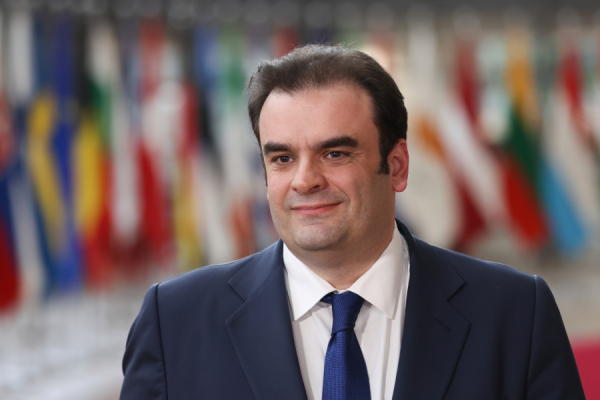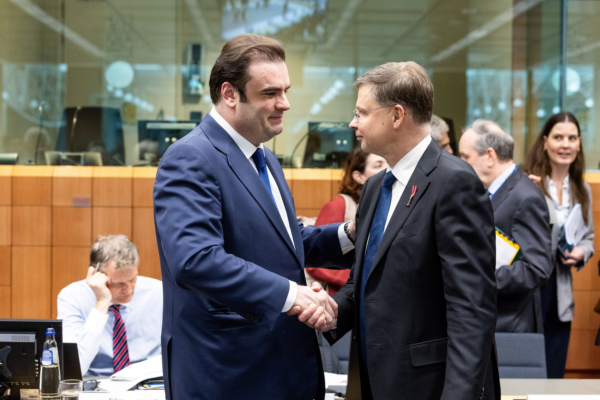
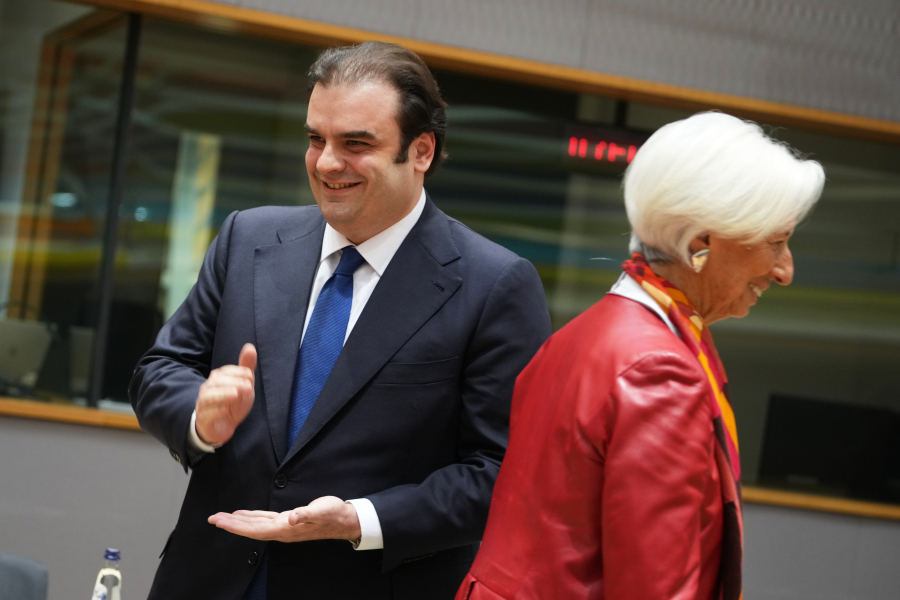
With a packed agenda and key decisions on the table, at a time of heightened geopolitical and economic pressure on the euro area, Kyriakos Pierrakakis on Monday makes his debut in Brussels as president of the Eurogroup.
His first meeting is being held in an expanded format and carries substantial political weight. At its core are two sensitive issues: the evaluation of candidates for the post of vice president of the European Central Bank and the formal welcome of Bulgaria as the newest member of the euro area.
Bulgaria’s finance minister is taking part in the meeting, as the country officially becomes the 21st member of the single-currency bloc. Pierrakakis will formally welcome Sofia into the euro area, while the European Commission and the European Central Bank present assessments of the country’s transition progress and its readiness to adopt the euro. The timing, however, is politically delicate for Bulgaria, which is heading toward early elections following the failure to form a government and the resignation of the previous administration.
Alongside enlargement of the euro area, finance ministers are exchanging views on policy priorities for 2026, based on recommendations from the European Commission. These priorities stress the need to safeguard fiscal sustainability while preserving room for strategic investment, particularly in defence and competitiveness. They also focus on improving the efficiency of public finances and completing national recovery and resilience plans. Strong emphasis is placed on investment in research and innovation, the green and digital transitions, economic security and the reduction of strategic dependencies, as well as on strengthening labour markets through skills development and education. The creation of a European Savings and Investments Union and progress toward a digital euro also feature prominently on the agenda.
The most politically charged item, however, is the selection of the next vice president of the European Central Bank, as the term of Spain’s Luis de Guindos expires at the end of May 2026. Eurogroup ministers will review six candidacies: Portugal’s Mario Centeno, former president of the Eurogroup; Finland’s Olli Rehn; Latvia’s Martins Kazaks; Estonia’s Madis Müller; Lithuania’s Rimantas Šadžius; and Croatia’s Boris Vujčić.
Following the Eurogroup’s deliberations, a formal recommendation will be sent to the European Council, which will take the final decision by reinforced qualified majority among euro area countries. This requires the support of at least 16 of the 21 member states, representing 65 per cent of the euro area’s population. Before the final appointment, the opinions of both the European Central Bank and the European Parliament will also be taken into account.