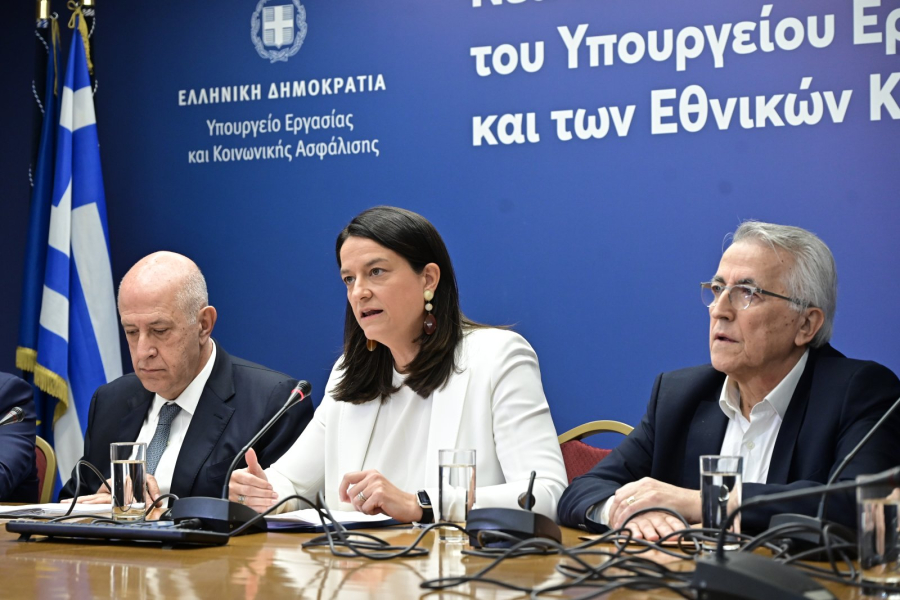
After seven months of negotiations between Greece’s Ministry of Labor and the country’s national social partners, the government has announced what it describes as a landmark agreement to strengthen collective labor bargaining and reverse key restrictions imposed during the bailout era. The initiative aims to expand coverage of collective agreements from the current 30% of the workforce—about 800,000 employees—to roughly 80% in the coming years. A detailed Action Plan is expected before the end of December, with legislation planned for early 2026.
The agreement rests on three major reforms. First, it makes it easier to extend sectoral collective agreements so that they apply to a larger share of workers. The threshold required for such an extension is lowered from 50% to 40% of the sector’s workforce, and when national social partners jointly sign an agreement, the numerical requirement will not be examined at all. The government also plans to simplify registration procedures for trade unions and employer organizations to encourage broader participation in the collective bargaining framework.
Second, the agreement restores full protection of working conditions after a collective agreement expires. Under the new regime, all terms of an expired agreement continue to apply—initially through a three-month extension and subsequently until a new collective or individual contract is signed. This reverses the “partial continuation” rule implemented during Greece’s bailout years and reintroduces the pre-crisis system, which the government argues offers greater stability and security for workers.
The third element seeks to streamline dispute-resolution procedures. A new pre-assessment mechanism for unilateral recourse to mediation and arbitration will be established within the national mediation service, while the second level of arbitration will be abolished to accelerate decisions. Court challenges to arbitration outcomes will remain possible. Labor Minister Niki Kerameus hailed the accord as “historic,” arguing that it creates a stable, transparent framework and marks “the beginning of a new era” for collective bargaining in Greece. She said the reforms would lead to higher wages, improved benefits, and a more predictable working environment for millions of workers, while also offering clarity to businesses.
Employer and worker representatives offered largely positive reactions. Leaders of Greece’s main business associations described the agreement as a modern framework that supports cooperative problem-solving and reflects a more mature phase in labor-management relations. The head of the national trade union confederation welcomed the reforms as part of a broader effort to re-regulate labor law and restore protections eroded during the crisis years.
However, the political opposition delivered sharp criticism. Effie Achtsioglou, parliamentary spokesperson for the New Left, called the government’s announcements an “historic lie,” arguing that the reforms do not restore fundamental principles such as the more favorable regulatory rule or unilateral access to arbitration—both of which she says were dismantled by the current government. She contends that collective agreements remain effectively weakened, as employers can still refuse to sign them and can bypass sectoral agreements in favor of less favorable company-level contracts. According to her, the result is that more than 75% of Greek workers remain uncovered by collective agreements while wages stagnate amid rising living costs.