
The two leaders also issued a firm condemnation of any attempt to use religion to justify violence, emphasizing the responsibility of Christian leaders to act as agents of peace.
In the declaration, they described Christian unity as inseparable from efforts to promote peace among all peoples. “Together, we raise our voices in fervent prayer for God’s gift of peace in our world,” the document states, noting with concern that conflicts and violence continue to devastate countless lives in many regions across the globe. The two primates urged political leaders to do everything in their power to ensure an immediate end to the tragedies of war.
Bartholomew and Leo stressed that the search for full communion is not rooted in human diplomacy, but in obedience to Christ’s prayer in the Gospel of John—“that they may all be one.” They renewed their pledge to continue walking together “in love and truth,” and called on clergy, monastics, and laypeople to pray and work for the fulfillment of this divine appeal for unity.
The declaration highlights that Christians remain united in the faith professed in the Nicene Creed, including the confession of Jesus Christ as “true God from true God,” who was incarnate, crucified, and resurrected, and who will return in glory to judge the living and the dead. This shared foundation, they said, enables both Churches to face common challenges with mutual respect and genuine hope.
The two leaders expressed gratitude that this year all Christians celebrated Easter on the same date, calling it a gift of Divine Providence. They stated their desire to continue working toward a solution that could allow the annual celebration of Easter to coincide in the future, guided by “wisdom and spiritual understanding.”
The declaration also notes that 2025 marks the 60th anniversary of the landmark 1965 Joint Catholic–Orthodox Declaration by Pope Paul VI and Ecumenical Patriarch
Athenagoras, which lifted the mutual excommunications of 1054. Bartholomew and Leo described that act as “prophetic,” saying it paved the way for dialogue rooted in trust and mutual love. They encouraged Christians who remain hesitant about engaging in dialogue to listen to the guidance of the Holy Spirit, who calls believers to offer the world a renewed witness of reconciliation.
Reaffirming their support for the Joint International Commission for Theological Dialogue between the Roman Catholic and Orthodox Churches, they noted that the current phase of discussions addresses issues historically considered divisive.
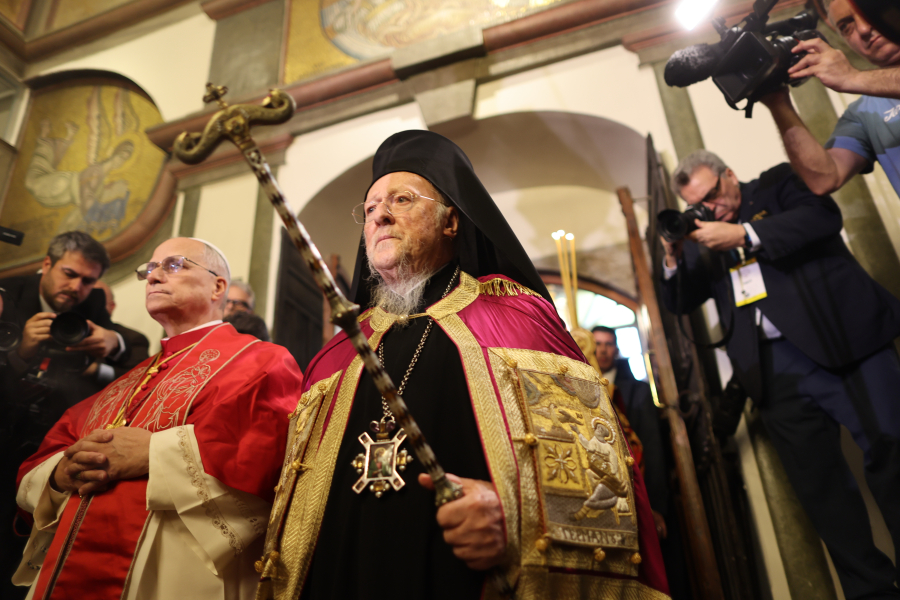
Patriarch Bartholomew and Pope Leo signed the declaration in the Throne Room of the Patriarchal House immediately after a service of thanksgiving at the Patriarchal Church of St. George.
Later on Saturday, Pope Leo presided over a large Mass for the Catholic community at Istanbul’s Volkswagen Arena.
On Sunday, he was scheduled to attend the patriarchal and synodal Divine Liturgy for the Feast of St. Andrew, founder of the Church of Constantinople, alongside Patriarch Bartholomew and Patriarch Theodore of Alexandria. The service was expected to draw hierarchs from both Churches, representatives of other Christian traditions, diplomats, and government officials.
After the liturgy, the two church leaders were to bless the faithful from the balcony of the Patriarchal House. Pope Leo is set to depart Istanbul for Beirut on Sunday afternoon, continuing the second leg of his apostolic journey.