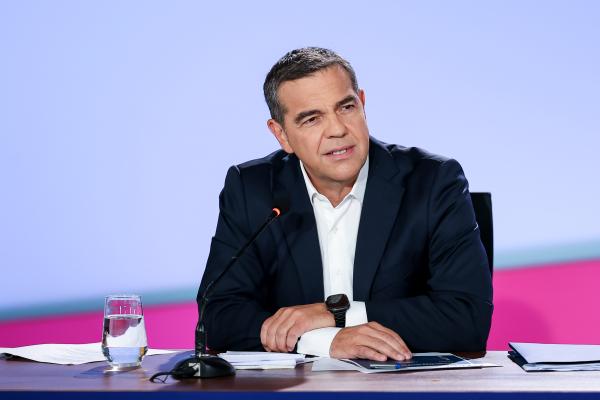
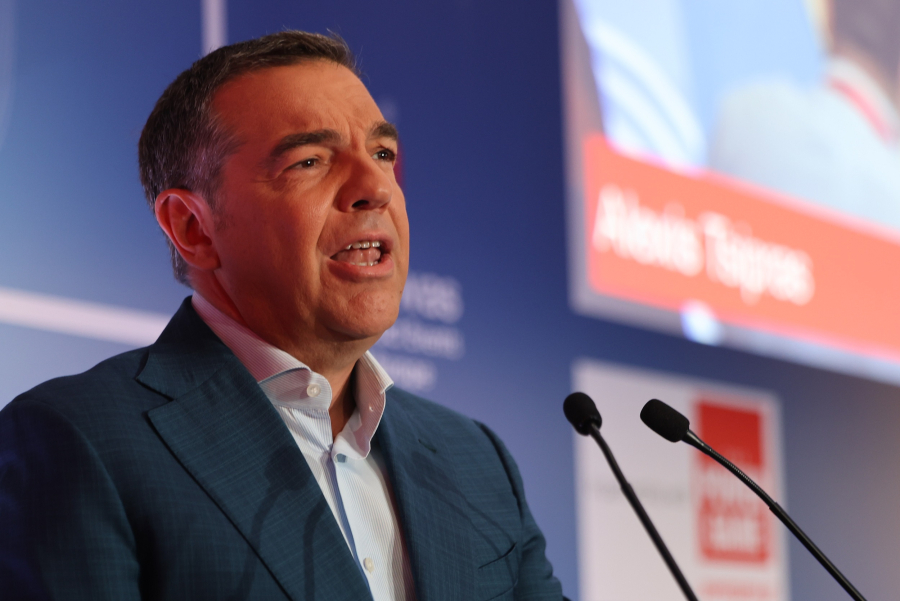

Former Greek prime minister Alexis Tsipras announced on Monday that he is resigning from parliament, formally submitting his resignation letter to House Speaker Nikitas Kaklamanis. The move brings to a close a sixteen-year parliamentary career that saw Tsipras rise from a young opposition MP to become Greece’s youngest-ever prime minister, and marks what appears to be the beginning of a new political chapter beyond the confines of SYRIZA — in line with the broader rebranding effort he has pursued over the past two years.
In a statement accompanying his resignation, Tsipras described his decision as “one of conscience,” saying that after sixteen years as MP, party leader, opposition chief and prime minister, he could no longer justify holding a parliamentary seat that, in his view, no longer served the public good.
“I resign because I cannot, and do not wish to, retain the office of MP with all its privileges when I feel that my participation—especially as a former prime minister—offers nothing of substance to those who trusted me,” he said.
Tsipras sharply criticised the current state of the Greek Parliament, claiming it has been “democratically stripped” and is unable to fulfil its constitutional role. He placed the blame on the governing majority, which he accused of undermining parliamentary accountability.
At the same time, he made clear that his resignation did not mark a retreat from public life: “I resign as a SYRIZA MP, but I do not resign from political action.”
The former prime minister described his next steps as a return “to the hopeful uncertainty of social engagement,” vowing to “listen more closely to society and its needs” rather than leading from above. Freed, as he put it, “from offices, commitments and mechanisms that no longer express society,” Tsipras framed his decision as a moral act at a moment when Greece, he said, faces a “dangerous deadlock—economic, political, geostrategic, but above all moral.”
“Hope is needed,” he said, “through actions, not words—actions that prove we are not all the same, actions that can overcome today’s impasses.” Rejecting the idea of “Messiahs or laboratory-made parties,” Tsipras reaffirmed his belief in “the power of popular movements fighting collectively for social justice” and “the will and actions of the many.”
Addressing his former political allies, he emphasised that his departure should not be seen as a rupture: “We will not be opponents,” he said. “Perhaps soon we will sail together again toward calmer seas.”
His message extended to the wider public, which he described as suffocating under a “regime of generalized corruption that breeds inequality and injustice.” Such a state of affairs, he warned, “cannot continue.” If those responsible for the democratic opposition “cannot put aside their self-interest to bring about change,” he said, “then we must all become the change we seek—to take the future into our own hands. That is worth every effort and every struggle.”
Tsipras’s resignation came just days after remarks at the Sorbonne, where he told a student that “parties are created from the bottom up, if they meet the needs of society.” Both his comments in Paris and his resignation statement are being interpreted as hints at the possible creation of a new grassroots political movement, one that could emerge from social demands rather than established party structures.
Analysts in Athens view his move as both a critique of the governing conservative New Democracy party and a subtle rebuke of his former party, SYRIZA, which has struggled with internal divisions and strategic uncertainty since his departure from its leadership. By stepping down, Tsipras frees himself from parliamentary and partisan constraints, positioning himself to reconnect directly with the electorate.