Germany’s Rheinmetall and a consortium led by India’s Kalyani Group are competing for a stake in a Greek ammunition factory, in a contest that underscores growing international interest in Europe’s efforts to expand defense production.
The two bidders have submitted offers for the Aigio plant, operated by state-owned Hellenic Defence Systems, or EAS, in southern Greece. The bids could be opened as early as Monday, with Deloitte overseeing the international tender as financial adviser.
Under the proposed structure, EAS would retain a controlling 51% stake in a new joint venture, while the winning private investor would acquire 49% and help finance the modernization and expansion of the facility.
ΔΙΑΒΑΣΤΕ ΕΠΙΣΗΣ



The Indian bid brings together Kalyani Group and GEK TERNA, one of Greece’s largest infrastructure and construction groups. Kalyani has expressed interest in the Aigio facility for some time, with executives visiting the site to assess its existing infrastructure and potential for new production lines.
Rheinmetall, meanwhile, is seeking to expand its industrial footprint in Greece as European governments increase defense spending and accelerate efforts to strengthen domestic weapons manufacturing.
The competing bids have also highlighted an unusual corporate alignment.
GEK TERNA chose to partner with the Indian group despite having established a strategic cooperation agreement in late 2025 with Rheinmetall Landsysteme, a subsidiary of the German defense manufacturer, to pursue opportunities in Greece’s defense industry.
The apparent contradiction reflects Rheinmetall’s corporate structure. The German bidder in the Aigio tender is a different subsidiary from the one involved in GEK TERNA’s existing partnership, making the two initiatives separate commercial arrangements.
Beyond the competition for ownership, the tender represents a test of Greece’s ambitions to rebuild its defense-industrial capabilities.
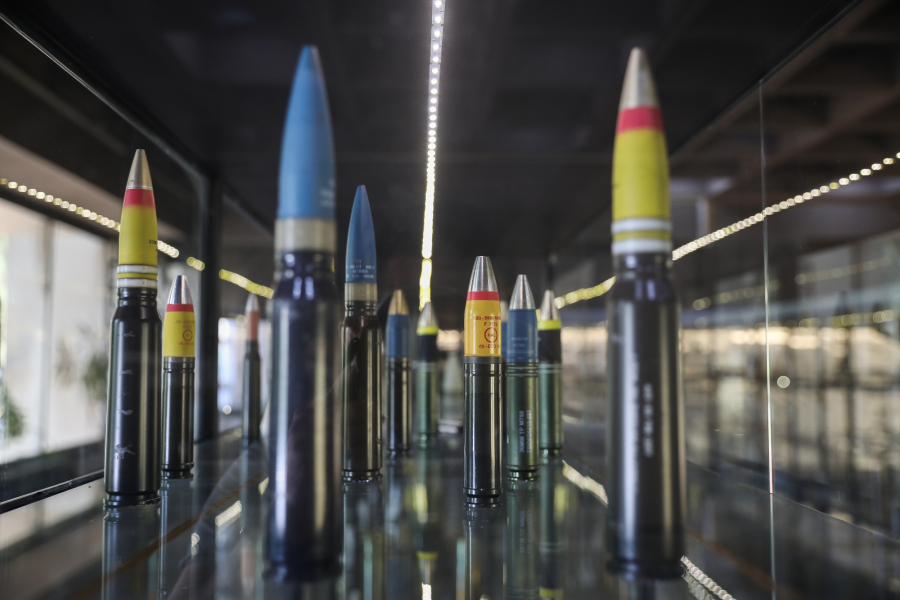
The Aigio facility is earmarked for development into a modern manufacturing center for large-caliber ammunition components, including metal projectile bodies, forging operations and cartridge-case production.
Such capabilities have become increasingly valuable as European countries seek to replenish ammunition inventories and reduce dependence on external suppliers.
For Greece, the investment offers an opportunity to integrate its domestic defense industry more closely into European supply chains while creating skilled manufacturing jobs and developing export-oriented production.
The central challenge will be whether the winning investor can translate rising demand and government-backed industrial ambitions into a commercially sustainable operation with long-term orders and competitive production costs.