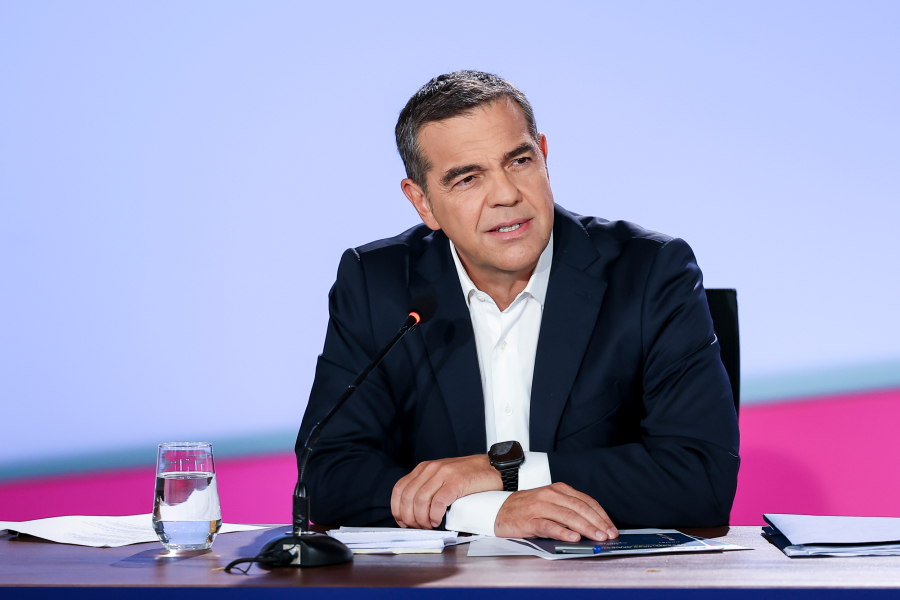
Former Greek Prime Minister Alexis Tsipras set his sights firmly on a return to power Wednesday, outlining an electoral strategy built around a direct confrontation with Prime Minister Kyriakos Mitsotakis and putting Greece’s long-running surveillance and Predator spyware scandal back at the center of the political debate.
Speaking at a press conference in Thessaloniki, Tsipras said his objective was victory at the next national election and argued that a change in government was necessary not only to address economic pressures facing Greek households but also to restore accountability over the surveillance affair.
Tsipras said he would seek to form a coalition government if his political camp wins the first mandate to do so. He also appeared comfortable with the possibility of a second election, arguing that polling shows a large majority of Greeks want political change.
ΔΙΑΒΑΣΤΕ ΕΠΙΣΗΣ


The former prime minister presented his economic program as a practical response to the concerns of ordinary households, focusing on energy security, purchasing power and public services.
Politics, he said, is ultimately judged “at the supermarket, in electricity bills” and in waiting lines at public hospitals—not simply through headline economic indicators.
But Tsipras reserved his strongest attack on Mitsotakis for the surveillance scandal, an affair that has raised questions about Greece’s intelligence services, political accountability and the use of Predator, a sophisticated commercial spyware.
He sought to turn the unresolved questions surrounding the affair into an electoral issue.
“The surveillance case is the most critical issue” for those who want politics conducted according to democratic rules, he said, arguing that it had left a stain on Greece’s democracy and rule of law.
Tsipras accused authorities of a coverup and claimed that another Mitsotakis government would mean “no investigation and no accountability.” He pledged that a government led by his political camp would allow the judiciary to investigate freely and pursue responsibility regardless of how senior those involved might be.
“In a democracy, politicians do not put other politicians in prison. That is the job of the judiciary,” Tsipras said, adding that governments nevertheless have a responsibility to allow justice to operate independently.
His economic message was similarly framed as a sharp break with Mitsotakis. Tsipras accused the prime minister of governing in the interests of powerful corporate groups, calling him the “prime minister of the cartels.”
He also defended his proposal for a “patriotic contribution,” a levy targeting the wealthiest 1% of Greeks and large companies. Tsipras cited wealth-related taxation in Switzerland and Norway and invoked Greece’s historical tradition of wealthy benefactors.
Unlike traditional philanthropy, however, he said the contribution should be imposed “through a legal rule established by the state.”
The proposal crystallizes the broader choice Tsipras wants to put before voters: between Mitsotakis’s economic and political record and a more redistributive program emphasizing household finances, public services and institutional accountability.