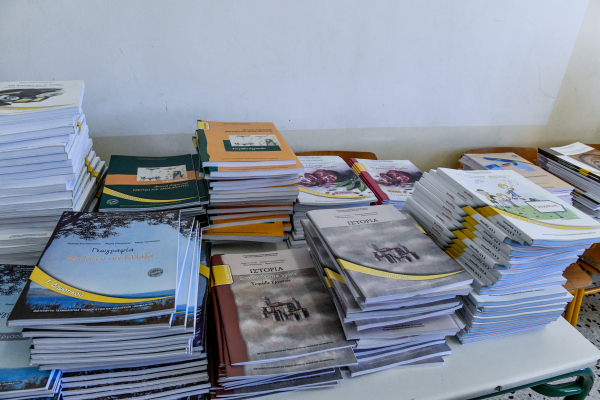

Public expenditure on education in Greece amounted to just 3.3% of gross domestic product in 2023, according to the latest data from Eurostat, the European Union’s statistical agency. Only Romania devoted a smaller share of its economy to education.
Across the EU, governments spent an average of 4.7% of GDP on education, covering everything from early-childhood programs to universities. The figure was unchanged from 2022, suggesting that education’s overall weight in European public spending remained broadly stable.
For Greece, however, the comparison underscores a sizable gap. Its spending was 1.4 percentage points below the EU average, placing the country near the bottom of the 27-member bloc at a time when investment in skills, productivity and human capital has become increasingly important to Europe’s economic competitiveness.
ΔΙΑΒΑΣΤΕ ΕΠΙΣΗΣ
Romania recorded the EU’s lowest level of public education spending, at 3% of GDP, while Malta, at 3.4%, was just above Greece. At the other end of the spectrum, northern European countries devoted considerably larger shares of their economies to education. Sweden led the EU with public education expenditure equivalent to 6.8% of GDP, followed by Finland at 6.3% and Belgium at 6.2%.
The scale of the disparity is striking. For every €100 of economic output, Greece devoted the equivalent of €3.30 to public education spending. The EU average was €4.70, while Sweden allocated €6.80. That means Sweden’s public education spending, measured relative to the size of its economy, was more than twice Greece’s. The gap between the two countries stood at 3.5 percentage points of GDP.
The broader European picture has also shifted since the pandemic. EU public expenditure on education reached 5% of GDP in 2020, the highest level recorded since Eurostat’s comparable series began in 2012. By 2023, that share had fallen by 0.3 percentage point.
The figures are particularly significant for Greece because the country spent much of the previous decade recovering from a prolonged sovereign-debt crisis that imposed severe constraints on government budgets and public investment. While the Greek economy has since returned to growth and public finances have improved, education spending as a share of GDP continues to trail most of the rest of Europe.