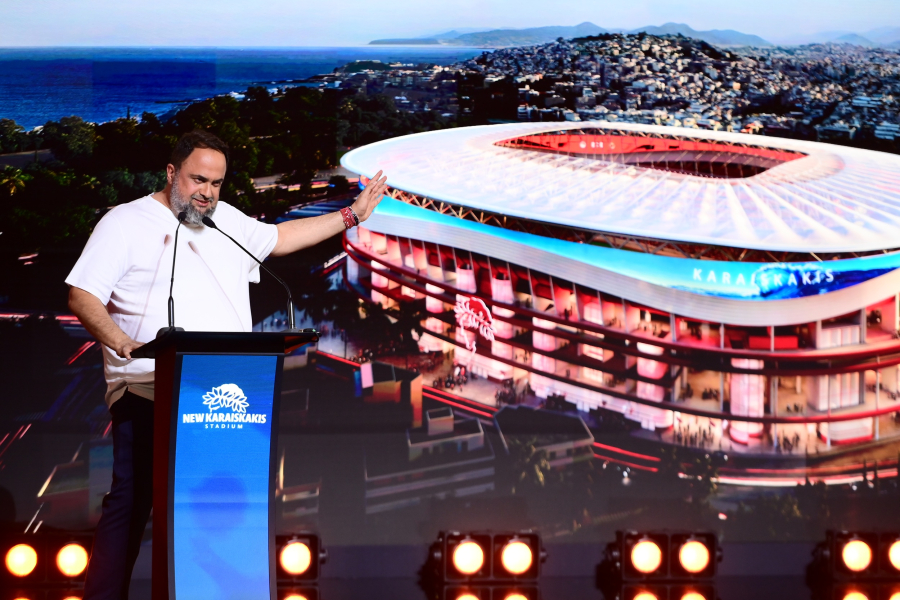

Vangelis Marinakis, the shipping magnate and owner of Olympiacos, has unveiled plans for a new Georgios Karaiskakis Stadium, a €250 million project that he says will become the Greek club's own “Theatre of Dreams” and cement its place among Europe's football elite.
Presenting the project at the Municipal Theatre of Piraeus on Thursday, Marinakis described the proposed stadium as the next chapter in the transformation of Olympiacos, the country's most successful football club and one of Europe's most decorated multi-sport organizations.
The development would create Greece's largest football stadium, with a capacity exceeding 53,000 seats, significantly expanding the current Karaiskakis Stadium and reflecting the growing demand for tickets after a string of sell-outs in recent seasons.
{https://youtu.be/wslPSwcgNG4?si=6PRzTQnoXFgPtWGq}
Marinakis said the project would be financed entirely by Olympiacos and by himself personally, emphasizing that the club is not seeking financial support from the Greek state. Instead, he called on the government to approve a legislative amendment that would allow the stadium to reach its planned height of more than 52 metres.
“If we had the regulation, we would have started in May,” Marinakis said. “The issue is that we must not remain at the model stage.”
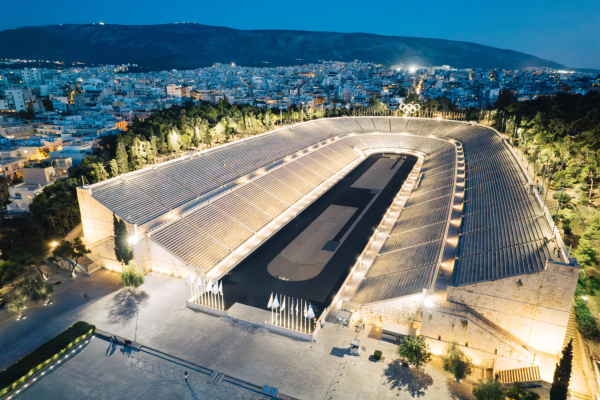
According to the club president, construction could begin immediately once the legislation is passed, allowing Olympiacos to move into the new stadium by August 2028. During the construction period, the club would temporarily relocate to Athens' Olympic Stadium for two seasons.
The project represents one of the largest privately funded investments in Greek sports infrastructure in recent decades and comes during a period of unprecedented success for Olympiacos under Marinakis's ownership.
Since taking control of the club in 2010, Marinakis has overseen a period of domestic dominance and has pushed aggressively to establish Olympiacos as a European force. The club became the first Greek side to win a major UEFA competition by lifting the Europa Conference League trophy, while its academy team won the UEFA Youth League, achievements that Marinakis cited as evidence that Olympiacos now belongs among the continent's elite clubs.
“The dreams of Olympiacos never end and they are always getting bigger,” he said. “It will become our own Theatre of Dreams.”
The reference to Manchester United's Old Trafford was deliberate. The new Karaiskakis is envisioned not simply as a football stadium but as a modern entertainment and business complex capable of hosting major international sporting and cultural events.
The venue would rise across four levels and include more than 100 luxury suites and over 5,000 square metres of premium hospitality areas, positioning it among the most sophisticated stadium developments in Southern Europe.
Plans also call for a 2,000-square-metre media centre, including a 320-seat auditorium and an additional 1,000 square metres of dedicated workspaces, designed to accommodate the demands of modern broadcasting and international events.
More than 5,000 square metres have been allocated for restaurants, cafes and fan-service areas, reflecting a broader industry trend toward turning football stadiums into year-round destinations rather than venues used only on matchdays.
The technological ambitions are equally significant. The project includes a 30,000-square-metre bioclimatic roof, renewable energy systems and advanced broadcasting, lighting and sound infrastructure. The stadium would also house two high-tech control rooms equipped with the latest operational technology.
Perhaps the most eye-catching feature is a proposed 10,000 square metres of LED screens, which the club says would create Europe's largest multi-faceted display system for football and cultural events.
The design places particular emphasis on crowd management and accessibility. Plans include 32 escalators, 60 elevators, 20 double staircases and 70 access gates spread across the four levels of the stadium, allowing spectators to move efficiently throughout the venue.
The wider redevelopment also extends beyond the stadium itself. The club says the project would include major transport interventions, thousands of new parking spaces and infrastructure improvements designed to ease access to and from Piraeus, Greece's largest port city.
Piraeus Mayor Yiannis Moralis, who also addressed the presentation, said the plans had already received unanimous approval from the city council and argued that the investment could transform the entrance to the city.
For Marinakis, however, the project carries significance beyond architecture and infrastructure. The stadium is intended as a symbol of Olympiacos' ambitions and of his broader vision for the club.
At a time when European football is increasingly defined by commercial scale and modern facilities, Marinakis is betting that a new home can help propel Olympiacos into a different category of club—one capable of competing not only in Greece but also on the continent's biggest stages.
Whether the project proceeds now depends largely on a legislative decision in Athens. But after unveiling the plans, Marinakis left little doubt about his intentions.
“This is a historic day for Olympiacos, for the city that gave birth to the club and for Greece,” he said. “Our next meeting, I hope, will be inside the new Karaiskakis.”