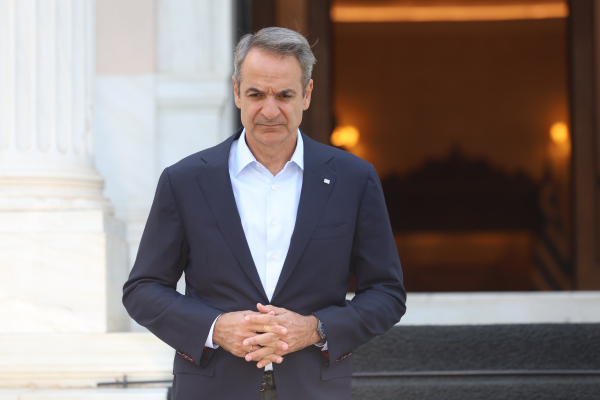

A new opinion poll in Greece has delivered troubling news for Prime Minister Kyriakos Mitsotakis and his governing conservative party, New Democracy, which has fallen to its lowest level of support since coming to power in 2019. The survey, conducted by polling company Alco and presented on Alpha television on Monday, places New Democracy at just 22.8% in voting intention, reflecting growing public frustration with both the government and the country’s institutions.
The findings suggest that many Greeks are becoming increasingly disillusioned not only with the political system, but also with the state’s ability to uphold democratic norms and the rule of law. Nearly three-quarters of respondents — 72% — said they do not believe the rule of law truly exists in Greece, while only 24% said they believe it does. Even more striking, 78% said the law is not applied equally to all citizens.
Concerns over corruption appear to dominate public sentiment. According to the poll, 82% of respondents believe corruption is one of the main obstacles preventing the proper functioning of the rule of law. Another 70% pointed to government interference in institutions, while 68% cited the failure to properly enforce laws. The results reflect a broader crisis of confidence in public institutions at a time when political tensions in Greece remain high.
The poll also highlights increasing political fragmentation. A growing share of voters now identify as undecided or open to supporting new political movements, suggesting dissatisfaction with the existing party system. Around one-third of voters are either undecided or considering backing alternative political forces.
Among opposition parties, the center-left PASOK remains in second place with 12.2%, far behind New Democracy but slightly improved from previous polling. The nationalist Greek Solution party ranks third with 8%, while the Communist Party of Greece polls at 7%. SYRIZA, the left-wing party led until recently by former Prime Minister Alexis Tsipras, continues to struggle, dropping to 3.4%.
The survey also explored hypothetical scenarios involving potential new political formations. One question examined the possibility of a political comeback by Alexis Tsipras, who governed Greece during the country’s financial crisis years. The findings suggest he still retains influence among left-wing voters, particularly former SYRIZA supporters, though public opinion remains divided over his possible return.
Another figure attracting attention is Maria Karystianou, who has emerged as a prominent public voice following the deadly Tempi rail disaster in 2023, which triggered mass protests over state accountability and safety failures. According to the poll, a potential political movement associated with her appears capable of attracting support from across the political spectrum, including some former New Democracy voters.
The results also indicate that anti-establishment sentiment is intensifying. Alco found that 61% of voters now describe their political stance as a “protest vote,” the highest level recorded even compared with the period before last year’s European Parliament elections. By contrast, only 36% of respondents appear motivated primarily by political stability.
The poll is likely to increase pressure on the Mitsotakis government at a sensitive moment, as economic concerns are increasingly being overshadowed by debates over institutional credibility, transparency, accountability, and democratic governance. Analysts say the findings suggest that public distrust — rather than economic policy alone — could become the defining issue in Greece’s political landscape over the coming months.