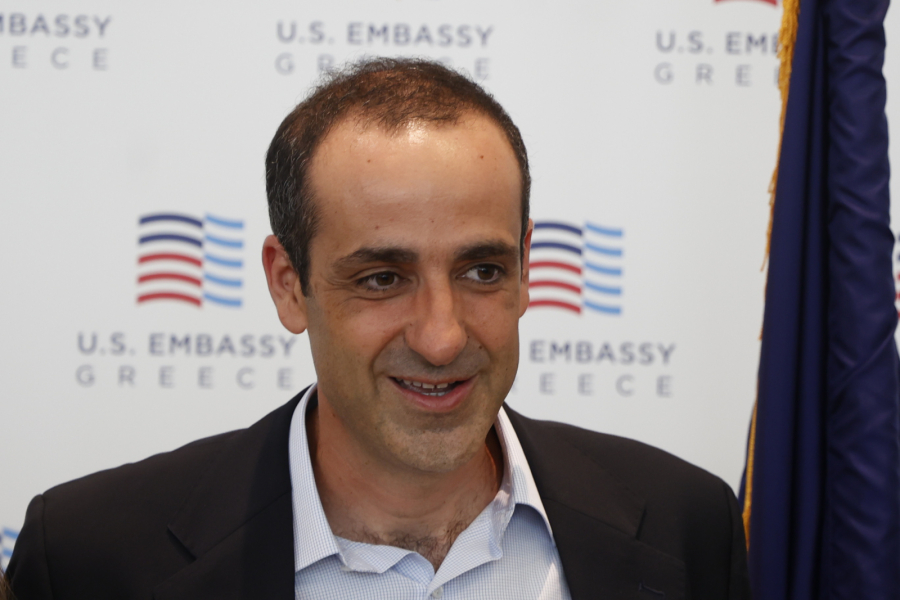

The first major public intervention by Grigoris Dimitriadis since resigning over Greece’s wiretapping scandal has reignited one of the country’s most politically toxic controversies, drawing furious reactions from opposition parties and piling fresh pressure on Prime Minister Kyriakos Mitsotakis ahead of a potentially volatile election cycle.
In an interview published Sunday in the Greek newspaper Real News, Dimitriadis — Mitsotakis’s nephew and once one of the most powerful figures inside the prime minister’s office — defended his role during the surveillance affair while portraying himself as a political scapegoat who stepped down to shield the government and the country from institutional damage.
“I assumed political responsibility in order to protect the government, the intelligence services, my political camp, but above all the homeland,” Dimitriadis said.
The remarks immediately triggered a political storm in Athens because they appeared, for the first time, to publicly frame his resignation as an act of protection for the Mitsotakis administration rather than a personal acknowledgment of wrongdoing. Opposition parties seized on the comments as an implicit admission that responsibility for the surveillance scandal reached the top levels of government.
The scandal, which has haunted Greek politics since 2022, erupted after revelations that journalists, politicians and public figures had been targeted either by Greece’s national intelligence service, the EYP, or through the Predator spyware system. Among those found to have been targeted was Nikos Androulakis, leader of the center-left opposition party PASOK-KINAL and a member of the European Parliament. The revelations sparked accusations that Greece’s conservative government had overseen an opaque surveillance apparatus operating with weak institutional oversight.
Dimitriadis resigned in August 2022, alongside the head of the intelligence service, but has largely remained silent publicly until now.
In the interview, Dimitriadis lashed out at Androulakis, accusing him of cultivating political “toxicity” and anger for partisan gain. Referring to legal disputes surrounding the surveillance investigations, he argued that critics were ignoring multiple Supreme Court rulings while elevating the opinion of a lower court judge for political reasons.
“Androulakis has chosen to practice politics in a specific way,” Dimitriadis said. “He is permanently angry and seems to feed off toxicity.”
He also accused unnamed “power centers operating behind closed doors” of orchestrating attacks against him and the government.
The language drew immediate condemnation from PASOK, which accused Dimitriadis of attempting a political comeback while remaining protected by what it described as a systematic cover-up orchestrated by the prime minister’s office.
PASOK spokesperson Kostas Tsoukalas said Dimitriadis had effectively admitted political responsibility for the illegal surveillance network while simultaneously signaling that he was no longer willing to “pay the political price in silence” on behalf of others.
The party also renewed demands for a new parliamentary inquiry into the wiretapping affair, insisting that Dimitriadis should be the first witness called to testify. In a lengthy statement, PASOK accused the government of constructing a “shadow state” of illegal monitoring operations and warned that appeals to “national security” could not justify surveillance of political opponents and journalists.
Androulakis himself escalated the rhetoric further, saying the latest developments demonstrated a “decline of the rule of law” in Greece under Mitsotakis’s leadership.
“Today we have two interviews confirming the decay of the rule of law in the country,” he said, referring both to Dimitriadis’s interview and separate comments by Christos Menoudakos, who criticized failures to implement judicial decisions connected to the scandal.
The left-wing opposition party SYRIZA also launched a blistering attack, claiming Dimitriadis had effectively implicated Mitsotakis directly by suggesting he acted under political instructions. In a statement dripping with sarcasm, the party asked whether the prime minister was remaining silent because he feared what else his nephew might reveal.
SYRIZA accused Dimitriadis of helping orchestrate a cover-up designed to protect both the ruling New Democracy party and the Mitsotakis family. It also alleged that his comments amounted to an admission that he coordinated the relationship between the intelligence services and the Predator spyware network — accusations the government has consistently denied.
The political fallout comes at a sensitive moment for Mitsotakis, whose government has sought to move beyond the surveillance affair by emphasizing economic growth, investment and geopolitical stability.
But the issue has persisted as a rallying point for the opposition and a recurring concern among European institutions and civil liberties advocates, who have questioned whether Greece’s democratic safeguards and judicial oversight mechanisms were sufficiently robust during the scandal.
Dimitriadis, however, appeared unapologetic throughout the interview, portraying himself as hardened by political warfare and warning that Greece’s political climate would become even more poisonous as elections approach.
“There is an extremely toxic atmosphere,” he said. “And it will intensify.”