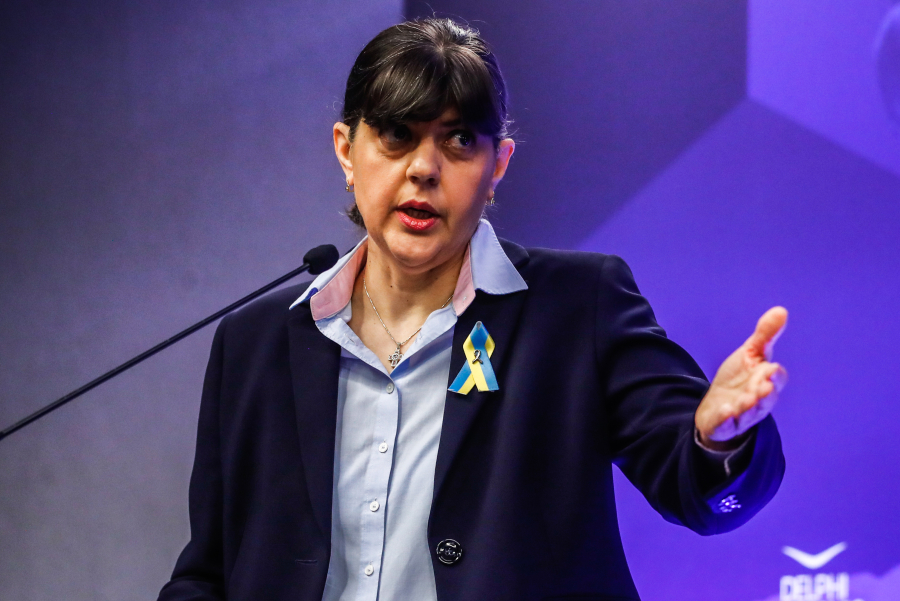

The Greek government led by Kyriakos Mitsotakis came under renewed pressure this week after unusually blunt remarks from Europe’s top prosecutor cast a harsh spotlight on alleged corruption tied to the country’s farm subsidy system. Speaking at the Delphi Economic Forum on Thursday, European Chief Prosecutor Laura Kövesi described OPEKEPE—the agency responsible for distributing European Union agricultural subsidies—as “an acronym for corruption,” accusing it of embodying “nepotism and clientelism.” She said her office’s investigation has faced obstacles and political pressure, raising concerns about interference in a case involving the use of EU funds.
Her remarks sharply contradicted recent statements by Greek Health Minister Adonis Georgiadis, who had defended the practice of political mediation as part of lawmakers’ role and argued that the European probe risks undermining democratic processes. In comments that drew criticism, Mr. Georgiadis suggested that what investigators are scrutinizing falls within the “job description” of elected officials. He later added, with sarcasm, that “as long as Ms. Kövesi allows it, we still have democracy.”
Ms. Kövesi rejected that framing, saying the debate is being deliberately diverted from the central issue. “The real question is what happened at OPEKEPE and who is responsible,” she said, stressing that the conduct outlined in the case file constitutes criminal offenses under both Greek and European law. “No one can convince me that corruption is part of politicians’ job description—anywhere in Europe.”
The investigation, led by the European Public Prosecutor’s Office, involves allegations of misuse of EU agricultural funds and has already prompted procedures to lift parliamentary immunity for several Greek lawmakers. Ms. Kövesi emphasized that such steps are procedural and do not imply guilt but are necessary to allow investigators to gather evidence and question political figures.
She also dismissed claims that her office has selectively released information about the case, calling such accusations unfounded. Instead, she argued that attempts to question the integrity of the investigation are part of a broader effort to shift attention away from the substance of the allegations.
In a pointed comparison that resonated beyond Greece, Ms. Kövesi criticized what she described as inconsistencies in how financial crimes are treated across the European Union. She said she was struck by provisions in Greece that can allow individuals accused of fraud to avoid harsher penalties by returning misappropriated funds, calling for a more uniform application of justice across member states.
The comments triggered a wave of political reactions in Athens. Opposition leader Nikos Androulakis said the prosecutor’s statements exposed deep institutional weaknesses, while former prime minister Alexis Tsipras argued that such revelations would have led to a resignation in other European countries. Former senior official Evangelos Venizelos warned that government attacks on the European prosecutor risk appearing as interference with judicial authorities. Left-wing opposition party SYRIZA said the case concerns serious criminal conduct rather than routine political practices, echoing Ms. Kövesi’s insistence that clientelism and favoritism cannot be normalized within democratic systems.