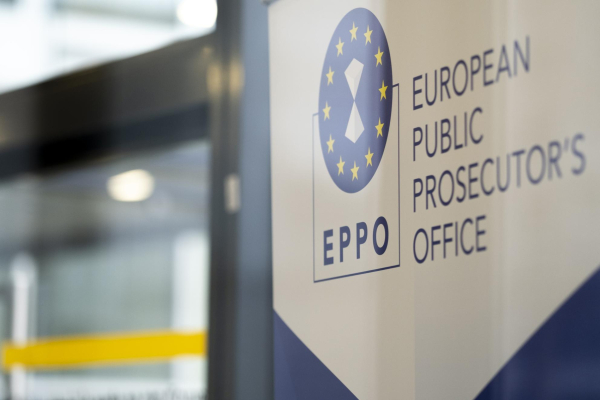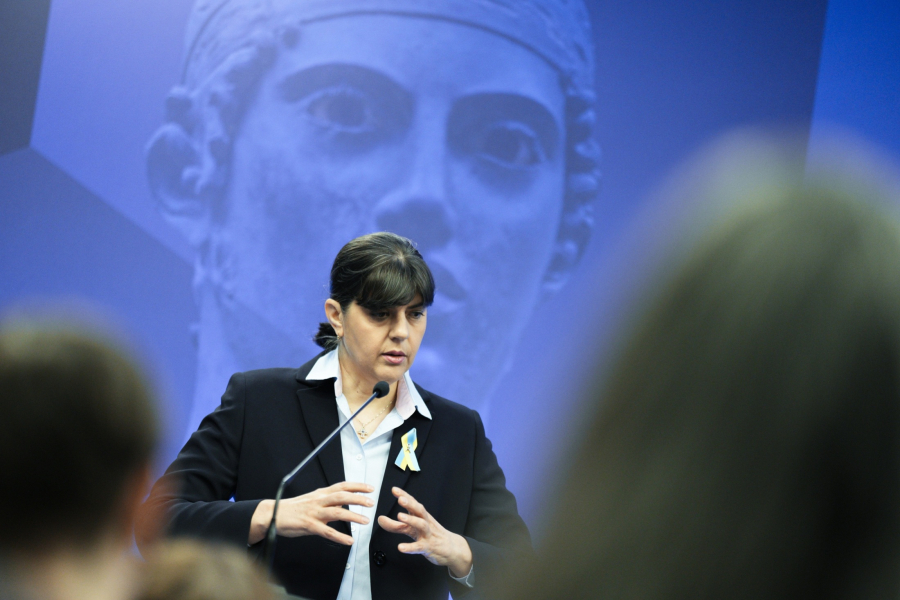
ATHENS — A dispute is escalating between Greece and the European Public Prosecutor’s Office (EPPO), after European Chief Prosecutor Laura Kövesi formally raised concerns with the European Commission over recent legal and judicial developments that she says risk weakening the EU body’s independence and effectiveness in the country.
In a letter sent to Brussels, Kövesi warned that recent legislative changes adopted by the Greek government, alongside decisions by national judicial authorities, could hinder EPPO’s ability to investigate and prosecute crimes involving EU funds and broader financial interests of the bloc.
At the centre of the confrontation is a fast-track amendment introduced by Greece’s Justice Minister Giorgos Floridis, which changes criminal procedures for felony cases involving members of parliament. The amendment establishes a special judicial process under which investigations involving politicians would be handled by a senior appellate investigating judge.
EPPO argues that the rushed amendment negatively affects its operational capacity in Greece, raising concerns over whether the office can continue to pursue cases falling under its jurisdiction without interference or procedural constraints.
The European prosecutor’s concerns extend beyond the legislation itself. Kövesi also criticised a recent decision by Greece’s Supreme Judicial Council not to fully recognise a November 2025 decision by EPPO’s governing College to renew the mandates of three European Delegated Prosecutors in Greece for five years.
The issue is particularly sensitive because delegated prosecutors are the backbone of EPPO operations at national level, conducting investigations on behalf of the EU body while operating within domestic judicial systems.
According to EPPO, the developments raise “serious doubts” over Greece’s adherence to the EU principle of sincere cooperation under Article 4(3) of the Treaty on European Union — language that signals an unusually sharp institutional warning from one EU body toward a member state.
The Greek government has moved quickly to reject suggestions of institutional conflict.
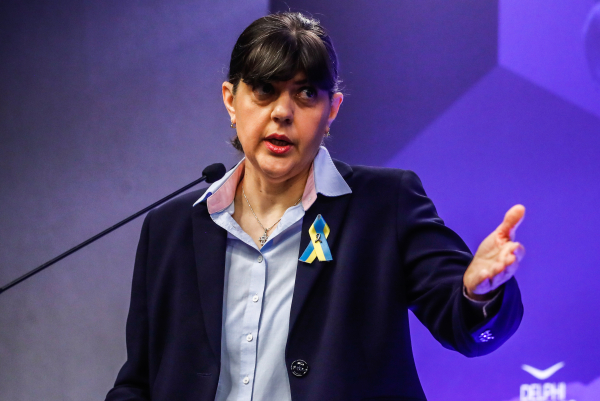
Officials from the Ministry of Justice pointed to public comments made by Kövesi during the Delphi Economic Forum in April, arguing they demonstrate that EPPO had been consulted and was aware of the planned reforms.
Government sources noted that Kövesi had publicly acknowledged meetings with Greek ministers regarding both additional resources for investigations and possible legislative initiatives aimed at accelerating judicial procedures.
“I understood that they wanted to do something to accelerate the procedure. I truly welcome that. And I agree that we need to do something,” Kövesi had said at the time.
Athens argues these remarks undermine claims that EPPO was blindsided by the reforms, insisting there had been substantive exchanges between the two sides.
Still, the disagreement risks adding Greece to a growing list of member states facing scrutiny over rule-of-law issues and institutional independence, even as the country seeks to project an image of political stability and judicial modernisation.
The controversy has already spilled into domestic politics. Opposition figures and critics of the government argue the legislative changes create unequal treatment between politicians and ordinary citizens by introducing separate judicial procedures for elected officials.
Among them, Theoni Koufonikolakou, head of public relations at INAT, argued that lawmakers should not receive more favourable treatment than ordinary citizens during criminal investigations, describing such an approach as incompatible with equal application of the law.
EPPO, created in 2021, serves as the EU’s independent prosecutorial authority and is responsible for investigating crimes affecting the bloc’s financial interests, including fraud, corruption and misuse of EU funds. Its intervention in Greece now sets up what could become a broader institutional test of how far national governments can reshape domestic legal frameworks when EU prosecutorial powers are involved.