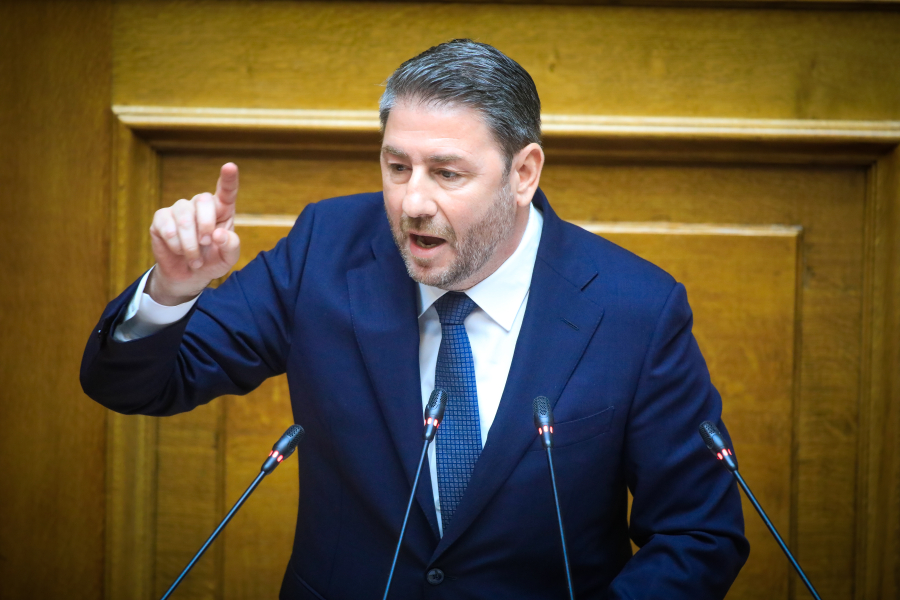
Greece’s wiretapping scandal, which has increasingly become one of the most damaging controversies facing Prime Minister Kyriakos Mitsotakis’ government, deepened further on Friday after parliament rejected an opposition proposal to launch a new inquiry into the affair.
The vote exposed both the political tensions surrounding the case and the divisions inside parliament, as only 161 of Greece’s 300 lawmakers took part in the ballot. Opposition parties boycotted the vote and walked out of the chamber in protest, arguing that the procedure had been altered to prevent the investigation from moving forward.
The proposal, submitted by opposition party PASOK, sought the creation of a parliamentary inquiry committee to examine new developments in the surveillance scandal, which involves allegations over the use of Predator spyware and the monitoring of politicians, journalists, military officials and other public figures.
ΔΙΑΒΑΣΤΕ ΕΠΙΣΗΣ

The motion was ultimately rejected with 155 votes against and six in favor. All 155 votes opposing the proposal came from lawmakers of the governing New Democracy party, while the six votes supporting it came from five MPs of the small opposition party Course of Freedom and independent MP Nikos Papadopoulos.
The central dispute focused on the voting threshold required to approve the inquiry. PASOK argued that 120 votes — equivalent to two-fifths of parliament — were sufficient, while the government maintained that the case involved national security matters and therefore required an absolute majority of 151 MPs.
New Democracy justified its position by citing constitutional provisions related to national security, defense and foreign policy. Opposition parties accused the government of changing its interpretation of the rules in order to block further scrutiny of the scandal.
PASOK leader Nikos Androulakis, who himself was among those targeted in the surveillance operation, accused the government of manipulating parliamentary procedures to shield the prime minister’s office. He argued that the government was “moving the goalposts” out of fear and said PASOK would not “legitimize the theatre of the absurd” by participating in what it viewed as an illegitimate process.
SYRIZA leader Sokratis Famellos described the procedure as a “clear parliamentary coup,” claiming the government was attempting “at all costs” to bury the truth surrounding the surveillance affair. He argued that the government had previously maintained the case involved only private individuals, but was now invoking national security solely to raise the approval threshold and block the inquiry.
Communist Party (KKE) leader Dimitris Koutsoumbas accused the government of turning the concealment of scandals into a routine practice, telling New Democracy lawmakers: “You wake up every morning asking yourselves what we have to cover up today.” He said his party would not legitimize what it considered an unlawful procedure and joined the parliamentary walkout.
Smaller opposition parties, including Greek Solution, NIKI, New Left and Course of Freedom, also denounced the move, collectively accusing the government majority of carrying out another episode in what they described as the cover-up of the surveillance scandal.
Former prime minister Antonis Samaras, a prominent figure within New Democracy who has repeatedly criticized Mitsotakis in recent months, also launched a sharp attack from parliament. He questioned why the government was now invoking national security after previously insisting the affair involved only private individuals.
Samaras raised questions over whether the surveillance material could still be in foreign hands and asked why the state had not fully investigated the case despite court developments and testimony suggesting possible links between spyware operators and state actors. He warned that the handling of the affair risked humiliating democratic institutions and said the day would be remembered as “another link in a chain of opacity.”
The issue has become particularly sensitive because the government had not invoked national security arguments in 2022, when parliament approved an inquiry into the same wiretapping affair using the lower 120-vote threshold.
As the controversy continues to grow, political pressure on Mitsotakis appears to be mounting. The prime minister’s European reformist image has increasingly come under strain over accusations that his government sought to obstruct investigations into the surveillance affair, which concerns wiretapping operations allegedly carried out between 2020 and 2022 using Predator spyware. The scandal has proven especially damaging because Greece’s National Intelligence Service (EYP), which reported directly to the prime minister after Mitsotakis placed it under his office’s supervision following his election in 2019, has remained at the center of the controversy. With new revelations, court developments and mounting political attacks, the pressure surrounding the prime minister and his handling of the affair continues to tighten.