Greece’s opposition is weighing its most aggressive move yet against Prime Minister Kyriakos Mitsotakis as the country’s wiretapping scandal returns to the center of political life, reviving questions over surveillance, institutional accountability and the rule of law nearly four years after the affair first erupted.
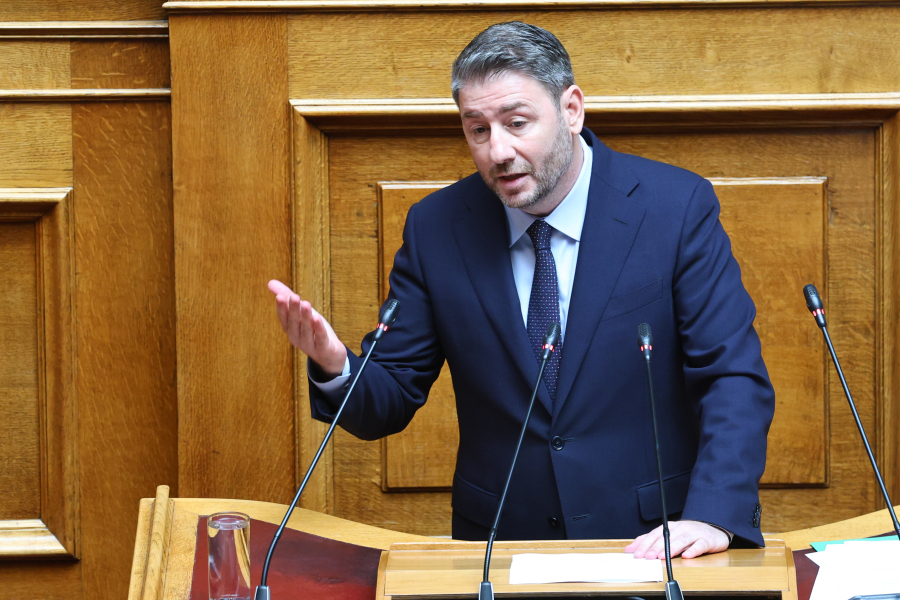
PASOK leader Nikos Androulakis is keeping the threat of a no-confidence motion alive after a fresh confrontation in Parliament over his surveillance by Greece’s intelligence service exposed new contradictions and reignited accusations of a cover-up.
The immediate trigger is the government’s expected rejection of PASOK’s request to establish a new parliamentary inquiry into the wiretapping affair. Opposition officials believe Mitsotakis’ ruling New Democracy party will invoke national security grounds and require an absolute majority of 151 MPs for approval — a threshold PASOK argues amounts to changing the rules to block scrutiny.
For Androulakis, the stakes are personal as well as political.
The PASOK leader himself was among those placed under surveillance by Greece’s National Intelligence Service (EYP) while serving as an MEP and campaigning for the party leadership in 2021. The revelation triggered one of the biggest political crises of Mitsotakis’ first term, prompting resignations at the intelligence service and inside the prime minister’s office, but never fully disappearing from Greek politics.
Now the issue has resurfaced after a tense appearance by EYP chief Themistoklis Demiris before Parliament’s institutions and transparency committee. According to PASOK officials, Demiris acknowledged he had never seen documents explaining the reasons behind Androulakis’ surveillance and suggested that requests related to monitoring operations are at times communicated orally. Androulakis reacted sharply. “Stop insulting our intelligence,” he told the intelligence chief, according to party sources, accusing him of evasion and institutional contempt.
The exchange touched the core question that has haunted the scandal since its emergence: why was the leader of Greece’s center-left opposition monitored in the first place?
Androulakis has repeatedly demanded access to the full file concerning his surveillance, arguing Greece’s Council of State — the country’s highest administrative court — ruled that monitored individuals must have access not only to authorization decisions but also to the underlying justification.
PASOK says EYP has still refused to provide those documents.
“Why are you refusing to comply with the explicit ruling of the Council of State?” Androulakis asked Demiris during the hearing, warning he may initiate legal proceedings against the intelligence chief personally.
He framed the standoff in broader terms, arguing the government’s handling of the affair is damaging Greece internationally and undermining confidence in state institutions.
The confrontation widened further after Supreme Court prosecutor Konstantinos Tzavellas declined to appear before the parliamentary committee, citing separation of powers concerns. Androulakis called the decision “completely unjustified,” arguing senior judicial officials have a duty to contribute to parliamentary oversight.
Behind the procedural battle lies a larger strategic dilemma for PASOK.
Party officials are reluctant — for now — to immediately trigger a no-confidence vote. A three-day parliamentary showdown could allow Mitsotakis to regroup his party at a sensitive political moment and reframe the debate around stability.
Yet PASOK also risks appearing hesitant after repeatedly describing the government’s actions as an institutional deviation.
“If this is a democratic and institutional issue, then every constitutional instrument must remain on the table,” one senior party figure said privately.
The timing is equally complicated. Opposition officials acknowledge that a parliamentary escalation could struggle for public attention amid competing events and a fragmented opposition landscape increasingly shaped by new political movements.
Still, PASOK sees an opportunity.
As pressure grows on the government, Androulakis is attempting to position himself not simply as an opposition leader but as the standard-bearer of institutional accountability and rule-of-law politics — issues that have repeatedly drawn international scrutiny toward Greece in recent years.
Whether that culminates in a no-confidence motion may depend on what happens next in Parliament.
For now, the message from PASOK is clear: if the government blocks a new inquiry into the wiretapping affair, the political conflict will move to a higher level.