
France’s newly adopted cultural restitution law could open the way for the return of several Parthenon fragments held by the Louvre to Greece, according to an analysis published in Le Monde by Greek lawyer and CNRS researcher Katerina Titi.
The legislation, approved by the French parliament on 7 May and hailed by supporters as a landmark reform, establishes a legal framework for the return of cultural artefacts deemed to have been unlawfully acquired. While much of the public debate in France has focused on the restitution of African heritage objects following President Emmanuel Macron’s 2017 pledge to address colonial-era collections, Titi argues that the law may also have implications for contested antiquities from the ancient Mediterranean world.
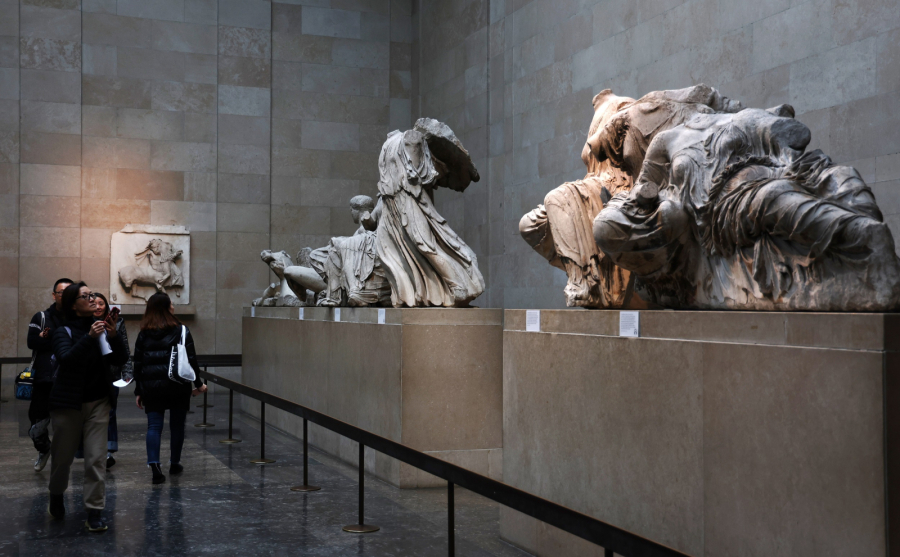
Among the most sensitive cases are fragments from the Parthenon, the fifth-century BC temple on the Acropolis in Athens, parts of which remain dispersed across major museums and collections worldwide.
The Louvre holds several Greek antiquities believed to originate from the monument, including confirmed and possible Parthenon fragments. Titi argues that some of these objects could fall within the scope of the new legislation.
The law, however, comes with significant restrictions. It applies only to objects acquired after 1815 and excludes artefacts obtained through archaeological sharing agreements or scientific exchanges.
According to Titi, provenance research will be central to determining whether any objects qualify for restitution.
“To understand the law’s true reach, detailed investigation into the history of each archaeological object is necessary,” she writes, adding that such efforts are often complicated by gaps in archival documentation.
Her article focuses in particular on fragments linked to Louis-François-Sébastien Fauvel, the French painter, diplomat and antiquarian who worked in Ottoman-controlled Athens in the late 18th century on behalf of the French ambassador.
Fauvel’s activities have long attracted controversy. Titi cites instructions reportedly given to him by his employer urging him to take whatever could be removed from Athens and its surrounding territory.
One fragment associated with Fauvel — the so-called Ergastines slab, part of the Parthenon frieze — entered French public collections in 1792 after being seized during the French Revolution. Because it became state property before the law’s 1815 cut-off date, it appears to fall outside the new framework.
Another fragment, however, may present a different case. A metope depicting a centaur and a Lapith figure was acquired by the Louvre in 1818 through an auction, placing it after the threshold established by the legislation.
Several other fragments linked to the Parthenon entered the museum even later, including sculptural heads acquired in the late 19th and early 20th centuries.
Titi suggests that only one architectural fragment associated with the monument entered French collections before 1815, potentially leaving other pieces open to legal scrutiny.
She also raises a broader question over whether the decisive factor should be the date of looting or the date an object entered public collections.
French law, she notes, defines unlawful acquisition not only as theft or plunder but also as obtaining an object from someone without legal title to transfer it.
That interpretation could broaden the debate around objects removed long before 1815 but incorporated into state collections later.
The process remains far from automatic. French national museums, including the Louvre, retain a role in approving any removal of objects from their collections.
Even where the law does not apply, returns remain possible through separate legislation adopted on a case-by-case basis.
The debate over Parthenon sculptures and fragments has intensified internationally in recent years. The Vatican, Italy and Heidelberg University have all returned fragments from their collections to Athens, while pressure continues over the larger collection held by the British Museum in London.
Titi argues that France, which maintains close diplomatic ties with Greece, could choose a similar path even beyond the provisions of the new law.
“Public collections must critically examine the provenance of their holdings,” she writes, “whether they concern colonial-era objects or archaeological artefacts.”