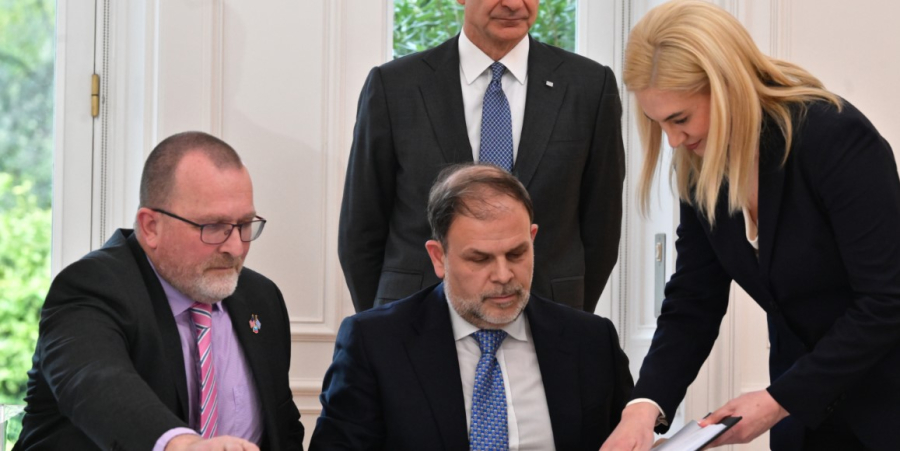

Greece is moving into the implementation phase of its national hydrocarbons program following the signing of lease agreements between the Greek state and a consortium led by Chevron and HELLENiQ ENERGY.
The agreements are being signed on Monday at the prime minister’s office in Athens, in the presence of Prime Minister Kyriakos Mitsotakis, and grant exclusive rights for the exploration and potential production of hydrocarbons in offshore areas south of the Peloponnese and the island of Crete.
The four contracts linked to Chevron’s exploration plans have already been cleared by Greece’s Court of Audit and are now entering the parliamentary ratification process. Once approved, geophysical and seismic surveys will begin, with completion expected by 2026. If the schedule is maintained, Chevron’s survey vessels are expected to collect seismic data in waters south of the Peloponnese and Crete by the autumn of that year. At the same time, a drilling rig leased by Energean and currently operating in Israel is expected to be redeployed to the Ionian Sea for the first exploratory well at the “Asopos 1” target.
This geological structure is believed to contain a carbonate reservoir at a depth of around 4,000 meters below the seabed, with estimated potential reserves of up to 280 billion cubic meters of natural gas.
Under the terms of the agreements, minimum guaranteed spending for the first phase of exploration, which includes two-dimensional seismic surveys, exceeds €20 million. A second phase involving three-dimensional seismic data acquisition предусматриes investment of €24 million, while a third phase focused on exploratory drilling is expected to require around €100 million.
The seismic surveys are scheduled for late 2026 and will cover an area of approximately 47,000 square kilometers. In the offshore zone south of Crete, which is the primary focus of the U.S. company’s interest, at least nine geological structures have been identified as having elevated prospects for commercially viable hydrocarbon deposits.
The agreements are being signed at a time when major U.S. energy companies are expanding their international footprint, driven by Washington’s emphasis on “American energy dominance.”
ExxonMobil and Chevron have been increasing their presence across the Middle East, Africa, and the Eastern Mediterranean, securing agreements in Iraq and holding talks with countries including Algeria, Azerbaijan, and Kazakhstan, while also signalling interest in a potential return to Libya.
The development comes against the backdrop of shifting regional dynamics. Just days before Chevron’s senior management arrived in Greece, the company signed a cooperation agreement with Turkey for joint oil and natural gas exploration. Under that deal, Turkey’s state-owned Turkish Petroleum Corporation will work with Chevron on seismic surveys and drilling projects, part of Ankara’s broader strategy to boost domestic energy production. The timing of the agreement also coincides with an improvement in relations between the United States and Turkey.