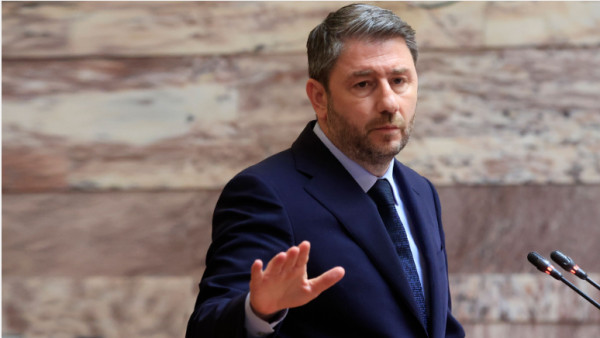

Greek opposition leader Nikos Androulakis, head of PASOK–Movement for Change, is in Strasbourg, where the European Parliament’s plenary session on Wednesday is set to debate Greece’s wiretapping scandal involving the use of illegal spyware.The debate was requested by Giannis Maniatis, head of the PASOK–KINAL delegation to the European Parliament and vice-president of the Socialists and Democrats Group. The initiative comes amid recent developments in Greece concerning the use of the Predator spyware, which has become the focus of an ongoing political and judicial controversy over unlawful surveillance.
In a statement PASOK–KINAL said that court proceedings had revealed what it described as a direct connection between individuals accused of operating the Predator spyware and Greece’s National Intelligence Service (EYP), as well as links to the ruling New Democracy government. According to the party, the court’s decision effectively reopens the wider wiretapping investigation, since prosecutors have been asked to examine the possible involvement of additional suspects and potential criminal offenses, including espionage.
PASOK–KINAL also noted that the request for a debate in the European Parliament, which was supported by the Socialists and Democrats Group, was rejected only by the European People’s Party—of which Greece’s ruling New Democracy is a member—and the far-right Identity and Democracy group, which includes Germany’s Alternative for Germany party.
While in Strasbourg, Androulakis is scheduled to meet with Iratxe García Pérez, leader of the Socialists and Democrats Group in the European Parliament.
Meanwhile, a lawyer representing victims of the Predator spyware has raised on Tuesdaya new argument that could broaden the legal implications of the case. Zacharias Kesses suggested that the surveillance of former Greek foreign minister Nikos Dendias may amount to espionage.
In a post on social media, Kesses said that Dendias was targeted with Predator spyware on April 20, 2021, while serving as Greece’s foreign minister. On that same day, Dendias was accompanying then defence minister Nikos Panagiotopoulos on an official visit to Saudi Arabia. During the visit, Greece and Saudi Arabia signed an agreement governing the presence of Greek armed forces in the country and agreed to deploy a Greek Patriot missile battery to protect critical energy infrastructure from terrorist threats. A memorandum of understanding with the Gulf Cooperation Council was also signed, and the trip was described at the time as being of major geostrategic significance.
Kesses argued that the fact the foreign minister’s phone was allegedly targeted with spyware during such a sensitive diplomatic mission could meet the legal definition of espionage, since it may involve the exposure of confidential state information. Under Greek law, state secrets include information restricted to a limited group of officials and classified in order to protect the country’s territorial integrity, defence capability, international relations or economic interests.
The lawyer also highlighted the personal relationship between Panagiotopoulos and businessman Giannis Lavranos, who has been convicted at first instance in the wiretapping case. In the same post, Kesses published the message that was allegedly used to infect Dendias’s phone with the Predator spyware.