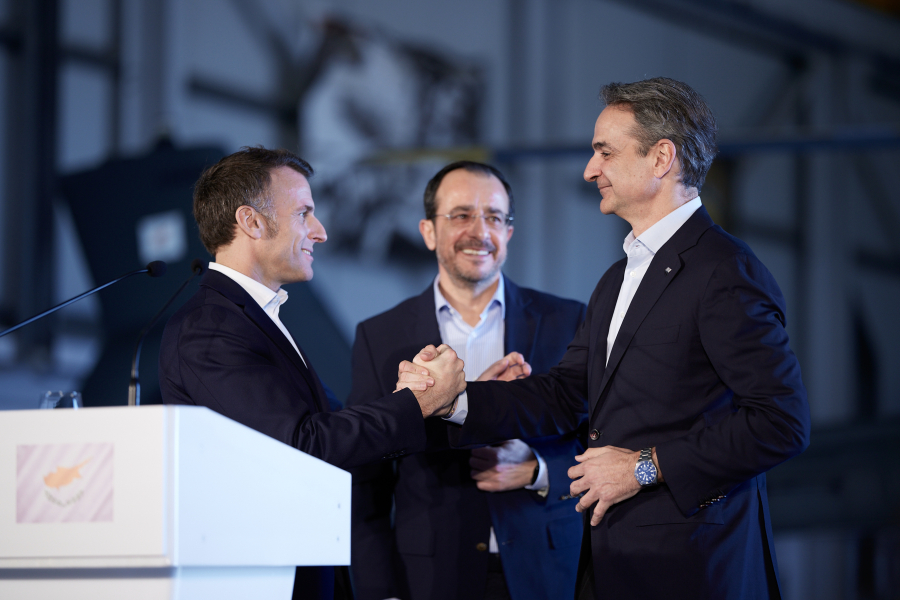

The joint appearance of French President Emmanuel Macron, Greek Prime Minister Kyriakos Mitsotakis, and Cypriot President Nikos Christodoulides in Paphos on Monday was designed to send a strategic message far beyond Cyprus. At the center of that message was Macron’s stark warning that “an attack on Cyprus is an attack on Europe,” a statement that elevates the island’s security from a regional issue to a broader European concern.
The meeting comes at a moment of heightened tension in the Eastern Mediterranean and the wider Middle East, with the war dynamics involving Israel, Hezbollah and Iran raising fears of spillover effects across the region. Cyprus, due to its geographic proximity to the Middle East and its role as an EU member state located at the bloc’s southeastern frontier, has increasingly become both a strategic hub and a potential vulnerability for Europe.
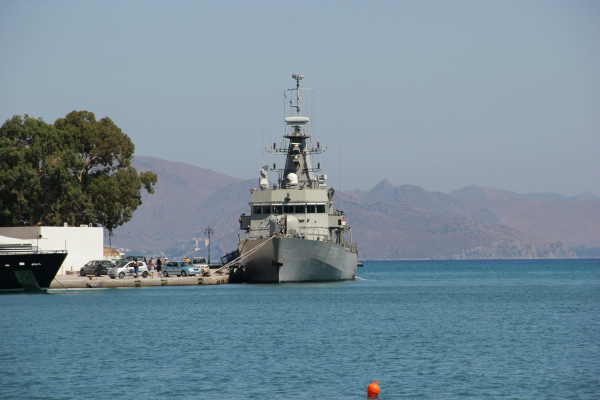
Against this backdrop, the coordinated presence of Greek and French military assets around Cyprus appears intended to serve both as reassurance and deterrence. Greece has already deployed two frigates and four F-16 Viper fighter jets to the island, while France has reinforced its presence with a frigate, an air-defence system and the nearby deployment of the aircraft carrier Charles de Gaulle. These moves underscore the growing security cooperation between Athens, Paris and Nicosia, a trilateral relationship that has gradually expanded over the past decade.
For Greece, the deployment also reflects the longstanding political and historical link with Cyprus, which Athens views as inseparable from its own strategic environment. Mitsotakis framed the move as a defensive action aimed at protecting an EU member state while demonstrating that bilateral and European defence agreements have practical consequences. In effect, Athens is highlighting that the EU’s mutual defence clause — often criticized as largely symbolic — can translate into tangible military support.
France’s role in the crisis is equally significant. Macron has consistently sought to position France as the European power most willing to project military force in support of EU strategic interests. By linking Cyprus’ security directly to that of Europe, Paris reinforces its broader argument that Europe must develop greater strategic autonomy and be prepared to act collectively when regional stability is threatened.
At the same time, the rhetoric from all three leaders suggests a careful balancing act. While emphasizing deterrence and solidarity, they also repeatedly stressed that their actions are defensive and aimed at preventing escalation. Macron’s call for Hezbollah to halt attacks on Israel and for Israel to avoid further strikes in Lebanon reflects concern that a widening conflict could destabilize the entire Eastern Mediterranean.
Cyprus itself is attempting to maintain a delicate position. President Christodoulides reiterated that the island is not participating in military operations and continues to focus on a humanitarian role, particularly in facilitating assistance to the Middle East. However, the presence of allied military forces on its territory inevitably places Cyprus closer to the center of regional security calculations.
The broader strategic message from the trilateral meeting is that developments in the Middle East are increasingly viewed by European leaders as directly affecting European security — not only through military risks but also through potential disruptions to energy supplies, shipping routes and migration flows. The reference to safeguarding navigation in the Strait of Hormuz illustrates these wider concerns, given the strait’s critical role in global energy markets.
Ultimately, the meeting in Cyprus reflects a gradual shift in how Europe approaches its southeastern neighborhood. Rather than treating instability in the Middle East as a distant crisis, European governments — led in this case by France and Greece — are signaling that they see the region as directly connected to Europe’s strategic interests. Whether this emerging posture translates into a more coherent European security policy remains uncertain, but the message from Paphos was clear: Cyprus is being framed as both a frontline state and a symbol of European solidarity in an increasingly volatile region.