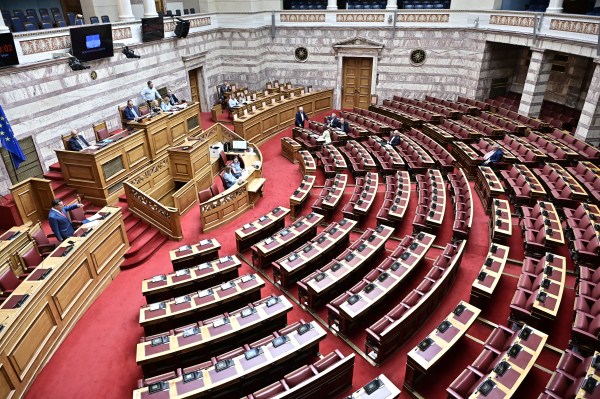


The European Parliament held a debate on Wednesday on the issue of illegal surveillance in Greece linked to the Predator spyware, following recent judicial developments and amid ongoing concerns about the rule of law in the country. The discussion was initiated by the Socialists and Democrats group after a court ruling vindicated Nikos Androulakis, the leader of Greece’s PASOK party, who had been targeted by the illegal spyware while serving as a Member of the European Parliament.
Speaking on behalf of the European Commission, Commissioner Wopke Hoekstra addressed the broader problem of spyware across the European Union, stressing that any unlawful attempt to access citizens’ data -including that of journalists and political opponents - is unacceptable. He said the Commission is closely monitoring the issue and includes it in its annual Rule of Law reports, particularly in relation to institutional oversight and the protection of journalists.
Referring specifically to Greece, Hoekstra noted that according to the European Commission’s 2025 Rule of Law report, the country has yet to issue a presidential decree intended to strengthen protections for the privacy of communications against surveillance software. He also pointed out that the Commission’s annual assessments refer to judicial investigations that cleared Greek state services and officials of responsibility for the use of Predator, as well as to inquiries conducted by independent bodies such as the Hellenic
Data Protection Authority and the Authority for the Security and Privacy of Communications.
The commissioner emphasized that independent authorities play a key role in maintaining the system of checks and balances that safeguard the rule of law, and that they must be able to operate independently and with sufficient resources. At the same time, he underlined that the European Union already has a strong legal framework designed to protect citizens from the illegal use of spyware through legislation governing data protection and the privacy of communications.
Hoekstra explained that EU privacy rules prohibit the monitoring or interception of communications without the user’s consent except in limited circumstances, while data protection regulations require that personal data be processed lawfully and transparently. He also stressed the importance of distinguishing between the illegal use of spyware and the legitimate use of surveillance tools by law enforcement authorities in the context of criminal investigations.
According to Hoekstra, such tools can only be considered lawful under strict conditions: when their use is non-discriminatory, justified by an overriding public interest, proportionate, and fully compliant with the EU Charter of Fundamental Rights. Additional protections for journalists are included in the European Media Freedom Act, which stipulates that journalists cannot be targeted with spyware because of their professional activities unless there is an exceptional public interest and prior judicial authorization.
The debate in the European Parliament quickly turned into a political confrontation among Greek members of the chamber.
Giannis Maniatis, a Greek MEP from PASOK and the Socialists and Democrats group, argued that the recent court ruling on the surveillance scandal confirms the opposition’s long-standing allegations. He said four individuals were convicted in connection with the case and that the judicial process has opened new avenues of investigation, including the possibility of espionage charges. Maniatis also raised questions about a potential link between Greece’s National Intelligence Service and the Predator software, claiming that attempts had been made to cover up aspects of the case and that several key questions remain unanswered.
Kostas Arvanitis, a left-wing Greek MEP, was even more critical. He referred to the conviction of four individuals—two Greeks and two Israelis—who received combined prison sentences exceeding 120 years for their role in illegal surveillance activities. According to Arvanitis, the ruling has also prompted an investigation into espionage and concerns a number of individuals who were allegedly targeted, including politicians and journalists such as Androulakis. He argued that ultimate responsibility lies with the office of the Greek prime minister and accused the parliamentary majority in Greece of preventing a full investigation into the affair.
Criticism of the Greek government also came from Emmanouil Fragkos, a member of the nationalist Greek Solution party. He argued that discussions about the rule of law in Greece cannot overlook cases such as the surveillance scandal and other controversies which, in his view, raise serious questions about the functioning of democratic institutions. Fragkos suggested there are indications of a cover-up and questioned the independence of the judiciary, noting that the leadership of the country’s highest courts is appointed by the government.
Responding on behalf of the governing New Democracy party, Greek MEP Dimitris Tsiodras rejected the opposition’s accusations, saying they were attempting to turn the European Parliament into a stage for domestic political disputes. He argued that the Greek judiciary had imposed severe penalties on those responsible for illegal surveillance, which, he said, demonstrates that democratic institutions are functioning properly. Tsiodras also referred to a ruling by Greece’s Supreme Court stating that no state bodies were involved in the use of the Predator software.
Another Greek MEP, Nikolaos Anadiotis of the conservative NIKI party, described the surveillance scandal as a “deep wound for democracy.” He argued that the Predator case represents one of the most serious recent tests for the rule of law within the European Union and called for the creation of a European regulatory framework governing spyware, as well as an international investigation into its use.