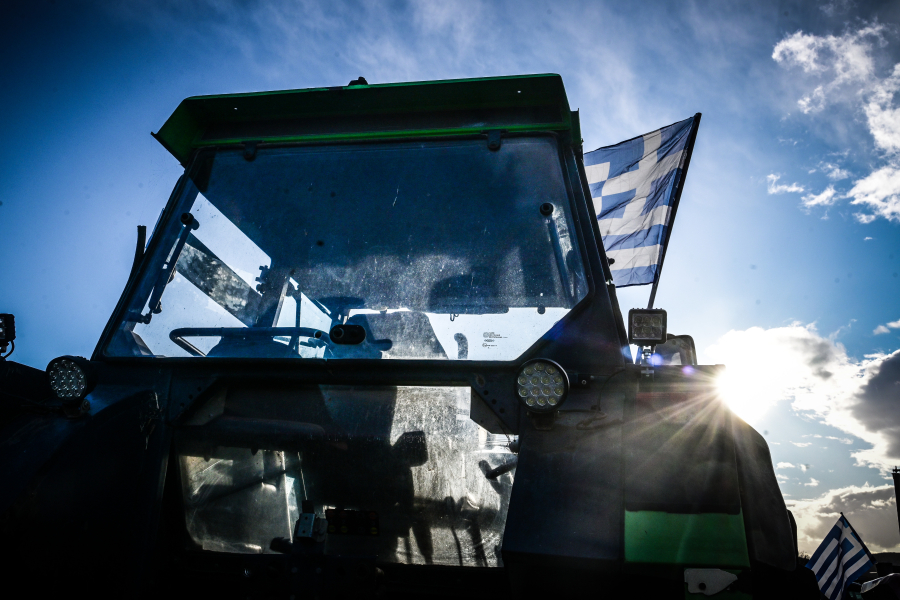
While several farmer associations and protest groups signaled openness to dialogue, including a request for a meeting with the Prime Minister, the dominant reaction on the ground has been one of dissatisfaction, with demonstrators arguing that the measures fall short of their demands.
According to a letter sent by 18 farmer roadblocks and agricultural associations to the Minister of Rural Development and Food, Kostas Tsiaras, there is support for direct talks with the Prime Minister.
However, farmers and livestock breeders across the country say the six measures announced were already expected and do not address the structural problems threatening their livelihoods.
At the northern border crossing of Promachonas, one of Greece’s key trade gateways, farmers decided to intensify their actions following a general assembly. The crossing will remain closed to freight trucks for 48 hours, from Thursday at noon until Saturday at noon, a move expected to disrupt cross-border transport.
Similar decisions were taken at the Bralos roadblock in central Greece, where farmers announced that tractors from neighboring regions would reinforce the protest. From Thursday morning, demonstrators plan to shut down all roads in the area. Farmers there have also unanimously called for a meeting with the Prime Minister, insisting that additional financial support must be discussed beyond what was announced by the government.
In southern Greece, the Coordinating Committee of the Laconia roadblock confirmed that protests will continue and intensify, in line with decisions taken during a nationwide farmers’ meeting earlier this month. Road closures are planned on key national routes near Sparta, while farmers from Laconia will also support a 48-hour blockade at the Nestani toll station in the Peloponnese.
Elsewhere, reactions to the government’s announcements were similarly critical. In Boeotia, farmers said the measures were met with concern and skepticism. On the Patras ring road in western Greece, both farmers and livestock breeders maintained a hard stance, saying the announcements failed to meet expectations and offered little in terms of immediate relief.
In Aetolia-Acarnania, livestock breeders from the Angelokastro protest site announced plans to block the Ionian Motorway and its service roads starting early Thursday morning, with additional closures planned at key junctions in the region. In northern Greece, farmers and livestock breeders staged a symbolic two-hour blockade of the Thessaloniki–Moudania highway near Nea Triglia, signaling broader mobilizations ahead.
Protesters argue that the detailed implementation of the government’s measures does not provide meaningful solutions to the rising costs, debt burdens, and income instability facing Greece’s agricultural sector. General assemblies are being held across the country to determine next steps, as a coordinated 48-hour nationwide escalation is expected to begin imminently. Farmer representatives say they are determined to continue their mobilizations until substantial and sustainable support measures are secured.
The government’s proposals were presented at the Ministry of Rural Development and Food by Agriculture Minister Kostas Tsiaras, alongside Deputy Prime Minister Kostis Hatzidakis, Digital Governance Minister Dimitris Papastergiou, and Deputy Finance Minister Thanos Petralias. Many of the measures had been largely pre-announced in recent days.
Mr. Tsiaras emphasized that 98 rural development projects with a combined budget of approximately €1 billion are currently underway, along with five major irrigation projects financed through public-private partnerships, worth an additional €500 million. He also highlighted that Greece recorded a positive agricultural trade balance for the first time since 1984, with agri-food exports exceeding €11.2 billion, accounting for nearly a quarter of the country’s total exports.
The measures include tax reductions on agricultural inputs such as animal feed and fertilizers, cuts to property taxes for farmers in small rural communities, and a system allowing farmers to receive fuel tax refunds directly at the pump through a digital verification process. Electricity prices for agricultural use are set to be reduced, while new frameworks have been introduced to restructure non-performing loans held by farmers and agricultural cooperatives. Additional provisions include targeted financial aid for grain and cotton producers, extended maternity benefits for female farmers, and changes to the national agricultural insurance system to increase compensation without raising premiums.
Deputy Finance Minister Thanos Petralias explained that the fuel tax refund system will rely on a mobile application that verifies farmers’ eligibility in real time at fuel stations, with the system expected to be operational in late 2026. Digital Governance Minister Dimitris Papastergiou announced a national product traceability initiative that will introduce barcodes on all Greek products, allowing consumers to track origin from production to retail.
Addressing concerns over subsidy payments, Deputy Prime Minister Kostis Hatzidakis said that €3.82 billion in agricultural payments were made in 2025, acknowledging a one-month delay that he said was necessary to avoid penalties from the European Union. He noted that thousands of tax identification numbers are currently under review as part of cross-checks and audits, arguing that stricter oversight will lead to fairer distribution of subsidies. According to Mr. Hatzidakis, the government believes that a majority of the farmers’ demands are being addressed, a claim that protest leaders continue to dispute.