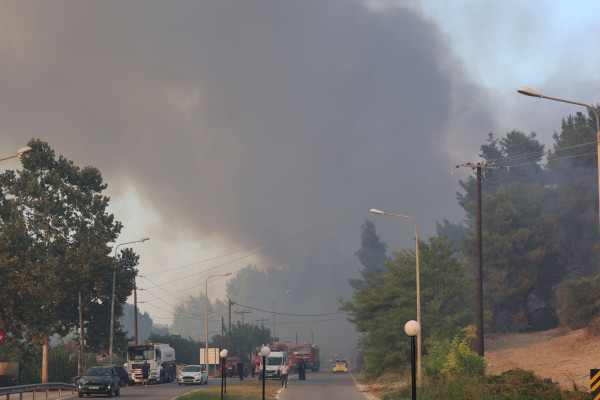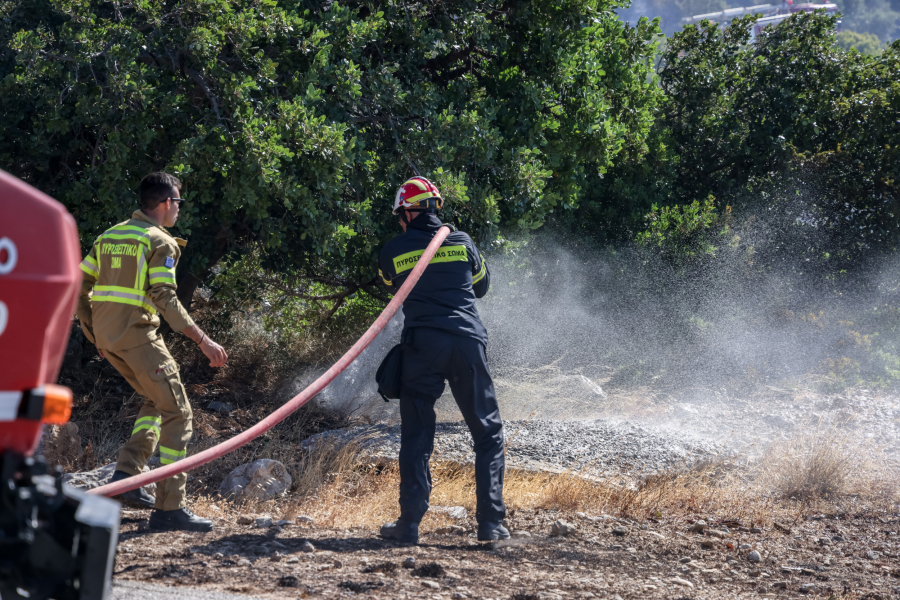

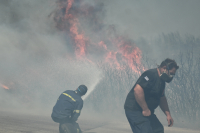
Wildfires driven by powerful winds tore across several Greek islands and parts of the mainland on Thursday, burning homes and farmland, forcing evacuations and reaching one of Crete’s best-known natural landmarks as authorities struggled to contain multiple fronts during the height of the Mediterranean fire season.
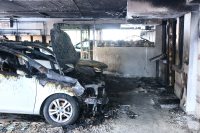
The most serious blaze was in the southern part of Rethymno, a regional unit on the island of Crete, where flames reached the palm forest of Preveli, a protected landscape near the island’s southern coast. Images from the area showed fire moving through the grove and nearby olive trees, adding an environmental loss to a fire that had already damaged agricultural land, livestock facilities and homes.
Greek fire authorities said 296 firefighters, including 15 specialized forest-fire units, were operating around Krya Vrysi and Asomatos in Rethymno with 66 vehicles. Sixteen emergency alerts were sent through Greece’s 112 public-warning system ordering or advising residents to leave threatened areas.
ΔΙΑΒΑΣΤΕ ΕΠΙΣΗΣ
Strong winds repeatedly revived fire fronts
Strong winds, in some locations exceeding 100 kilometers an hour, repeatedly revived fire fronts and complicated aerial firefighting. Local reports described gusts reaching exceptional intensity on Crete, while thick smoke reduced visibility and turbulence made water drops difficult or at times impossible.
The fire had burned for a second day after spreading rapidly through rural communities south of the city of Rethymno. Authorities declared the municipality of Agios Vasileios, which includes Preveli, in a state of emergency. By Thursday evening, an initial estimate indicated that about 45,000 stremmas- roughly 11,100 acres, or 4,500 hectares - had burned across Crete during July 29 and 30.
The human cost has also been severe. Three firefighters died while responding to fires that broke out Wednesday in different parts of Greece. Two were killed during operations in the Rethymno area, while a third firefighter, 27, died after collapsing while working at a fire near Gytheio in the southern Peloponnese. Greece’s Fire Service paid tribute to the men and said crews across the country remained on general alert.
Emergency operations continued around Preveli on Thursday evening. Greece’s Coast Guard said eight people were rescued by sea and taken toward the port of Agia Galini. A Coast Guard vessel and a Frontex boat remained in the area. A 71-year-old man suffering minor burns was transported to Rethymno General Hospital.
The crisis was not confined to Crete. On Paros, a popular Cycladic island in the Aegean Sea, a major fire flared again in the southern part of the island. Police closed access roads as flames approached populated areas near Trypiti. Ground crews and aircraft were deployed, though high winds again hindered operations. Fires were also reported on Andros, Lesbos, Kalymnos and other parts of the country.
The outbreak underscores Greece’s vulnerability to fast-moving summer wildfires, particularly on islands where narrow road networks and the need to transport reinforcements by sea or air can delay deployment. Authorities said firefighters had been transferred from Athens, western Greece and Thessaloniki to reinforce local crews.
With much of Greece facing a very high fire-risk forecast for Friday, the Fire Service warned that conditions could become still more difficult. In strong winds and dry summer vegetation, officials said, even a small ignition can quickly become a major fire.
For Preveli, the damage carries particular symbolic weight. The palm-lined river gorge, opening onto the Libyan Sea, is one of Crete’s most distinctive landscapes. On Thursday evening, it became another measure of the scale of Greece’s latest summer of fire.