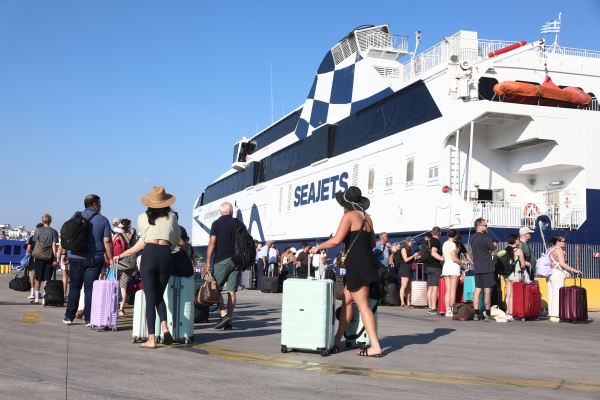


Greece’s tourism sector is showing early signs of strain as international passenger traffic at Athens International Airport slipped into decline in April, underscoring the growing impact of geopolitical tensions in the Middle East on European travel demand.
Passenger traffic through Athens International Airport, the country’s largest aviation hub and a key gateway for foreign visitors, rose just 1% in April from a year earlier to 2.74 million travelers, according to airport data released this week. The modest increase masked a more concerning trend beneath the surface: international passenger traffic fell 0.9%, marking the first contraction after months of uninterrupted growth.
The downturn comes as escalating instability in the Middle East begins to weigh on consumer confidence and travel flows across the broader region, raising concerns for Greece, one of Europe’s most tourism-dependent economies. Industry executives and analysts increasingly see April’s figures as an early warning sign ahead of the peak summer season.

Domestic travel continued to provide some support, with passenger numbers on internal routes rising 6.1% year over year, helping offset weaker international demand. Still, the latest data suggest that the rapid post-pandemic rebound that fueled record tourism revenues in recent years may be losing momentum.
The slowdown represents a sharp shift from the strong start to 2026. Passenger traffic at the Athens airport rose 8.6% in January and 13.2% in February before growth eased to 3.8% in March, signaling a gradual cooling trend that became more pronounced in April.
Even so, overall traffic for the first four months of the year remained firmly positive. From January through April, the airport handled 9.02 million passengers, up 5.9% compared with the same period last year. International traffic during the period still posted a 5.5% increase, while domestic traffic rose 6.8%.
Airlines have so far maintained their commitment to the Greek market despite mounting geopolitical uncertainty. Total flights at Athens International Airport increased 5.3% during the first four months of the year to 77,039. International flights rose 5.2%, suggesting carriers are continuing to preserve seat capacity in anticipation of sustained summer demand.
For Greece, where tourism accounts for roughly a quarter of economic output directly and indirectly, any sustained weakening in international arrivals could have broader implications for growth, employment and consumer spending. The country has emerged as one of Europe’s strongest-performing tourism markets since the pandemic, benefiting from strong demand from the U.S., Western Europe and the Middle East.
Whether April proves to be a temporary setback or the beginning of a broader slowdown may depend largely on how geopolitical risks evolve in the coming months. For now, the latest figures suggest that turbulence beyond Greece’s borders is beginning to ripple into one of the country’s most critical industries.