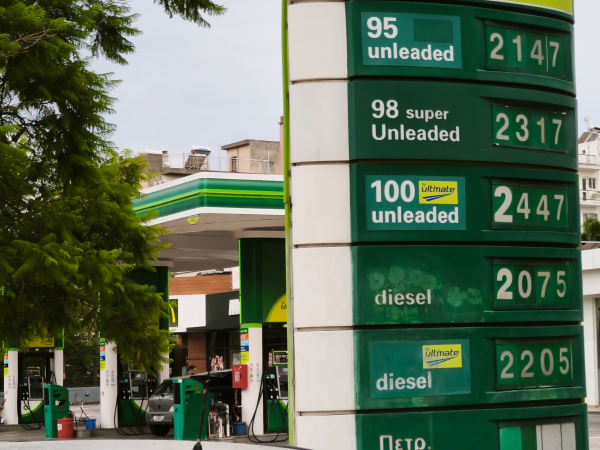
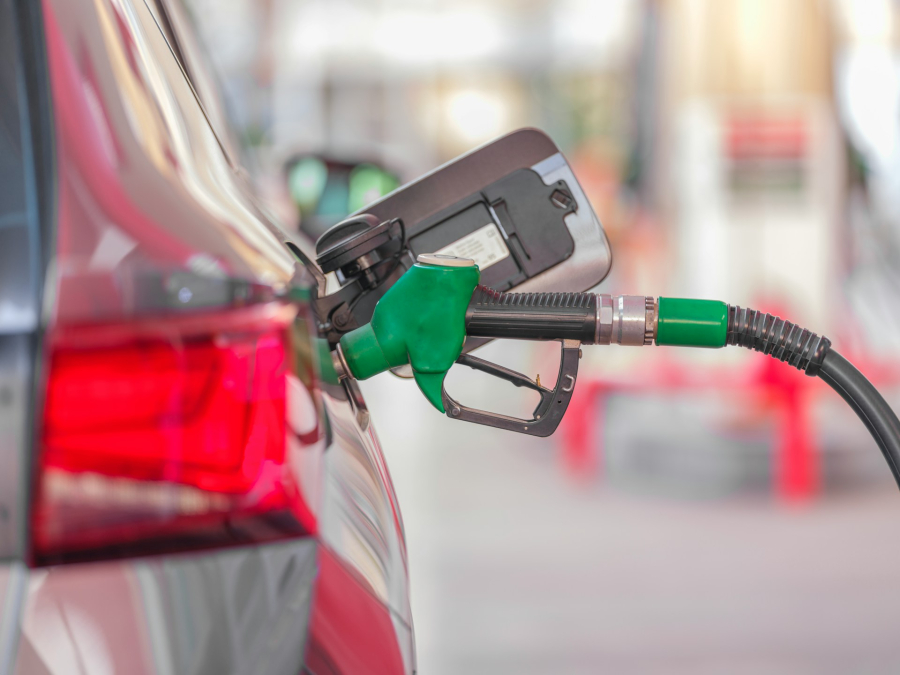

The Greek government is preparing a support package worth about €300 million for April and May 2026 to offset the impact of rising fuel prices following the Middle East crisis, choosing targeted subsidies rather than broad tax cuts on fuel. The policy reflects a broader debate in Greece and across Europe about how governments should respond to energy price shocks without undermining public finances.
According to the government’s economic team, measures such as the fuel pass subsidy are more effective than reducing fuel taxes, because they provide targeted support mainly to lower-income households and professionals most affected by rising energy costs. A general reduction in excise duty or value-added tax, officials argue, would benefit all consumers, including higher-income households with greater fuel consumption, making it a less targeted and more expensive policy.
However, the discussion over fuel taxation has intensified again after European Commission data showed that Greece still ranks among the EU countries with relatively high excise duties on both petrol and diesel. The issue has become politically sensitive as fuel prices remain high and inflationary pressures persist.
Finance Minister Kyriakos Pierrakakis recently argued that subsidies provide greater relief than a reduction in excise duty. He said excise duty on diesel is about €0.41 per litre and could be reduced to roughly €0.33 per litre under EU rules, implying a possible reduction of around €0.08 per litre. By contrast, the government’s subsidy measures correspond to an estimated benefit of around €0.20 per litre. For petrol, he said excise duty stands at roughly €0.70 per litre and could be reduced to €0.359 per litre, while current subsidies reach about €0.36 per litre and in some cases, such as on Greek islands, up to €0.43 per litre.
Yet data from the European Commission suggest the situation is more complex than this comparison indicates. Commission figures show that excise duty in Greece is approximately €700 per 1,000 litres for petrol and €410 per 1,000 litres for diesel, placing the country among the higher-tax jurisdictions in the European Union.
One key issue concerns the claim that EU legislation effectively sets minimum excise duty levels at around €0.359 per litre for petrol and €0.33 per litre for diesel. In practice, however, some EU countries appear to apply lower effective tax levels. Portugal, for example, has diesel excise duty of roughly €0.31 per litre, suggesting that the European framework allows some flexibility through exemptions, transitional arrangements or different national implementations of EU legislation.
Another important issue is the comparison between fuel subsidies and excise duty reductions, which are fundamentally different economic tools. Excise duty is a permanent tax embedded in the price structure of fuel, while a subsidy is a temporary fiscal measure funded by the state budget that covers part of the price without changing the tax system itself. Therefore, comparing a temporary subsidy per litre with a permanent tax reduction does not involve equivalent policy measures but rather different approaches to economic policy.
European Commission data also show that Greece remains among the countries with relatively high excise duties on both petrol and diesel compared with several other EU member states. Countries such as Cyprus, Portugal, Spain, Slovenia and Croatia have lower excise duties on petrol, while for diesel Greece’s tax level is higher than in countries including Portugal, Slovenia, Slovakia, Estonia and Spain.
The debate over whether subsidies or tax cuts are the more effective tool to address rising fuel prices is therefore likely to continue, as governments try to balance consumer relief, fiscal stability and European regulatory constraints in an environment of continued energy price volatility.