The escalating military tensions involving the United States, Israel and Iran are opening a new period of uncertainty for Greece’s economy, at a time when the country had been trying to regain stability after years of overlapping crises. While the conflict is unfolding far from Greek territory, its economic repercussions could quickly reach the country through higher energy prices, inflationary pressure and disruptions to key sectors such as tourism.
Energy sits at the center of the risk. The effective closure of the Strait of Hormuz and the disruption of global oil and natural gas flows have revived fears of a new energy shock. That shock could ripple through inflation, consumer spending, production costs and investment decisions across Europe, with Greece particularly exposed because of its reliance on imported energy. Brent crude recently closed at $92.69 per barrel, marking the largest weekly increase in years. International analysts now warn that prices could climb toward $100 or higher if the crisis persists.
For Greece, the implications are significant because the country’s economic planning for 2026 was built on much lower energy assumptions. The state budget was based on an average oil price of around $62 per barrel, economic growth of about 2.4% and inflation near 2.2%. If oil remains above $90 and natural gas prices stay elevated, those projections could quickly become unrealistic.
A scenario already examined by policymakers suggests that if oil prices rise by about $40 per barrel and remain there throughout 2026, Greece’s growth rate could slow to roughly 1.9%. Private consumption would likely weaken and investment plans could be delayed. The economy would still expand, but at a slower pace and under greater pressure on household incomes.
Greek consumers are already seeing the first signs of the shock at fuel stations. Domestic fuel prices have begun to rise, with unleaded gasoline increasing by up to ten euro cents per liter within a single week. Average prices have now exceeded €1.80 per liter, and further increases are expected if global oil markets remain volatile.
The impact of higher fuel costs goes well beyond motorists. Fuel acts as a multiplier across the entire economy because it affects transportation, production and distribution. When transport costs rise, they feed into the price of raw materials, manufactured goods and services, eventually reaching retail prices. Past crises have shown that even moderate increases in fuel costs can trigger wider inflationary pressures, particularly in periods of market uncertainty.
The food sector is watching developments closely. For now, widespread price increases on supermarket shelves have not yet materialized, but the risk is growing. Higher energy prices tend to spread gradually throughout the entire supply chain, from agricultural inputs and food processing to storage, refrigeration and logistics.
Many food products operate on thin profit margins, leaving companies with little room to absorb rising costs. If the crisis in the Middle East persists, the pressure could soon translate into higher prices for basic food items. Greek authorities have already placed monitoring mechanisms on alert in an effort to prevent profiteering or unjustified price hikes, but when the source of pressure is energy costs, controlling inflation becomes far more difficult.
The concern among economists is not only about higher prices but about the possibility that inflation could become more persistent. If the spike in energy prices proves temporary, the economy may absorb part of the shock. If it lasts for months, however, higher costs could begin to affect wages, expectations and everyday pricing behavior, creating a broader inflationary cycle.
Within the financial sector, Greek banks appear better prepared to handle external shocks than in the past. Over the last decade they have strengthened their capital buffers, improved liquidity and dramatically reduced non-performing loans. Bank executives therefore believe the current geopolitical crisis does not pose an immediate threat to financial stability in Greece.
Even so, the sector will not be immune if the energy shock continues. Higher inflation could delay or reverse expectations of monetary easing in Europe, creating a more complex environment for lenders. Rising interest rates may support revenues from existing loans tied to floating rates, but they can also reduce demand for new borrowing, slow credit expansion and complicate corporate investment plans.
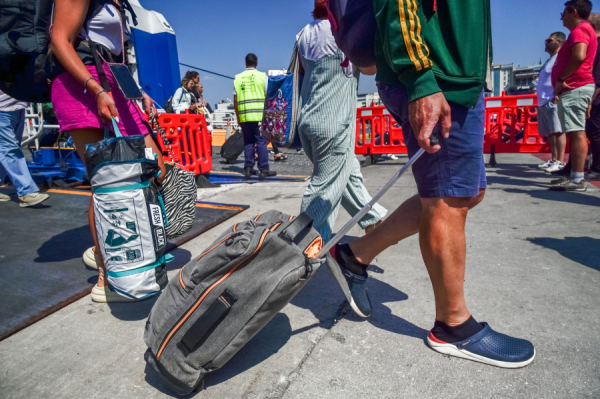
Tourism, one of Greece’s most important economic pillars, may also feel the effects of geopolitical instability even though the country itself remains far from the battlefield. Greece is entering the 2026 tourism season after an exceptionally strong year in 2025, when the country welcomed nearly 43 million international visitors and generated more than €23.6 billion in tourism revenue. Early bookings for the upcoming summer had initially pointed to another strong season.
However, the crisis in the Middle East is introducing new uncertainties. Disruptions to international aviation routes are already increasing costs and causing delays, particularly for travelers passing through major Middle Eastern airline hubs. At the same time, global travelers often perceive the entire Eastern Mediterranean as a single geopolitical region, meaning instability elsewhere can influence perceptions about destinations that remain safe.
Industry analysts believe the greatest vulnerability lies in long-haul tourism, cruise travel and luxury packages that combine multiple destinations in the region. By contrast, traditional mass tourism from Europe—supported by direct flights and established tour operators—appears more resilient so far. Major travel companies report that Greece continues to rank among the most sought-after destinations for summer 2026, even as some demand shifts toward western Mediterranean resorts and the Canary Islands.
Ultimately, the economic impact on Greece will depend largely on how long the geopolitical crisis lasts. If tensions ease relatively quickly and global energy flows stabilize, the effects on the Greek economy could remain manageable. If the conflict drags on, however, the country could face a more difficult combination of expensive energy, rising inflation, weaker consumption and cautious investment.
In recent years Greece has shown greater resilience to external shocks than in the past, thanks to stronger fiscal management and a healthier banking sector. Yet the country remains vulnerable to global energy disruptions. When energy prices surge and geopolitical tensions spread uncertainty across markets, the consequences inevitably reach households and businesses—regardless of how far away the conflict itself may be.