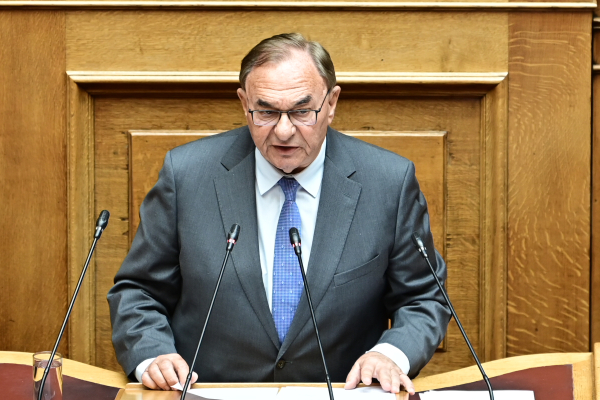


Greek Foreign Minister Giorgos Gerapetritis continues to not acknowledge that Greece’s National Intelligence Service (EYP) used the Predator spyware, despite a recent court ruling that placed the agency under scrutiny. The decision by the Single-Member Misdemeanor Court of Athens brought the intelligence service into the frame of the wiretapping scandal. The EYP operates under the supervision of the Greek prime minister’s office. Nevertheless, Gerapetritis insists that it is up to the judiciary to determine whether private individuals involved in the surveillance acted on orders and, if so, from whom, stressing that he wants the case to be fully clarified.
Speaking in an interview published on March 3, 2026, the minister expressed complete confidence in the justice system and defended the government’s handling of the affair. He argued that a recent court ruling has already helped place the case in what he described as its proper perspective. He added that he would comment further on unresolved questions once he has studied the written judgment, noting that the investigation is expected to expand following the first-instance decision.
In the interview with journalist Rania Tzima, Gerapetritis—who was among the political figures reported to have been targeted in the surveillance affair—explained why he did not personally pursue legal action against private actors allegedly involved in the interceptions. He said he has “absolute trust” in the Greek justice system both because of his public office and his professional background as a constitutional law scholar. He also noted that he cannot be certain that his own mobile phone was infected with illegal spyware.
According to him, once the judicial investigation had begun there was no reason for him to become personally involved in legal proceedings over an incident whose underlying facts were still unclear. The case moved forward regardless, he said, because several of the suspected offences were prosecuted automatically by the authorities rather than requiring a formal complaint from victims. He added that, to his understanding, the investigation has already expanded to include all individuals potentially involved.
Gerapetritis repeatedly referred to the recent court ruling in the case, which he said he intends to study carefully once the official text is finalized. He stressed that the justice system has fulfilled its duty and will continue to do so, emphasizing that the decision issued so far is only a first-instance judgment and that further stages in the judicial process are expected.
The minister also firmly defended the government against accusations that it attempted to obstruct the investigation. He rejected claims that the authorities hindered efforts to clarify the case, saying that the fact a court ruling has now been issued demonstrates that the judiciary operated independently. He argued that the trial did not take place because of a complaint filed by opposition leader Nikos Androulakis but because the seriousness of the alleged offences required an investigation to be opened automatically. In his view, the outcome or development of the trial would not have been different even if ministers or other victims had joined the proceedings as civil claimants. He also referred to legislative measures taken by the state to strengthen the legal framework governing lawful surveillance and the lifting of communications secrecy.
Gerapetritis’s remarks were sharply criticized by lawyer Zac Kesses, who represents victims of the Predator spyware. Kesses argued that the minister, as Greece’s foreign minister and a professor of constitutional law, cannot claim ignorance about the legal implications of the case. He said that in the interview Gerapetritis asserted that the course of the trial would not have changed if ministers, including himself, had joined the proceedings as civil claimants. According to the lawyer, that claim is incorrect.
Kesses noted that the Single-Member Misdemeanor Court of Athens sentenced the defendants to a combined total of 126 years in prison but discontinued criminal prosecution on one charge for victims who did not file formal complaints within the legally required deadline. He attached the court ruling and accused the minister of misleading the public, calling on him to stop “underestimating the intelligence of citizens” and to abandon what he described as political hypocrisy.