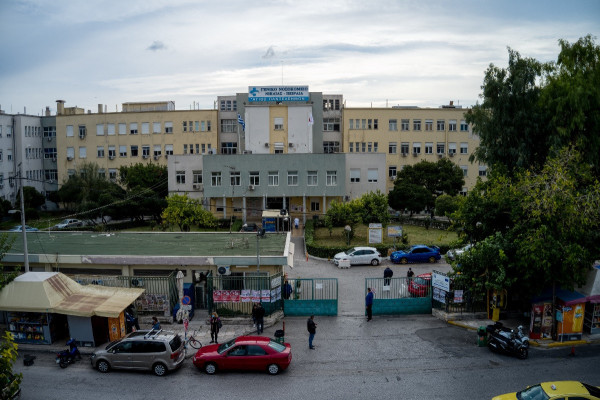
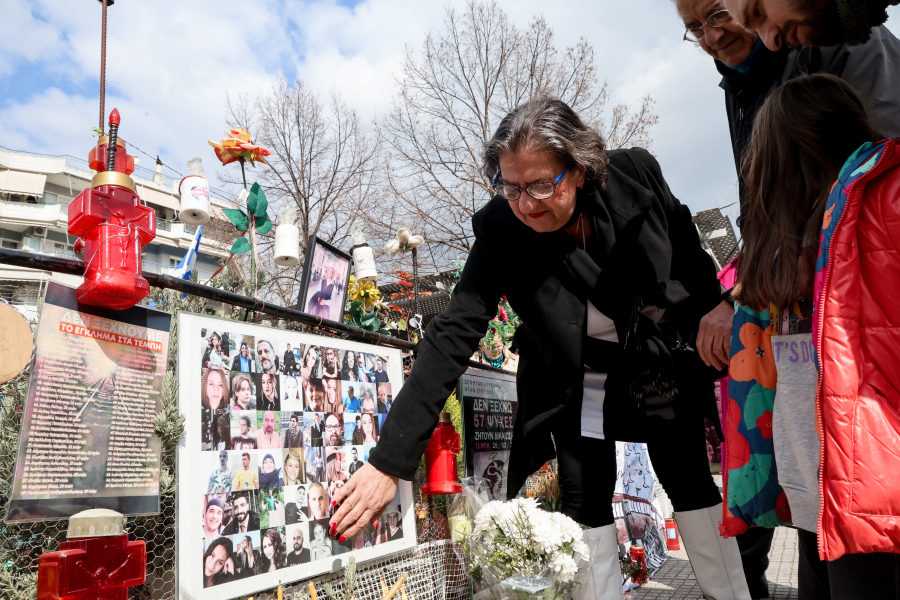
The main criminal trial into Greece’s deadliest railway disaster in decades will begin on March 23 in the central city of Larissa, when the Three-Member Court of Appeal for Felonies formally opens proceedings into the Tempi train collision. The case concerns the head-on crash that occurred on the night of February 28, 2023, killing 57 people and exposing deep failures in the country’s rail safety system.
Presiding over the court will be appellate judge Georgia Stefanidou, who was transferred from Thessaloniki to Larissa last September and will be responsible for directing what is expected to be a long and complex judicial process. A total of 36 defendants will stand trial. Among them are the three station masters on duty that night at Larissa’s central railway station, their supervising inspector, senior and mid-level officials from state rail bodies OSE and ERGOSE, the national rail regulator, two senior civil servants from the Ministry of Transport and Infrastructure, and two former top executives of the private operator Hellenic Train.
Thirty-three of the accused face felony charges of endangering transport safety with possible intent, an offence that under Greek law carries penalties ranging up to life imprisonment, along with a series of misdemeanours. Three defendants, including the two former Hellenic Train executives, are charged only with misdemeanours.
Despite the scale of the case, the proceedings are overshadowed by the risk of statutory limitation. Under Greek law, misdemeanours—including involuntary manslaughter, which applies to the deaths of the 57 victims—expire in 2031. While that date may appear distant, the concern is acute, as the case must pass through three levels of jurisdiction, including the Supreme Court. With the first-instance trial alone expected to last close to two years, legal observers warn that the risk of charges becoming time-barred cannot be dismissed.
Parallel to the main trial, Greece’s Supreme Court is examining whether criminal responsibility may extend to former political leaders. Two judicial councils are reviewing the potential liability of former transport ministers Christos Triantopoulos and Kostas Achilleas Karamanlis, under constitutional provisions that grant special procedural treatment to ministers.
One strand of the investigation focuses on the alleged alteration of the crash site in the immediate aftermath of the disaster. Former deputy minister Christos Triantopoulos is under investigation for breach of duty, along with seven alleged accomplices, including the former regional governor of Thessaly. Should the judicial council decide that the case merits prosecution, it would be referred to Greece’s Special Court, which is reserved for trying ministers.
A separate case involving former transport minister Kostas Achilleas Karamanlis remains at an earlier stage. Parliament has authorised criminal proceedings against him for breach of duty, following a case file submitted by the investigating magistrate. Prosecutors are also examining whether seven former senior civil servants at the transport ministry may be considered accomplices in the same offence.
Another sensitive aspect of the broader investigation concerns requests by families of victims to exhume the remains of nine people who died in the crash. Prosecutors ordered the exhumations and stipulated that any forensic examinations be conducted in Greek laboratories, a condition strongly opposed by relatives, who insist on testing abroad. The dispute has triggered a series of legal challenges and withdrawals of exhumation requests. While families are legally entitled to proceed independently after three years, any findings obtained outside the framework of the judicial order would carry reduced evidentiary weight, though they may still be assessed by the court.
In parallel, a separate trial already under way in Larissa since October concerns missing video footage from the Thessaloniki freight station, where the cargo train involved in the collision began its journey. The former head of the state railways, its former chief executive, and an executive of the private security firm responsible for video surveillance are charged with document suppression, instigation of that offence, and disobedience.
Further legal proceedings are expected to follow over a long-delayed railway signalling project known as Contract 717. Signed in 2014 and originally scheduled for completion in 2016, the contract was repeatedly extended and never fully implemented. Prosecutors are preparing a case against dozens of officials and executives over alleged fraud and false certification linked to European subsidies, as well as the approval of roughly three million euros in compensation to the contractor. Due to constitutional rules shielding ministers from ordinary prosecution, those charged include alleged instigators and accomplices, while the former transport minister who approved the payment is identified as the principal offender but has not been tried. The case is expected to reach the courtroom in 2026.