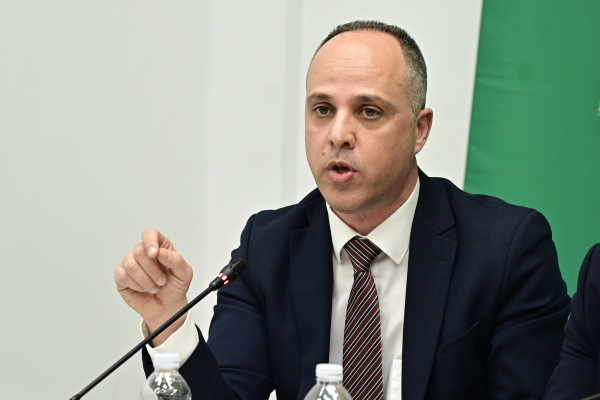
In a forceful closing argument during the 34th hearing of Greece’s wiretapping trial, public prosecutor Dimitris Pavlidis laid out a detailed account of events ranging from the launch of illegal surveillance operations to the criminal offenses he attributes to the defendants.
Pavlidis called for the conviction of all four defendants—Tal Dilian, Sara Hamou, Felix Bitziow and Giannis Lavranos—arguing that the court had established their links to the companies allegedly involved in the surveillance scheme, including the Intellexa consortium, Krikel and related entities. He stressed that under Greek law, criminal liability cannot be obscured by corporate structures, emphasizing that companies cannot be used as shields to conceal unlawful conduct.
Central to the prosecutor’s argument was the use of the Predator spyware, which he described as unequivocally illegal. According to Pavlidis, the software represents a grave violation of privacy and poses a direct threat to democratic governance by granting intrusive surveillance powers to individuals who should not possess them. He warned that any potential use of such tools by state authorities should serve as a serious alarm and noted that there is no dispute that Predator operated through technical infrastructure located within Greece.
Pavlidis also criticized the legal classification of the case, arguing that it should not have been tried as a misdemeanor before a single-judge court. He pointed out that the relevant offenses were later upgraded to felonies under Greek law and said that had the acts occurred even slightly later, the case would have fallen under the jurisdiction of a higher criminal court.
Referring to the testimony of multiple witnesses, including regulatory officials, journalists and technical experts, the prosecutor singled out the testimony of Panagiotis Koutsios, a former employee of Intellexa. While acknowledging that the witness’s account was informative and shed light on the company’s operations, Pavlidis expressed reservations about its completeness, stating that the full scope of the surveillance project had not been disclosed.
The prosecutor also voiced displeasure at the absence of the defendants from the courtroom throughout the proceedings, despite their legal right not to appear in person. He remarked that the failure of even one of the four accused to attend any of the numerous hearings could not go unnoted.
Addressing the broader investigation, Pavlidis observed a marked reluctance among dozens of alleged targets of the Predator spyware—many of whom he described as high-ranking public figures—to submit their mobile phones for forensic examination or to formally participate in the case by appointing legal counsel. He strongly defended the credibility of Citizen Lab, the internationally recognized digital rights research group whose reports have been central to the case. Pavlidis said that both implicit and explicit attempts had been made during the trial to undermine the organization’s reliability, but stressed that its findings are crucial and remain uncontested. He described Citizen Lab as having one of the world’s most advanced spyware research units, comparable only to Amnesty Tech and certain state or corporate intelligence capabilities, and noted that no party had challenged the technical evidence of device infections.
Turning to Intellexa’s business practices, the prosecutor highlighted evidence showing that Predator and its rebranded versions were marketed exclusively to governments rather than private individuals. He described Intellexa as a company that outwardly functioned like a conventional business, with formal registration, employees, offices and participation in international trade fairs. At the same time, he pointed to strict internal compartmentalization, noting that product demonstrations took place in restricted environments, often in the presence of military or police personnel, while employees were kept unaware of whether contracts were finalized or how the software was ultimately deployed. Non-disclosure agreements, he said, were a standard feature of the company’s operations.
Pavlidis proposed that the defendants be found guilty of multiple misdemeanor offenses allegedly committed between 2020 and 2021, including unlawful interference with systems used to store personal data. He argued that these acts were carried out jointly, repeatedly and in multiple instances, both as completed offenses and attempted ones. By expanding the scope of the charges to include cumulative commission, the prosecutor noted that the defendants could face separate penalties for each of the 92 identified victims of Predator, with a potential maximum sentence of up to eight years in prison.
He also called for convictions on charges of violating the secrecy of communications and illegally accessing information systems or data, again arguing that these acts were committed jointly and repeatedly. He emphasized that criminal responsibility should apply in cases where victims had filed valid and legally sound complaints.
The trial will continue in the coming sessions with closing arguments from lawyers representing the civil claimants, followed by the defense. The presiding judge is expected to announce the date for the court’s verdict at the conclusion of these proceedings, a decision that is being closely watched both domestically and internationally.