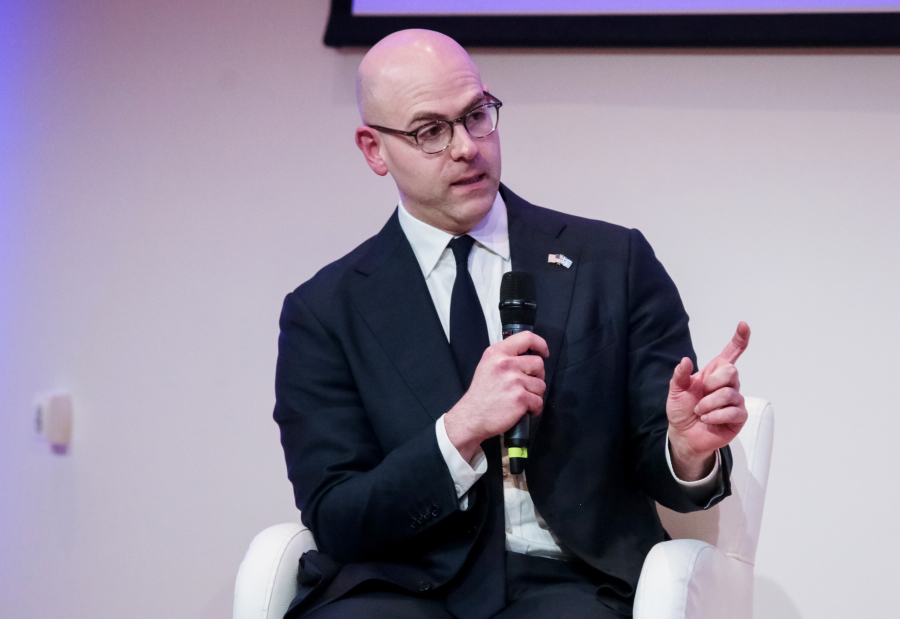

Steven Miran, a member of the Board of Governors of the Federal Reserve, highlighted Greece’s economic turnaround during a special event organised by the Delphi Economic Forum, held at the National Gallery in Athens. The event was introduced by the US Ambassador to Greece, Kimberly Guilfoyle, who described Dr Miran as one of the most influential voices in US economic policy and a key adviser to Donald Trump. The discussion concluded with an on-stage conversation between Dr Miran and Kathimerini editor-in-chief Alexis Papachelas.
In his remarks, Dr Miran said Greece’s emergence from the deep crisis that began in 2009 was the result of difficult but necessary reforms. He noted that the relaxation of certain regulatory constraints helped Greek businesses expand both at home and abroad, restoring confidence and improving competitiveness.
“There is little doubt that these reforms played a central role in the economy’s impressive comeback and in the improvement of living standards,” he said. According to Dr Miran, macroeconomic stability has largely been restored, unemployment has fallen to its lowest levels since the global financial crisis, and investment—particularly in export-oriented activities—has increased significantly.
He added that Greece offers a clear example of how targeted deregulation can support sustainable growth by strengthening productive capacity. Overly burdensome regulation, he argued, tends to undermine productivity and raise costs. At the same time, he stressed that the accommodative monetary policy of the European Central Bank was a key external factor underpinning the recovery.
During the subsequent discussion, Dr Miran turned to broader international issues. Referring to US tariffs, he said that while they had specific economic side effects, they also contributed to market stabilisation and debt reduction, ultimately reinforcing financial stability.
On global trade, he observed that market volatility has eased in recent months. He pointed out that the eurozone runs a larger trade deficit with China than the United States, while the influx of low-cost
Chinese exports has weighed on European demand and could also affect US growth. More broadly, he noted that international developments play a decisive role in shaping inflation trends, which often move in parallel across different economies.
Asked about the persistence of inflation and the delay in returning to the 2% target, Dr Miran said this could reflect both post-pandemic distortions and longer-term international factors, such as export
restrictions in strategically important sectors. He predicted a period of disinflation, particularly in services and housing.
Turning to currency markets, he argued that the stability of the global financial system matters more than the precise level of the dollar’s exchange rate. While a stronger or weaker dollar has implications
for growth, inflation and employment, stability remains the overriding priority.
He also addressed developments outside the traditional banking system, including cryptocurrencies. Fewer regulatory constraints, he said, can foster innovation and growth, but differences in regulatory
frameworks have encouraged new forms of non-bank lending. This phenomenon, he added, is not inherently problematic from an economic standpoint but is partly a consequence of heavy regulation in the
banking sector, which is now being gradually eased.
Finally, on concerns about a potential bubble in artificial intelligence, Dr Miran acknowledged that market corrections are always possible. From the perspective of a central bank, however, he said it is more
prudent to respond once such corrections materialise than to attempt to anticipate them. He concluded by expressing confidence in the dollar’s long-term international role, arguing that US economic
growth—supported by advances in artificial intelligence and regulatory changes—will continue to attract global capital.