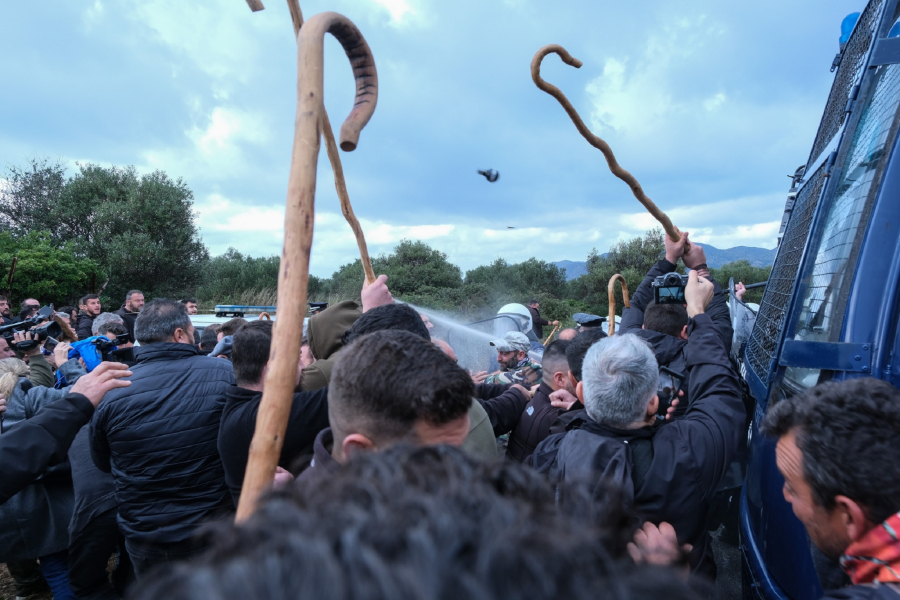

The Greek government has hardened its stance toward the nationwide farmers’ protests following serious clashes on Monday, signaling a sharp escalation in its approach to the unrest. In Crete, farmers are reportedly facing charges of forming a «criminal organization», according to police sources, though authorities have yet to clarify whether the accusations will be treated as a felony or as the lesser offense of criminal conspiracy. The move reflects the government’s increasingly forceful posture, a strategy critics warn is heightening tensions rather than containing them.
Police have identified roughly 200 people through drone footage and other surveillance material around the airports of Heraklion and Chania, which have become focal points of the demonstrations. Some of those identified have past case files unrelated to the current protests, and authorities appear to be drawing on these histories to justify the more severe charge. Legal experts caution that proving the existence of a criminal organization in this context is exceedingly difficult, yet the threat of such accusations could deter broader participation in the mobilizations. The case file being prepared is expected to include allegations ranging from grievous bodily harm to breach of the peace and obstruction of transportation.
Despite the tightening security measures, unrest continues. Earlier in the day, police, acting on government orders, sealed off access to both airports in Crete. Even so, groups of farmers and livestock breeders managed to break through the police perimeter at Heraklion and enter the airport grounds, underscoring the determination of the demonstrators and the limits of the government’s control.
The standoff has also exposed fractures within the governing party. Former prime minister Antonis Samaras publicly criticized the government’s handling of the crisis and aligned himself with the farmers’ grievances. «One thing is certain: those standing at the roadblocks are not winning the lottery every few weeks», he remarked, a pointed reference to the economic pressures facing rural communities. His intervention places him once more at odds with Prime Minister Kyriakos Mitsotakis and highlights the widening internal tensions within New Democracy.
The government hopes to calm the situation by promising to deliver the full basic subsidy payment by the end of December. Officials believe that once the money is deposited, tempers may cool. But political observers warn that New Democracy’s relationship with rural Greece has deteriorated significantly. Thessaly, still recovering from the devastation of Storm Daniel, faces a string of political and administrative crises, and the region’s political leadership has been weakened by scandals, fatigue, and internal conflict.