Tensions are rising across Greece’s agricultural heartland as farmers accuse the government of “mockery” after discovering that the advance payment of their basic EU subsidy was immediately absorbed by ELGA, the national agricultural insurance organization. The unexpected deductions, which left many with little or no money in their accounts, have fueled renewed anger and mobilization.
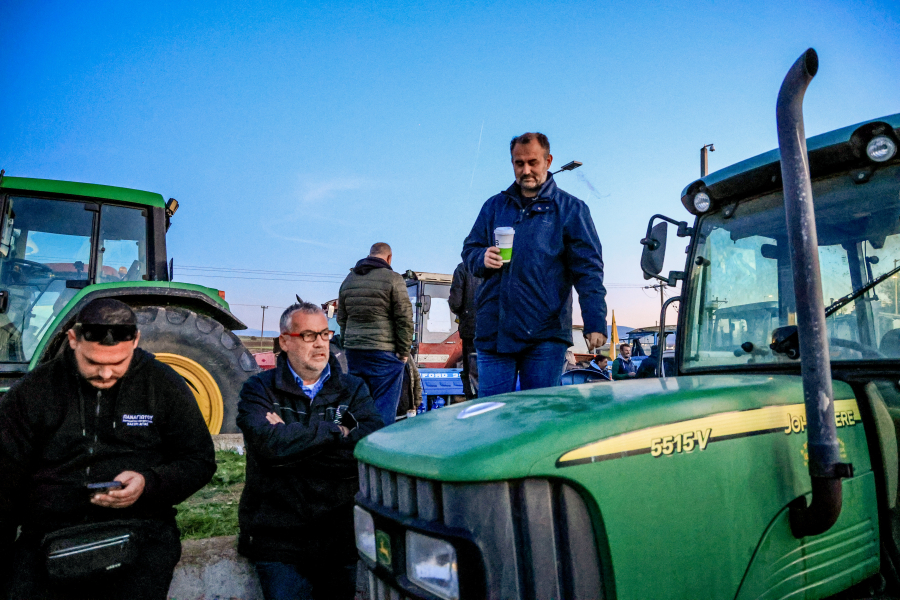
In the region of Thessaly, more than 1,000 tractors have gathered at the Nikaia junction near Larissa — a number expected to grow in the coming days. Farmers from Karditsa, Larissa, and Magnesia held a large assembly earlier today to map out their next steps, including the possibility of a coordinated blockade of both the Thessaloniki and Volos ports. Such a move would significantly intensify pressure on the government.
Farmers say the distribution of payments has been chaotic and unfair. Speaking to local media, a Karditsa farmer explained that some received the subsidy only for the entire amount to be seized by ELGA, others received nothing at all, and a third group saw ELGA withdraw additional funds directly from their personal accounts because the subsidy was insufficient to cover this year’s higher insurance premiums. “They owed us money — and they took even more,” he said.
Another farmer, Aris Poligenis, accused the government of deliberately making the payments late at night in an attempt to defuse the protests. “They put in a few crumbs on Saturday evening, between 9 and 10 p.m., when the banking system is basically shut down, hoping we wouldn’t take to the streets the next day. It didn’t work. Here in Karditsa, things are only just beginning,” he warned. Poligenis claimed that around 2,000 tractors are now mobilized in his region alone and urged farmers nationwide to block roads and support every protest site.
Anger is widespread among livestock farmers as well. At Nikaia, Vasso Fasoula described how her entire subsidy disappeared due to ELGA deductions, leaving her with nothing. “Whatever money entered my account left immediately. It’s a complete deception — they pretend to pay us without actually paying us,” she told Greek reporters. Fasoula said that more tractors were on the way and confirmed that a blockade of major northern ports was increasingly likely. She also stressed that payments from 2024 remain outstanding, including compensation owed to farmers affected by devastating storms Daniel and Ianos.
In Karditsa, farmers announced a new assembly for Tuesday, with increasing numbers joining the movement. Their anger intensified following comments by government ministers suggesting that only “dishonest” farmers had reason to be concerned. The farmers’ response was sharp: “Those who steal don’t show up at roadblocks — they stay home, protected by the same people who accuse us,” said Kostas Tzelas, head of the local agricultural federation. He criticized the government for attempting to shift blame onto farmers for past scandals involving the OPEKEPE payment authority.
Tzelas argued that the government was ultimately responsible for any disruption on the roads. “We are here because we refuse to abandon our land,” he said. He also pointed to what he called double standards — farmers being dragged before prosecutors while those implicated in major financial irregularities “walk free.”
The mobilization is spreading across more than 45 villages in Thessaly, each sending representatives to form a joint coordination committee. Farmers say they will not enter negotiations merely to explain their grievances but to demand meaningful solutions. Community spirit is strong at the Nikaia roadblock, where farmers are even planning to set up a Christmas tree as they prepare for a long struggle.
Local officials have publicly backed the movement. The mayor of Larissa, Thanasis Mamrakos, and the regional governor of Thessaly, Dimitris Koureta, both visited the site. Koureta, condemning recent clashes between riot police and protesters, vowed to stand on the front lines. “Your problems are far greater than a one-time payment,” he told them. “Next time there is a confrontation, I will be in front — let them strike me first.”
As more tractors roll in and roadblocks multiply, Greece’s farmers insist they are determined to continue until the government addresses the rising cost of production, delays in compensation, and what they describe as systemic failures in agricultural policy. Their message is clear: the movement is growing, unified, and far from backing down.