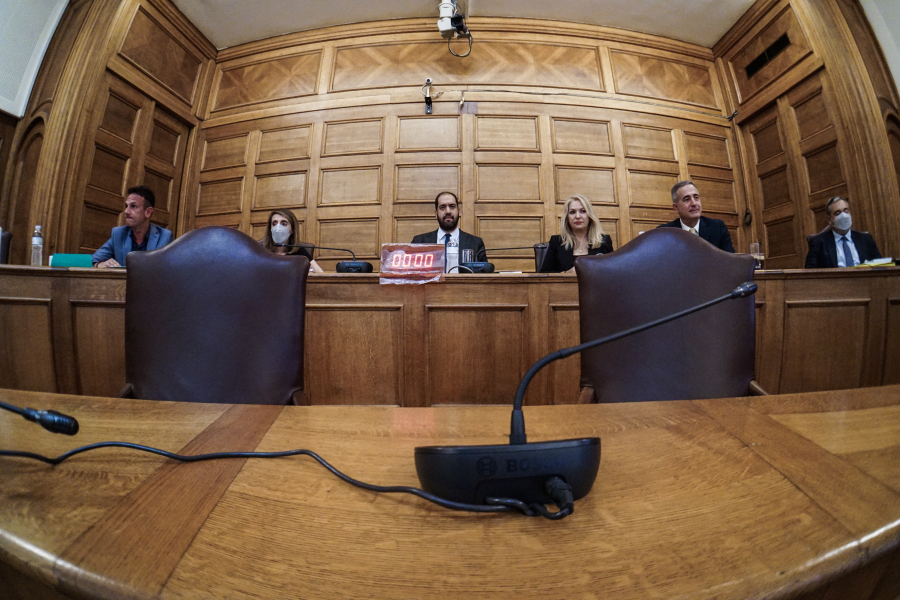
Former director of the Hellenic Police’s Forensic Laboratories and onetime president of the European Network of Forensic Science Institutes, Penelope Miniati, told a Greek court Tuesday that she was never summoned by judicial authorities to testify in the investigation into the Predator spyware scandal—despite being one of its confirmed targets. Miniati had been monitored both by the National Intelligence Service (EYP) and through the Predator malware.
The ongoing trial centers on four business figures tied to the development and deployment of Predator: Yiannis Lavranos, described as the real owner of the company Krikel, along with Felix Bitzios, Tal Dilian, and Sara Hamou of Intellexa, the consortium linked to the spyware system.
Miniati said she only learned officially in 2023 that her phone had been infected. A journalist called to inform her that her name appeared on the list of monitored individuals. At that time she had already retired from the police.
She attempted to submit her phone to the Hellenic Data Protection Authority as evidence, but the agency declined to accept it. “I did click on the links,” she said, adding that the official prosecutorial report assumed that only two cases of infection were confirmed and the rest were merely attempted breaches—despite the fact that she was never contacted to verify her case. “Under oath, I state it was not an attempt.”
She explained that she opened the links contained in two messages later identified as Predator-infected. One arrived in May 2021 and appeared to come from a police officers’ union. The second, sent in November 2021, looked like an appointment confirmation for a COVID vaccination and included accurate personal details, including the exact time and date of her appointment. “I opened both, and my phone was infected,” she stated. The presiding judge questioned why she had taken no action. Miniati responded that she believed it was up to the justice system to call her and initiate proceedings.
Complicating her testimony was the revelation that one day before receiving the first Predator-linked message, she had been sent a threatening email at her office. The message warned that there was a contract to kill her, explicitly referencing the murders of Greek journalists Sokratis Giolias and Giorgos Karaivaz. “My family was frightened,” she recalled. “I was angry. And I informed my service.”
Miniati’s post was a sensitive one. As head of the Forensic Laboratories, she handled the initial evidence for major criminal investigations. Among the cases under her supervision was the high-profile murder of journalist Giorgos Karaivaz.
When asked whether she believed her forced retirement was connected to any of the cases she handled, Miniati said she could only speculate. “There were various cases in which certain individuals were displeased,” she noted.
The court also pressed her on her surveillance by the EYP. Miniati testified that, according to the prosecutor’s report she later read, the intelligence service had begun monitoring her legally—or “nominally legally,” as she put it—eighteen days before she received the first infected message. She received formal notification of this surveillance only in 2024. The justification provided, she said, was the standard catch-all: national security. “The EYP does not provide further information. The entire process requires time, lawyers, and emotional endurance.”
Throughout her testimony, she repeated that she had expected the justice system to call her, only to be surprised when official reports were issued without her input.