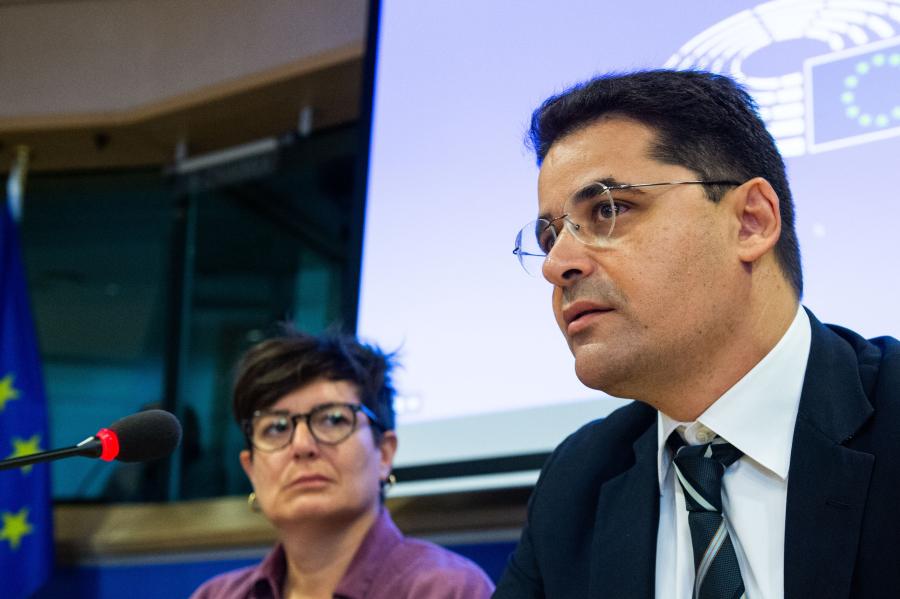
The testimony of investigative journalist Thanasis Koukakis — which will resume on Tuesday — has already brought sharp new focus to what many now regard as the most troubling political scandal to hit Greece in years: the illegal surveillance operation that combined state wiretaps with the Predator spyware system.
The trial in Athens centers on four business figures accused of violating Greece’s communications-privacy laws: Giannis Lavranos, widely described as the true owner behind the security contractor Krikel, and Felix Bitzios, Tal Dilian, and Sara Hamou, all associated with Intellexa, the company responsible for developing and operating the Predator spyware.
Speaking with the authority of the case’s original complainant and as a civil claimant, Koukakis delivered evidence-based, meticulously sourced testimony that pointed to a coordinated surveillance structure involving both the National Intelligence Service (EYP) and individuals with direct ties to the Prime Minister’s office. He emphasized that several of these figures, despite their apparent relevance, were never called to testify during the Supreme Court prosecutor’s preliminary investigation.
Drawing on years of documented investigative work, Koukakis unraveled for the court a web of influence linking private companies, politically connected individuals, and state mechanisms. According to his account, this network extended to the appointment of the EYP director himself; he testified that former EYP chief Panagiotis Kontoleon was placed in his role at the suggestion of one of the defendants. Personal connections — ranging from family ties with senior ministers to informal relationships built on activities as simple as parliamentary basketball — helped these actors secure deep political access and leverage.
Koukakis testified that while he was investigating alleged financial misconduct at Piraeus Bank, EYP began monitoring him on June 1, 2020. Soon after, he was targeted by at least seven confirmed Predator-infected messages.
His account portrays a unified operation: state surveillance used to gather information, followed by tailored spyware messages designed to lure him into activating Predator. He named two central figures — Grigoris Dimitriadis, then the Prime Minister’s chief of staff, and Kontoleon — as occupying pivotal positions in this chain of responsibility.
The stakes surrounding his reporting at the time were particularly high. He had uncovered a damning Bank of Greece audit describing illegal loans, capital-control breaches, and money laundering at Piraeus Bank. The findings had prompted asset freezes by Greece’s Anti-Money Laundering Authority. Soon after, however, the government passed legislation that allowed the release of assets tied to money-laundering cases — a move Koukakis described as “tailor-made,” one that provoked strong political reactions. Subsequent legal amendments further weakened financial-crime enforcement. In his view, these changes “facilitated economic crime in Greece,” contributing to most cases involving bank executives being archived.
Against this backdrop, his phone began malfunctioning. Calls connected instantly; the battery drained rapidly. A trusted source confirmed to him in July 2020 that EYP was monitoring him, and on August 10 provided photographs of transcripts from two of his private conversations. The revelation was “shocking,” he said. He also learned that on the same day EYP began intercepting his calls, the phone of Greece’s then–Financial Prosecutor, Christos Bardakis, had also been tapped.
When he filed a formal complaint with Greece’s communications-privacy authority (ADAE) on August 12, the state surveillance ended abruptly. But by that point, Predator had already been deployed. Koukakis described receiving the first infected message at the end of July 2020: a seemingly friendly alert urging him to check a link. He clicked it — unaware that this action infected his phone.
Asked in court to explain why both state wiretapping and Predator were used simultaneously, he responded unequivocally: Predator requires a lure; EYP provided the context. “It was clearly a single coordinated center,” he said.
Koukakis also emphasized that the widely discussed list of targeted individuals had been “confirmed with great accuracy.” He argued that judicial authorities failed to conduct a proper investigation, noting that the only effective method would have been to examine telecommunications providers’ records for EYP’s surveillance targets and examined phone devices for Predator infections.
He linked the origins of the wider surveillance operation to 2019, the year of the Cyprus spyware scandal, after which — according to his testimony — the Greek government began seeking its own surveillance software. “And when we say ‘government,’” he added, “we mean EYP and the Prime Minister’s office under the oversight of Dimitriadis, who enlisted the help of friends and contacts.” Intellexa, the company associated with Predator, established its Greek presence shortly thereafter; training of its first team concluded in July 2020.
Ultimately, Koukakis argued that “the Holy Grail” behind the entire affair was Greece’s multibillion-euro defense procurement programs — an area where political stakes and international interests run especially high. He urged the court to summon additional witnesses, insisting that crucial testimony has yet to be heard.